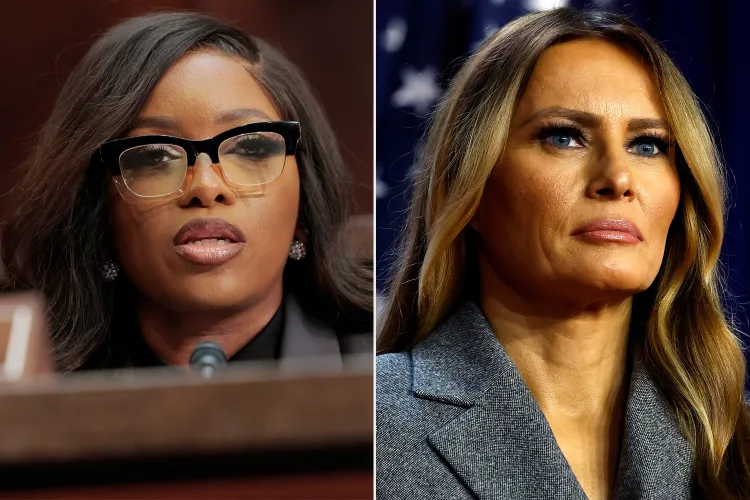

During a House Judiciary Committee hearing on Wednesday, Rep. Jasmine Crockett (D-Texas) raised concerns about the integrity of the visa process that allowed former First Lady Melania Trump to obtain permanent U.S. residency, questioning how she qualified for the elite EB-1 visa—commonly referred to as the “Einstein visa.”
“Since we’re talking about integrity,” Crockett said, “I’m confused as to why my Republican colleagues aren’t concerned about the lack of integrity surrounding how [President Donald Trump’s] family members obtained their visas.”
Crockett pointed specifically to Melania Trump’s immigration path. “Let me remind y’all—Melania, the First Lady, a model—and when I say model, I’m not talking Tyra Banks or Naomi Campbell-level—was granted an EB-1 visa,” Crockett stated. “That visa is supposed to be reserved for people with extraordinary abilities—people with Nobel Prizes, Olympic medals, or groundbreaking accomplishments in the sciences, arts, or business. As far as I know, she didn’t check any of those boxes. It doesn’t take an Einstein to realize the math isn’t adding up.”
Melania Trump, born in Slovenia in 1970, began modeling in her teens and later moved to the U.S. in 1996, initially on a tourist visa. She transitioned to a work visa as she pursued a modeling career in New York, reportedly under sponsorship from modeling agency executive Paolo Zampolli.
While she initially worked under an H-1B visa, reports suggest she later obtained an EB-1 visa in 2001—four years before marrying Donald Trump. The EB-1 category is typically reserved for individuals with “extraordinary ability” or international recognition in their fields, such as award-winning scientists, researchers, athletes, or executives.
Melania’s visa path has long sparked debate, with critics questioning how she qualified for one of the most selective immigration categories without widely recognized honors or professional accolades. Her parents, Viktor and Amalija Knavs, became U.S. citizens in 2018, reportedly through a family reunification process—another immigration policy Trump has frequently criticized.
The U.S. Citizenship and Immigration Services defines EB-1 applicants as individuals who have demonstrated “sustained national or international acclaim,” often supported by major awards or professional recognition.
Crockett’s remarks reignited scrutiny of the former First Lady’s immigration story, especially as Trump-aligned Republicans continue to push for stricter immigration enforcement and reforms.