
A widower is opening up about losing his wife to cancer — and why he chose to photograph her health decline over three years.
Mark Burkholder’s wife, Paige, was diagnosed with a rare form of liver cancer in 2022, just months after the couple relocated to the San Juan Islands, a small archipelago off the coast of Washington State. A history teacher, Paige had accepted a job offer there.
“The plan in moving here was to reconnect,” Burkholder, a writer and marketer, said of the 2021 move. “After we moved here, she started having the stuff that you just don’t really think about too much — some stomach pain, a little bit of back pain, and then that started getting bad.”
As the pain intensified, Paige went to the doctor for a scan. On the day she got the results, she met Mark at a local coffee shop.
“I remember looking out the window and seeing her face,” he said. “I just instantly knew that it was something bad.”
The scans revealed a mass on her liver — something a doctor described as “a tumor the size of a softball … almost certainly cancer.”
“It was fast and it was aggressive,” Burkholder said. In September 2022, Paige was diagnosed with cholangiocarcinoma, a rare cancer of the liver’s bile ducts. By the time she began treatment that December, the tumor had grown to the size of a football.
:max_bytes(150000):strip_icc():focal(675x321:677x323):format(webp)/mark-burkholder-012626-1-3db66c34e1a04f58b2db1a0018c0b16d.jpg)
Paige started chemotherapy around Christmas Day. “We drove through a blizzard, whiteout conditions,” Burkholder recalled. He remembers watching the snow fall while she called loved ones and tried to soften the news, telling them, “It’s a cancer I’ll live with.”
“After the first call or two, I sat next to her and I was like, ‘You know what’s going on — that this is terminal, right?’ ” he said. “She was creating hope for herself and for them. The way I look at it, my role as her caregiver was to live in reality.”
It was around that time Burkholder began thinking about how cancer is often portrayed publicly — and how little those portrayals match what it feels like behind closed doors.
“So much of the stuff that we see about cancer, it’s just like, the one pose, like ‘Warrior!’ ” he said. “But when you’re home alone, and you’re curled up in a ball on the sofa, suffering and crying and then you see online someone who’s just cherry-picked the one day they felt good, God, it’s really isolating to see what people are sharing, and the narrative they’re attaching to it that that gets put around cancer.”
To him, it wasn’t a neat storyline of triumph. “It’s sort of portrayed as this heroic struggle — but I think it’s really more like a trench warfare in World War One: You’re in a trench for months and you can never sleep because there’s bombs going off. There’s gunfire all the time.”
:max_bytes(150000):strip_icc():focal(749x0:751x2):format(webp)/mark-burkholder-012626-3-3c5a7cffa6834f2da7e1556d61816a97.jpg)
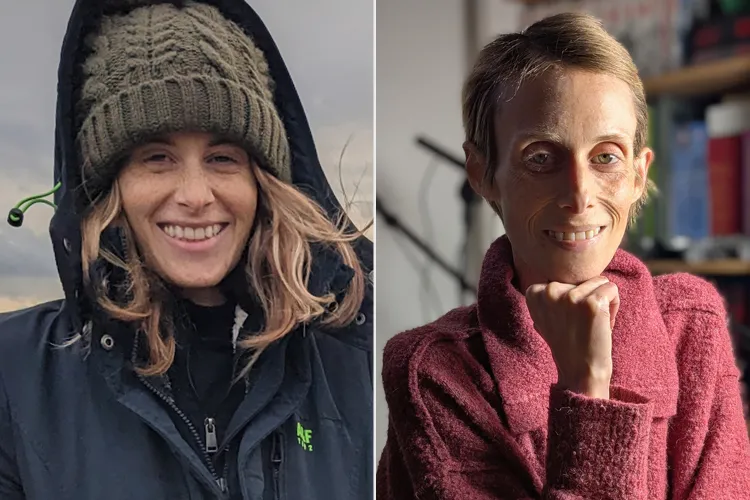
Burkholder began photographing and filming their experience — Paige living with terminal cancer, and him learning what it meant to be her caregiver — but the couple kept it private while she was alive.
“The parts that we really wanted to share were the more raw and honest parts, and sharing it during the journey was hard,” he said. “When we were feeling well enough to be thinking about recording something, we didn’t want to then use that time to plunge right back into the misery we’d just been through a month earlier.”
“[Posting] didn’t end up happening basically until she passed,” he added.
He uploaded his first TikTok on Dec. 13, three days after Paige, 35, died at home during the night.
That first post drew nearly 250,000 views. Another video, where Burkholder spoke about navigating her death with their dog, Olive, reached 1.2 million views. A separate post in which he described cancer as “aging in fast forward” neared 2 million views. As he read responses from others who had also lost loved ones, Burkholder realized the story he most wanted to tell wasn’t only about cancer — it was about caregiving.
:max_bytes(150000):strip_icc():focal(749x0:751x2):format(webp)/paige-portrait-012626-3-a501e1bb72cf4e31b90544b65ba0b85f.jpg)
“A lot of the time caregiving is just sitting on the couch for 24 hours a day because Paige would be passed out, or she’d be or pain,” he said. “When she was conscious, I would want to be with her and when she needed something, I needed to be there.”
“The hard part of caregiving is being present for 24 hours a day and just being on call always,” he continued. “And for me, the focus on caregiving is just because we talk so much about cancer and supporting people with cancer, and I just had not seen that much about the realities of caregiving, specifically the mental and physical toll of the 24-hour nature of it.”
“Every cancer journey is so unique,” he said. “I don’t think I could give any advice on battling cholangiocarcinoma. I don’t actually know that much about cholangiocarcinoma. What I do know and what I can give support on is presence.”
He said he also hopes to share practical guidance — like how to write a doctor “an email that’ll punch through and is clear and isn’t just going to have the doctor respond with another question that delays things three days.”
He also wants to offer a kind of “field manual” for accepting help when people offer it: “Hundreds of people are going to message you and say, ‘If there’s anything I can do, let me know.’ Well, you know what you should do then: Make a website with five links on it to a meal train, a GoFundMe, and an Amazon wishlist and whatever else.”
:max_bytes(150000):strip_icc():focal(749x0:751x2):format(webp)/paige-portrait-012626-5-b4bfb7a3374441a683d9c7439cd5e757.jpg)
As he put it, “We needed the support and if everyone in your life is willing to offer support, but doesn’t know how, all that support just disappears, which I think is what happens 99% of the time.”
At the heart of what he shares is a belief in radical honesty — because he thinks the “strong warrior” narrative can unintentionally shut the door on real support.
:max_bytes(150000):strip_icc():focal(749x0:751x2):format(webp)/paige-portrait-012626-6-e1e1646741db409aa71e7cdd2b253d90.jpg)
“In a weird way, if you present too much of the valiant warrior, you cost yourself a lot,” he said. “Everyone’s like, ‘Well, they’re just a badass strong cancer warrior. They don’t need help and support.’ But if you’re willing to be honest about how horrible this process is, then people actually can help you and understand that you need the help. This is my mission.”
He says the messages from others who have been through similar losses have been overwhelming — and heartbreaking.
“Everything Paige and I thought was true,” he said. “People are out there suffering, and everyone’s lost … that’s sort of the great heartbreak for me in all of this.”