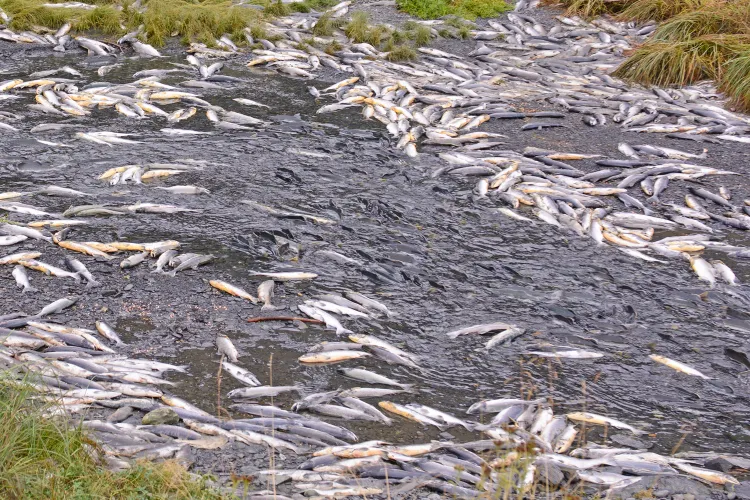

More than four million farmed salmon died prematurely in Tasmania in 2025, according to newly released government data.
Figures published Friday, Jan. 23, by Tasmania’s Environmental Protection Authority (EPA) show more than 20,000 metric tons of salmon died prematurely over the course of the year, including roughly 2,500 tons in November and December alone, the Tasmania Inquirer reported. About 500,000 fish deaths were recorded during the final two months as waters warmed heading into the summer season for the Southern Hemisphere.
In December, daily salmon deaths exceeded 40 tons per day — nearly three times the average recorded between July and October, according to the EPA. Research suggests Atlantic salmon begin experiencing serious health stress as water temperatures near 64 degrees Fahrenheit (18 degrees Celsius). At that threshold, oxygen levels can drop, organ damage may occur, and fish can become more susceptible to disease.
The regulator also disclosed that Tassal, Tasmania’s largest salmon producer, began administering medicated feed containing the antibiotic Florfenicol at one of its farms near Bruny Island on Jan. 24. The treatment was scheduled to continue through Feb. 2 and had been approved late last year to help control outbreaks of a marine bacterium known as Piscirickettsia salmonis.
:max_bytes(150000):strip_icc():focal(749x0:751x2):format(webp)/tasmania-fish-farm-020326-2c704d379fc64a0f91d4df5c7da0884b.jpg)
Tasmania’s Department of Health has advised recreational anglers who are concerned about antibiotic residue to avoid eating wild fish caught within roughly two miles of treated salmon farms for 21 days after medicated feed is used.
Salmon producers have used Florfenicol at least 13 times since early November, the Tasmania Inquirer reported. While companies are required to report antibiotic use, the EPA does not publicly release detailed data until months later.
Marine scientists and environmental advocates said the scale of the deaths is alarming. Stewart Frusher, a retired professor at the University of Tasmania’s Institute for Marine and Antarctic Studies, said the sharp rise in December mortality points to deeper environmental limits on salmon farming in the region.
“We are essentially at the stage where the waters in southeastern Tasmania aren’t fit for purpose for salmon,” Frusher said.
In a statement, Tasmania’s Chief Veterinary Officer Kevin de Witte said regulators are continuing to investigate the deaths, which he attributed mainly to the endemic bacterium Piscirickettsia salmonis. De Witte said the bacterium poses no risk to humans or food safety and added that the industry has invested heavily in vaccine research.
:max_bytes(150000):strip_icc():focal(749x0:751x2):format(webp)/tasmania-fish-farm-1-020326-5a803962a66f4538ae25fabcebe72112.jpg)
“Mortalities are a known aspect of salmon farming worldwide,” de Witte said, noting that warmer summer waters often increase health risks for farmed fish.
Jess Coughlan, a senior campaigner with Environment Tasmania, criticized what she described as the industry’s growing reliance on antibiotics and called for stronger consequences.
“Penalties must apply, as they do in Norway, as a disincentive to allowing current mortality rates to become the new normal,” Coughlan said.
Under Tasmania’s Animal Welfare Act, animal owners are prohibited from using management practices that are likely to cause unreasonable pain or suffering. Frusher noted that while animal welfare concerns often spur intense debate in other contexts, few regulations have been enacted in response to large-scale fish deaths.