
President Donald Trump is seeing a slow but noticeable dip in support among Republicans, according to new national polling data released one year into his second term.
The White House pushed back in comments sent to Newsweek, with a spokesperson citing what they called “recent credible polling” and arguing that “every one of President Trump’s common sense policies is supported by a majority of the American people.”
Why It Matters
New results from the Pew Research Center suggest Republicans and Republican-leaning independents are less unified behind Trump than they were a year ago—on his agenda, his conduct in office, and the idea that GOP lawmakers should automatically fall in line. Those shifts could affect how Congress negotiates with the White House and shape the runway to the 2026 midterms.
The findings arrive as Trump has publicly criticized what he calls “fake and fraudulent polling,” writing on his Truth Social platform this week: “My polling is highest ever.”
What To Know
Pew’s survey points to a steady cooling inside the GOP on questions tied to Trump’s leadership, ethics, and policy program, even as the White House projects confidence and Trump points to more favorable numbers from aligned polling.
The same Pew data also shows overall approval at 37 percent, down from 40 percent in the fall, alongside broader doubts—across the public—about Trump’s mental fitness and his respect for democratic values. The trend underscores how difficult it may be for Trump to expand beyond his core coalition, even as pro-Trump analyst Patrick Allocco argues the president’s base remains durable.
Growing Republican Doubt
According to Pew Research Center data, just 27 percent of Americans now say they support all or most of Trump’s policies, down from 35 percent last year. Pew indicates that the decline is driven entirely by Republicans.
A year ago, 67 percent of Republicans and GOP-leaning independents said they supported all or most of Trump’s policies and plans. That share has now fallen to 56 percent, reflecting movement within the party rather than among Democrats, whose views were already heavily negative.
Republicans remain more supportive of Trump than the country overall, but Pew’s numbers suggest their confidence has weakened across multiple measures:
- Ethics in office: The share of Republicans who say Trump acts ethically dropped from 55 percent to 42 percent.
- Respect for democratic values: Republican confidence slipped from 60 percent last year to 52 percent now.
- Mental fitness: GOP confidence declined from about three-quarters to 66 percent.
Perhaps the most telling shift is on party loyalty in Congress. Pew found that 61 percent of Republicans now say Republican lawmakers do not have an obligation to support Trump’s policies simply because he is a Republican president. Last year, 55 percent said the same.
For a sitting president—particularly one whose political brand has been closely tied to party dominance—that change suggests more Republican voters are leaving room for dissent, echoing dynamics seen at points during Trump’s first term.
Poll Methodology
The data comes from Pew Research Center’s American Trends Panel, a nationally representative probability sample recruited through address-based sampling and surveyed from January 20–26, 2026.
Pew reported a 92 percent response rate and used a mix of online and live telephone interviews in English and Spanish. Oversamples of non-Hispanic Asian adults and adults ages 18 to 29 were weighted back to national proportions. The reported margin of sampling error was plus or minus 1.4 percentage points.
Pew also described multiple quality controls, including instrument testing across web and mobile, checks for satisficing that removed two respondents prior to weighting, and differential post-paid incentives of $5 to $20 to boost participation among harder-to-reach groups. Weighting was calibrated to national benchmarks and trimmed at the 1st and 99th percentiles.
A Different Picture From Trump-Aligned Pollsters
Pew’s broader trend contrasts with more favorable assessments promoted by Trump allies.
In a recent Newsmax TV interview, Republican pollster Patrick Allocco argued that Trump’s support remains strong among Republican and Republican-leaning voters and that mainstream surveys often undercount them.
“Poll after poll is showing us that between 88 percent and 96 percent of Republicans who voted for him in 2024 are still supportive of him today,” Allocco said.
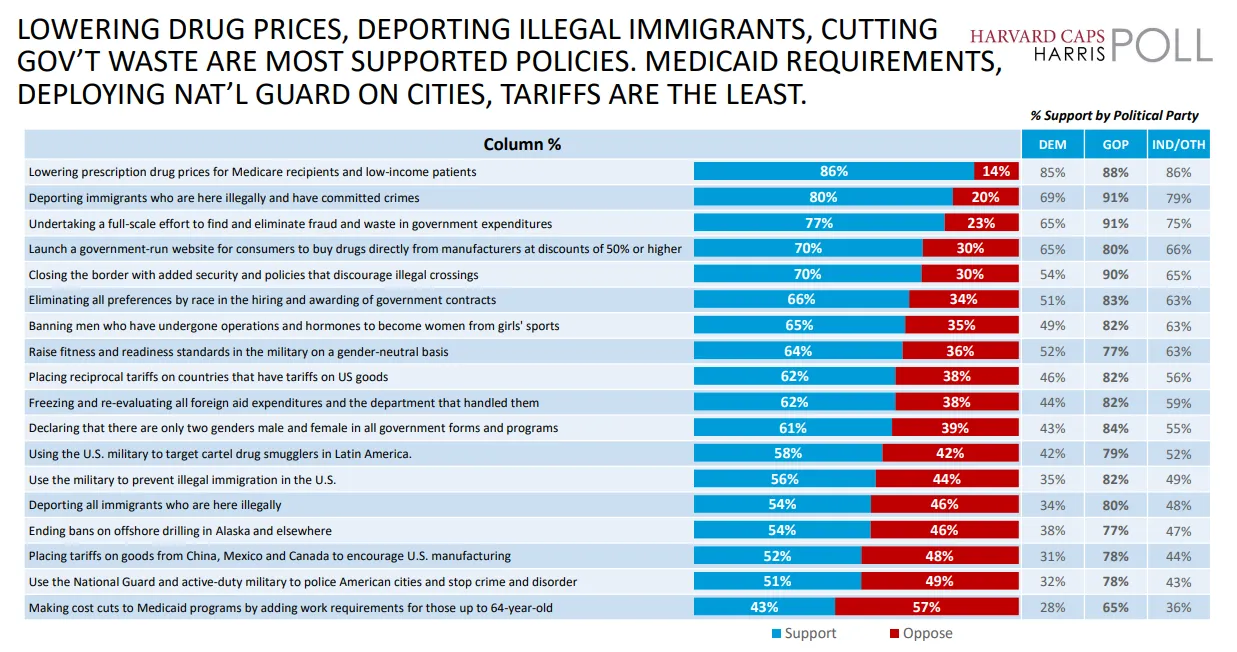
The White House, meanwhile, has pointed to a Harvard CAPS Harris Poll conducted online within the United States from December 2–4, 2025, among 2,204 registered voters, with a margin of sampling error of plus or minus 1.99 percentage points at a 95 percent confidence level.
That poll found 39 percent said the country was on the right track (up from 35 percent in the prior poll) and 36 percent said the economy was on the right track (up from 33 percent).
What People Are Saying
A White House spokesperson told Newsweek: “President Trump is the sharpest, most energetic, and hardest working President in modern American history. The President is in perfect health, which is why he was able to accomplish more in one year than many presidents did in eight.
“President Trump remains the unequivocal leader of the Republican Party, and his support with Republicans remains as strong as ever. Additionally, recent credible polling continues to show that every one of President Trump’s common sense policies is supported by a majority of the American people.”
Allocco told Newsmax that Trump “continues to draw support beyond the Republican base,” citing “30 percent of independents” and “4 percent of Democrats,” and adding that “59 percent of blue-collar workers are still with him,” while also saying the Trump team is struggling to connect with women ages 21 to 44.
He added, “If you were against his economic policies, if you’re against his foreign policies, if you’re against his immigration policies, chances are you didn’t vote for President Trump in 2024. What we’re seeing right now is…this uprising of anger that’s bubbling up to the surface.”
“We’re at a D-plus-3 right now on the generic ballot,” Allocco said, calling it “just a lean toward Democrats. It’s not a wave of any sort.” He said: “No forecaster right now is looking at a 26-seat flip of the House.”
What Happens Next
Republican leaders will likely weigh Pew’s findings against messaging from Trump-aligned pollsters as they decide when to stand firmly with the White House—and when to break away on contentious votes—especially as Pew found a majority of Republicans and GOP-leaning respondents say lawmakers are not obligated to support Trump if they disagree.