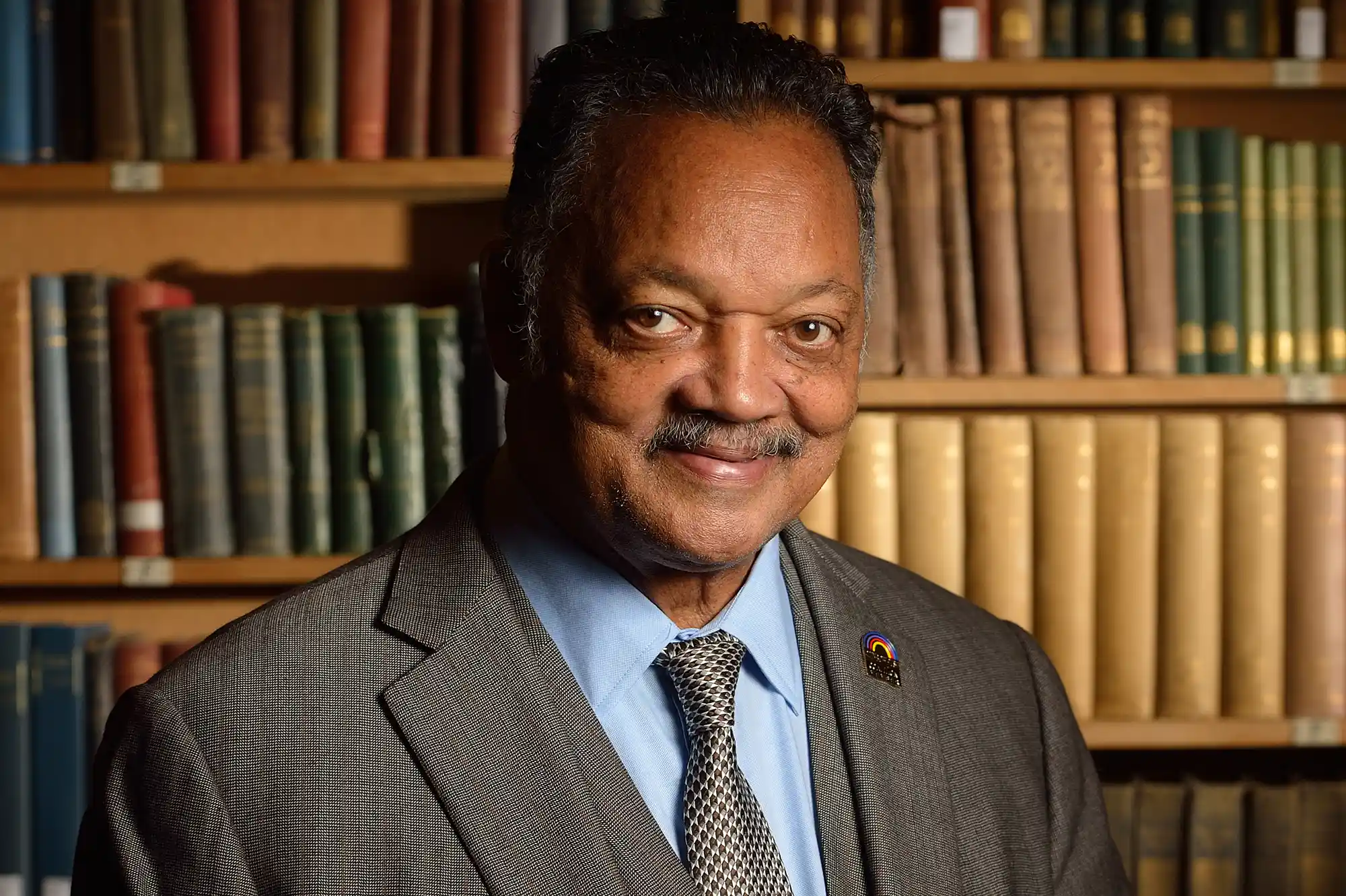

Rev. Jesse Jackson, a longtime civil rights leader and recipient of the Presidential Medal of Freedom, has died. He was 84.
The Baptist minister died peacefully on Tuesday, Feb. 17, surrounded by family, according to a statement shared by his relatives on social media.
“Our father was a servant leader — not only to our family, but to the oppressed, the voiceless, and the overlooked around the world,” the Jackson family said. “We shared him with the world, and in return, the world became part of our extended family. His unwavering belief in justice, equality, and love uplifted millions, and we ask you to honor his memory by continuing the fight for the values he lived by.”
:max_bytes(150000):strip_icc():focal(999x0:1001x2):format(webp)/rev-jesse-jackson-021726-4-b250ef50234a497e8bda48794a9a153d.jpg)
Jackson’s health had declined in recent years. On Nov. 12, the Rainbow PUSH Coalition announced he had been admitted to the hospital for observation related to progressive supranuclear palsy, a brain disease that can affect balance, swallowing, walking, and eye movements. Days later, his family said he was stable and breathing without the assistance of machines.
The family’s statement confirming his death said details for a celebration of life will be shared by the Rainbow PUSH Coalition.
Born in Greenville, South Carolina, on Oct. 8, 1941, Jackson became a prominent figure in the American civil rights movement. He marched alongside the Rev. Martin Luther King Jr. during demonstrations in the 1960s and was with King on the morning of his assassination at the Lorraine Motel in Memphis, Tennessee, on April 4, 1968.
“Every time I think about it, it’s like pulling a scab off a sore,” Jackson told The Guardian in 2018. “It’s a hurtful, painful thought: that a man of love is killed by hate; that a man of peace should be killed by violence; a man who cared is killed by the careless.”
Jackson later entered national politics, running for president in 1984 and 1988. He was also involved in high-profile diplomatic efforts, including helping secure the release of three U.S. soldiers from Yugoslavia in May 1999 after personally appealing to President Slobodan Milosevic.
In 2000, President Bill Clinton awarded Jackson the Presidential Medal of Freedom, praising his “keen intellect and loving heart.”
Earlier in life, Jackson was also a standout athlete. He received an offer to play baseball with the Chicago White Sox and earned a football scholarship to the University of Illinois after high school.
:max_bytes(150000):strip_icc():focal(749x0:751x2):format(webp)/rev-jesse-jackson-1-1-16cb74e0494745e5922c7beb4cb353aa.jpg)
Jackson is survived by his wife, Jacqueline Jackson, whom he married in 1962, their five children, and his grandchildren. He also had a daughter with a former staffer, stemming from an affair that became public before the child’s birth in May 1999.
In the years leading up to his death, Jackson experienced multiple medical setbacks. In November 2021, he was hospitalized after a fall during an event at Howard University. Two months earlier, he and his wife were hospitalized after testing positive for COVID-19.
:max_bytes(150000):strip_icc():focal(749x0:751x2):format(webp)/rev-jesse-jackson-3-1-ce6d9eecc0d546e0b78fddae6acf01f9.jpg)
Jackson was initially diagnosed with Parkinson’s disease in 2017. In April 2024, it was confirmed that he instead had progressive supranuclear palsy, a condition that can share similar symptoms. The Mayo Clinic notes that age is the only proven risk factor, with the disease most commonly affecting people in their late 60s and 70s.