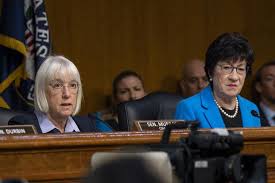

“I don’t care if Stephen Miller wants ICE to be able to beat up, shoot, or detain citizens. In America, we believe in our Constitution. We believe in law and order,” Senator Patty Murray said as she urged Congress to impose stronger oversight on the federal agencies responsible for immigration enforcement. Speaking at a Senate hearing on federal immigration operations, Murray argued that Immigration and Customs Enforcement (ICE) and Customs and Border Protection (CBP) are operating with sweeping power and too little accountability, and she criticized what she described as the outsized influence of Stephen Miller, the U.S. Homeland Security Advisor.
Murray alleged a pattern of misconduct by federal agents, including breaking into vehicles, using tear gas against peaceful protesters, and detaining citizens without warrants. She also pointed to cases involving family separations, children being used as leverage, and veterans being deported. “The chaos, the brutality— all of it has happened at the explicit direction of this president and a Republican Congress that wrote him a blank check for ICE and CBP,” Murray said. She added that basic safeguards—such as requiring agents to carry identification and obtain judicial warrants before entering homes—are being ignored despite long-established legal standards.
A central focus of Murray’s remarks was Miller’s role in shaping enforcement policy. Democrats, including Representative Seth Magaziner, have argued that Miller effectively controls key immigration enforcement decisions, creating a climate in which agency officials fear retaliation for speaking candidly. Magaziner said during a House hearing that ICE Director Todd Lyons and other witnesses offered vague or noncommittal answers because they feared consequences from Miller and South Dakota Governor Kristi Noem. Murray echoed that claim, calling Miller’s influence “outrageous” and arguing that any vision of enforcement that tolerates detentions or violence without due process runs counter to American law and constitutional protections. “Sorry, but I don’t care if Stephen Miller wants a special force that’s empowered to beat up and detain or shoot whomever he doesn’t like. In America, we believe in due process,” she said. “If you don’t like that, go to Russia.”
Murray’s comments come as Democrats push for legislation aimed at increasing oversight and accountability for ICE and CBP. Proposals include stronger transparency requirements, explicit compliance with constitutional protections, and limits on the detention of nonviolent individuals. Murray said the measures would not prevent the detention of convicted violent criminals, but would ensure federal agencies operate within the bounds of the law. “We are insisting on basic measures to protect our constitutional rights and hold these agencies accountable to some of the most basic standards as local police,” she said.
Other Democrats have also criticized Miller’s role in federal immigration strategy. House Democratic Leader Hakeem Jeffries called him a “malignant, unelected interloper,” while Representative Don Beyer described his rhetoric as “deranged” and “bloodthirsty.” Senators Ruben Gallego and Ben Ray Luján have likewise warned that the policies associated with Miller could pose risks to public safety and civil liberties. The debate has also intensified amid scrutiny of large-scale enforcement efforts such as Minneapolis’s Operation Metro Surge, which deployed hundreds of federal agents to detain undocumented immigrants and has been linked to multiple civilian deaths.
Miller remains a key figure in the administration despite the backlash. Supporters say he retains President Donald Trump’s confidence and argue that the dispute is ultimately about policy differences rather than misconduct. Republican lawmakers, including Senator Lindsey Graham, have suggested Miller’s removal is unlikely, framing the controversy as part of a broader partisan fight over immigration priorities.
Murray ended her remarks with a call for immediate action, warning that continuing to fund ICE and CBP without major reforms would amount to acceptance of what she described as unlawful conduct. “Americans are demanding accountability, and we will settle for nothing less,” she said. Her comments reflect intensifying partisan conflict over immigration enforcement, the role of unelected advisors in shaping federal policy, and Congress’s responsibility to ensure constitutional protections are upheld.