
President Donald Trump ignited a fresh wave of political and celebrity friction Wednesday, using his social media platform to launch a scathing attack on Democratic Congresswomen Ilhan Omar and Rashida Tlaib, as well as Academy Award winner Robert De Niro. The remarks, posted to Truth Social on Feb. 25, followed a contentious State of the Union address marked by visible friction between the executive and legislative branches.
The President’s comments targeted the lawmakers’ conduct during his Tuesday night address, specifically citing their vocal opposition during the proceedings. Trump, 79, characterized the representatives as “mentally deranged” and “lunatics,” further reviving a controversial rhetorical trope by suggesting the American citizens should be sent “back from where they came.”
Direct Attacks on Congressional Critics
In his post, President Trump focused on Rep. Omar (D-Minn.) and Rep. Tlaib (D-Mich.), who were seen heckling and protesting at various points during the “elegant” State of the Union event.
“When you watch Low IQ Ilhan Omar and Rashida Tlaib, as they screamed uncontrollably last night… they had the bulging, bloodshot eyes of crazy people,” Trump wrote. He claimed their behavior warranted institutionalization and asserted they “can only damage the United States of America.”
Rep. Omar, a naturalized U.S. citizen who arrived as a refugee from Somalia in the 1990s, has represented Minnesota’s 5th District since 2019. Rep. Tlaib, born in Detroit to Palestinian immigrants, represents Michigan’s 12th District. Both have been frequent targets of the President’s “America First” rhetoric regarding national loyalty and legislative decorum.
:max_bytes(150000):strip_icc():focal(749x0:751x2):format(webp)/Ilhan-Omar-and-Rashida-Tlaib-shout-at-US-President-Donald-Trump-as-he-delivers-his-State-of-the-Union-address-022626-7a388245bdde459283cbed781218832d.jpg)
Escalation of the De Niro Feud
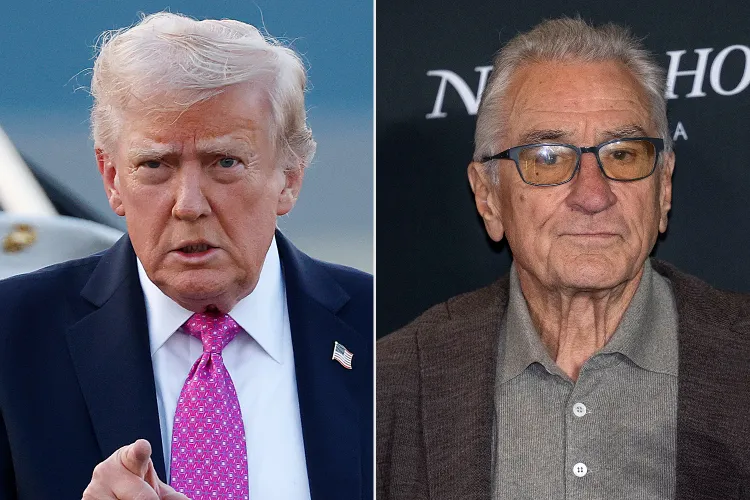
The President’s ire extended beyond the halls of Congress to longtime critic Robert De Niro. The 82-year-old actor recently participated in “State of the Swamp,” a counterprogramming event held at the National Press Club in Washington, D.C., where he delivered an emotional speech.
Trump labeled De Niro “sick and demented” and claimed the actor has “absolutely no idea what he is doing or saying.” The President also alleged, without providing evidence or specifics, that some of De Niro’s actions were “seriously CRIMINAL.”
The President further compared De Niro to another frequent adversary, Rosie O’Donnell, stating, “The only difference between De Niro and Rosie is that she is probably somewhat smarter than him, which isn’t saying much.”
The ‘State of the Swamp’ Counter-Narrative
The President’s social media response appears to be a direct reaction to De Niro’s heightened visibility during the week of the State of the Union. During his speech at the National Press Club, the Killers of the Flower Moon star spoke of feeling “betrayed” by the current state of the country.
“If you’re devoted to the Constitution and the rule of law… be ready to take the streets together, and we will take our country back,” De Niro told the audience.
On a recent episode of the MS NOW podcast The Best People, De Niro doubled down on this sentiment, calling the President “the enemy of this country” and urging a unified front to “get back on track.” De Niro emphasized that patriotism is not exclusive to the President’s base, stating, “We are Americans, too… we believe in what’s right and wrong; empathy, and kindness.”
:max_bytes(150000):strip_icc():focal(999x0:1001x2):format(webp)/robert-deniro-3dfb289e7d284969aa9c2e115c3c0f63.jpg)
Context and Outlook
This latest round of insults marks a return to a high-friction communication style that has defined the President’s relationship with both the “Squad” (the group of progressive lawmakers including Omar and Tlaib) and the Hollywood elite.
As the 2026 midterm cycle approaches, such exchanges underscore the deep ideological divide in Washington. While the President frames his rhetoric as a defense of national strength—claiming the country is “Bigger, Better, Richer, and Stronger”—critics argue the language further polarizes the electorate and challenges the norms of civil discourse between the branches of government.