
Biden, Clinton, and Obama gather at the House of Hope, while Michelle Obama’s absence aligns with her recent boundary-setting statements.
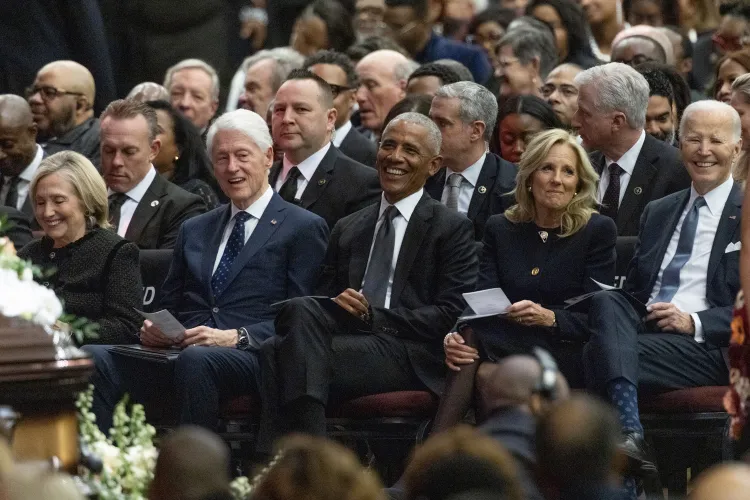
On Friday, March 6, three living Democratic presidents—Bill Clinton, Barack Obama, and Joe Biden—convened at the House of Hope in Chicago to pay their final respects to the late civil rights luminary, Rev. Jesse Jackson.
The high-profile memorial service celebrated the life and enduring legacy of Jackson, who died peacefully surrounded by family on Feb. 17 at the age of 84. While Clinton and Biden attended the service alongside their respective spouses, former Secretary of State Hillary Clinton and Dr. Jill Biden, Obama arrived at the memorial solo.
The arrival of the former commanders-in-chief commanded the attention of the arena. Speakers paused to acknowledge the historic gathering, with an announcer instructing the crowd: “Put your hands together for the three presidents: President Bill Clinton, President Joe Biden, and the Southside’s own, President Barack Obama.”
Chicago Mayor Brandon Johnson and Illinois Gov. J.B. Pritzker also delivered remarks, offering local and national perspectives on how Jackson’s decades of activism reshaped the American political landscape.
:max_bytes(150000):strip_icc():focal(749x0:751x2):format(webp)/Jesse-Jackson-Funeral-030626-1-fe7f22362ceb409ea5c5b62468d5f1d3.jpg)
A Legacy of Service and Civil Rights
Jackson’s family issued a statement shortly after his passing, emphasizing his global impact and grassroots devotion.
“Our father was a servant leader — not only to our family, but to the oppressed, the voiceless, and the overlooked around the world. We shared him with the world, and in return, the world became part of our extended family. His unwavering belief in justice, equality, and love uplifted millions, and we ask you to honor his memory by continuing the fight for the values he lived by.”
Jackson’s health had visibly declined in recent years. In November 2025, his civil rights organization, the Rainbow PUSH Coalition, confirmed he had been hospitalized for observation related to progressive supranuclear palsy. The Mayo Clinic characterizes the condition as a rare brain disease that impairs walking, balance, swallowing, and eye movements.
Despite his declining health, his historic contributions remained at the forefront of the Friday memorial. Among his many accolades, speakers highlighted his receipt of the Presidential Medal of Freedom—the nation’s highest civilian honor—awarded to him by President Clinton in 2000.
Michelle Obama’s Notable Absence
The gathering of former presidents also highlighted a continued shift in the public life of former First Lady Michelle Obama. Her absence at Friday’s funeral follows increased public scrutiny after she opted out of several high-profile events over the past year, including the funeral of former President Jimmy Carter and Donald Trump’s second inauguration.
The former first lady recently addressed her withdrawal from traditional political and ceremonial obligations on an episode of her IMO podcast. She framed these decisions as a deliberate effort to prioritize her own well-being over public expectations.
“It took everything in my power to not do the thing that was perceived as right, but do the things that was right for me. That was a hard thing for me to do,” she stated on the podcast, noting that she is currently practicing the “art of saying no.”
“It’s a muscle that you have to build,” she explained. “And I think we suffered, because it’s almost like we started training late in life to build that muscle, right? I am just now starting to build it.”
As the nation mourns Rev. Jesse Jackson, attention now turns to the Rainbow PUSH Coalition and the next generation of civil rights leaders who are tasked with carrying his formidable legacy forward into a deeply divided political era.