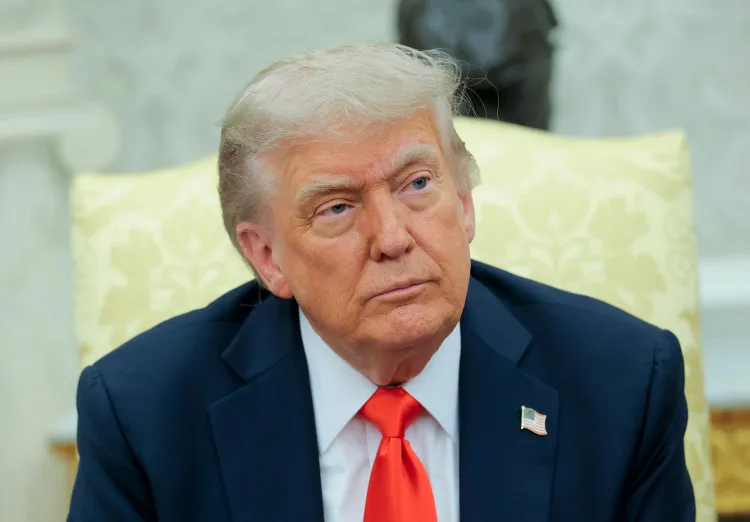

WASHINGTON — President Donald Trump intensified his use of racially charged language Friday, suggesting during a national television interview that immigrants possess a different and potentially inferior genetic makeup compared to white Americans.
Speaking with Fox & Friends host Brian Kilmeade, Trump argued that while some border crossings are a matter of policy failure, other immigrants are biologically predisposed to “go bad.”
“There’s something wrong there. The genetics are not exactly your genetics, it’s one of those problems, Brian,” Trump said during the phone interview. “It’s a terrible thing, and it happens, it happens too often.”
The comments represent a significant escalation in Trump’s long-standing use of dehumanizing rhetoric, moving beyond critiques of policy toward a pseudoscientific framework that historians and civil rights advocates liken to early 20th-century eugenics.
A Pattern of Biological Determinism
The Friday exchange is the latest in a series of remarks where Trump has linked ethnicity and national origin to biological fitness. In October 2024, during an interview with radio host Hugh Hewitt, Trump claimed that undocumented immigrants who commit crimes are driven by “bad genes,” asserting that “we got a lot of bad genes in our country right now.”
Critics argue these statements echo the “Great Replacement” theory and the rhetoric of the 1920s nativist movement, which led to the Immigration Act of 1924.
“Trump is an old-school eugenicist nativist,” said David J. Bier, director of immigration studies at the Cato Institute. “He actually is fine with immigrants as long as they have the right ‘genes.’ This argument was the basis of the creation of the restrictive U.S. immigration system 100 years ago.”
Fact-Checking the ‘Criminality’ Narrative
Trump’s rhetoric frequently relies on the premise that immigrants are inherently more prone to violence. However, federal data and independent studies consistently contradict this claim.
- Crime Statistics: A 2024 study by the Northwestern University and the National Bureau of Economic Research found that immigrants are 30% to 60% less likely to be incarcerated than U.S.-born citizens.
- ICE Data Nuance: Trump often cites a 2024 ICE report mentioning 13,000 “non-detained” immigrants with homicide convictions. However, Department of Homeland Security (DHS) officials clarified that these figures span four decades, including the Trump administration, and many individuals in that total are currently serving time in state or local prisons, not walking free.
| Group | Incarceration Rate (per 100,000) |
| U.S. Born Citizens | ~1,400 |
| Undocumented Immigrants | ~800 |
| Legal Immigrants | ~400 |
Data Source: Cato Institute Analysis of 2024 Census/ACS Data.
Historical and Political Repercussions
The White House and various human rights organizations swiftly condemned the remarks. Advocates point out that the phrase “poisoning the blood of our country”—which Trump used in late 2023—mirrors language found in Adolf Hitler’s Mein Kampf.
“He’s a white supremacist. He doesn’t hide it,” wrote commentator Mehdi Hasan on X (formerly Twitter).
The use of “genetics” as a political weapon marks a shift in the GOP’s 2026 platform strategy, leaning further into identity-based grievances. While Trump’s base often views such language as “unfiltered truth,” political analysts warn it may further alienate moderate suburban voters and minority communities.
As the 2026 midterms approach, the impact of this rhetoric on the legislative landscape remains a central point of contention for both parties.