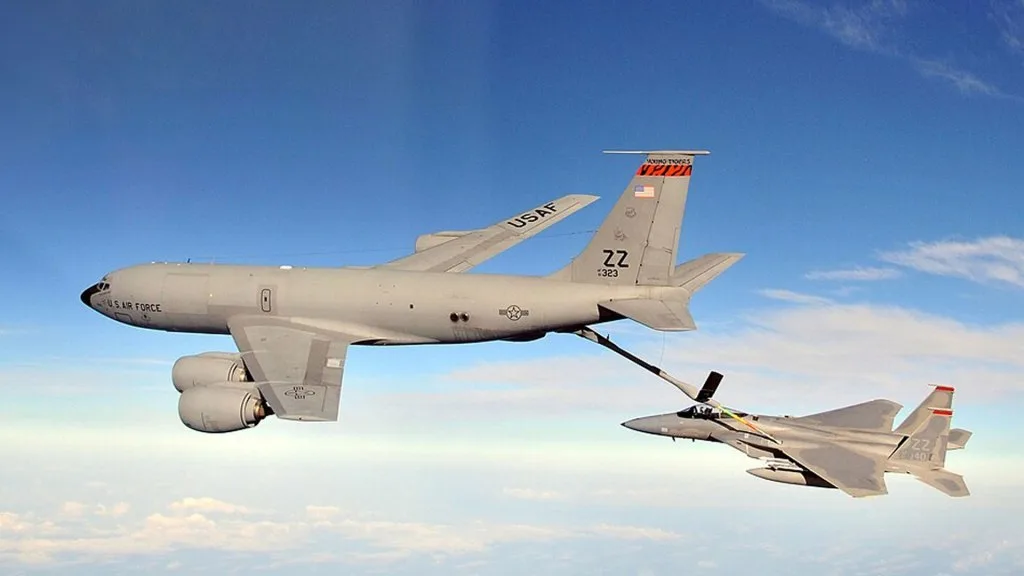

BAGHDAD — A U.S. Boeing KC-135 Stratotanker crashed in Iraq on Thursday during a high-stakes aerial refueling mission, claiming the lives of six service members. The tragedy has reignited a fierce debate over military safety protocols following revelations that the crew lacked parachutes—a standard piece of survival equipment removed from the fleet nearly two decades ago as a cost-cutting measure.
The aircraft was operating as part of “Operation Epic Fury” when it went down. Pentagon officials confirmed that the loss was not the result of enemy or friendly fire. While a second KC-135 involved in the operation returned safely to base, rescue teams were deployed immediately to the crash site to recover the fallen personnel.
A Controversial Legacy of Cost-Cutting
The primary focus of the investigation has shifted toward a controversial 2008 decision by the Air Force to strip parachutes from the KC-135 fleet. Under the “Air Force for Smart Operations in the 21st Century” (AFSO 21) program, leadership deemed the equipment “obsolete” for this specific airframe.
At the time, officials argued that the likelihood of a crew needing to bail out of a Stratotanker was statistically negligible. The removal was driven by a desire to reduce the time, manpower, and financial resources required to maintain and train for parachute use.
Current safety doctrine for large-scale military aircraft—similar to civilian airliners—prioritizes redundant mechanical systems and “crew resource management” to facilitate emergency landings over individual bailouts. However, critics argue that in the event of catastrophic structural failure or midair collisions, the absence of parachutes leaves the crew with zero options for survival.
Investigating the Cause
While the Department of Defense has not finalized a cause for the crash, investigators are weighing several possibilities:
- Mechanical Failure: The KC-135 is a derivative of the 1950s-era Boeing 707 airframe, making it one of the oldest platforms in the U.S. inventory.
- Refueling Mishap: The aircraft acts as a “flying gas station,” carrying tens of thousands of pounds of volatile jet fuel to replenish fighters and bombers mid-flight.
- Structural Malfunction: Given the age of the fleet, metal fatigue and flight control system failures remain persistent risks.
This incident marks the first loss of a KC-135 since 2013, when a flight control malfunction led to a fatal crash in the Kyrgyz Republic.
An Aging Fleet Under Pressure
The KC-135 Stratotanker remains the backbone of U.S. global reach, capable of weighing up to 322,500 pounds when fully laden. Despite its age, the Air Force currently plans to keep the airframe in service until at least 2050.
Upgrade programs have faced consistent delays, leaving crews to operate technology that was first engineered during the Eisenhower administration. This latest disaster is expected to put intense pressure on Congress and military leadership to accelerate the retirement of the KC-135 or implement more rigorous safety retrofits.
Official Response
Joint Chiefs Chairman General Dan Caine addressed the loss during a Pentagon briefing, calling for national reflection on the risks faced by service members.
“Please keep these brave airmen, their families, and their units in your thoughts,” General Caine stated. “Our service members make an incredible sacrifice to go forward and do the things that the nation asks of them. We owe it to them to determine exactly what went wrong.”
The names of the six deceased service members are being withheld pending the notification of next of kin. Recovery operations and the formal safety investigation remain ongoing.