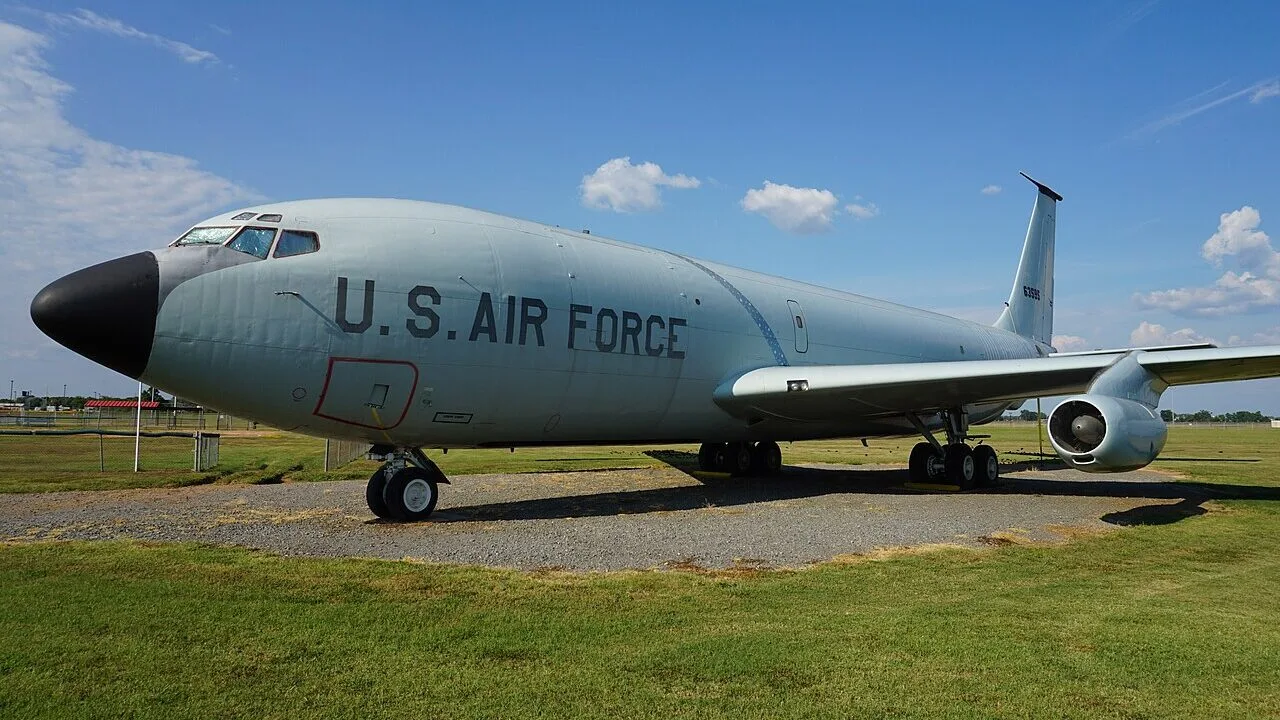

The strategic backbone of American airpower in the Middle East is facing its most severe strain in decades. Within a single 72-hour window, the U.S. Air Force has seen seven KC-135 Stratotankers—the aging but essential “flying gas stations”—knocked out of service by a combination of Iranian missile strikes and a tragic mid-air collision.
The losses come as Operation Epic Fury, the joint U.S.-Israeli campaign to dismantle Iran’s nuclear and missile infrastructure, enters its third week of high-intensity combat.
Missile Strike at Prince Sultan Air Base
U.S. officials confirmed that an Iranian ballistic missile barrage targeted Prince Sultan Air Base (PSAB) in Saudi Arabia late last week, damaging five KC-135 refueling aircraft stationed on the tarmac.
While initial reports suggested catastrophic losses, President Donald Trump clarified the extent of the damage via social media on Saturday.
“Four of the five had virtually no damage and are already back in service,” the President stated. “One had slightly more damage but will be in the air shortly. None were destroyed.”
Despite the optimistic assessment, the strike marks a significant breach of regional air defenses. PSAB serves as the primary hub for the 378th Air Expeditionary Wing, hosting dozens of tankers and strike fighters. The ability of the Islamic Revolutionary Guard Corps (IRGC) to penetrate the base’s perimeter with precision munitions underscores the persistent threat to U.S. “high-value, low-density” assets.
Fatal Collision Over Iraq
The damage at PSAB followed a catastrophic incident on Thursday evening near Turaibil, in western Iraq. Two KC-135s operating in “friendly airspace” were involved in a mid-air collision.
- Casualties: One aircraft crashed, killing all six crew members on board.
- Safe Landing: The second tanker, despite sustaining major structural damage, performed an emergency landing at Ben Gurion Airport in Tel Aviv.
The Pentagon has identified the fallen airmen as Maj. John A. Klinner, Capt. Ariana G. Savino, Tech. Sgt. Ashley B. Pruitt, Capt. Seth R. Koval, Capt. Curtis J. Angst, and Tech. Sgt. Tyler H. Simmons. While the Islamic Resistance in Iraq claimed to have downed the aircraft, U.S. Central Command (CENTCOM) has officially ruled out hostile fire, attributing the tragedy to the inherent risks of high-tempo night refueling operations.
Operational Impact: The ‘Tanker Gap’
For military planners, the loss of seven tankers is more than a line item on a balance sheet; it is a direct hit to the combat radius of the entire regional fleet.
| Aircraft Type | Impact of Tanker Shortage |
| B-2 Spirit | Requires multiple refuelings for long-range sorties from Missouri or Diego Garcia. |
| F-15E / F-35A | Combat time over Iranian targets is cut by nearly 40% without loitering tankers. |
| Drones (MQ-9) | Limited in their ability to provide continuous “eyes on” surveillance. |
The U.S. currently operates roughly 75% of the world’s tanker capacity, but the fleet is aging. The KC-135 Stratotanker, based on the 1950s-era Boeing 707 airframe, has faced persistent maintenance issues that are only exacerbated by the relentless sortie rates required by Operation Epic Fury.
Strategic Escalation
Since the conflict began on February 28, 2026, the U.S. has lost several high-profile assets, including three F-15s (notably lost to a friendly-fire incident in Kuwait) and nearly a dozen drones. However, the targeting of tankers represents a shift in Iranian strategy—focusing on the logistical “tail” that makes American “reach” possible.
As the U.S. military continues to hammer Iranian naval targets and missile factories, the safety of its logistical lifeline remains the campaign’s most significant vulnerability.