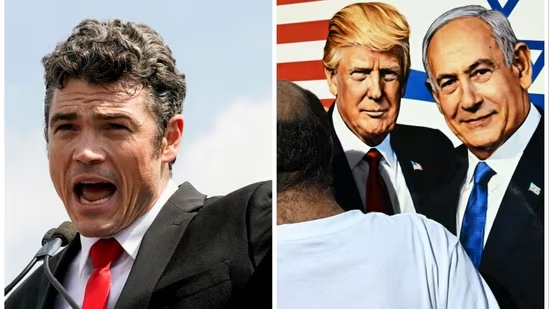

In a bombshell interview that has sent shockwaves through the nation’s capital, Joe Kent, the recently resigned Director of the National Counterterrorism Center (NCTC), has alleged that federal investigators were “blocked” from pursuing foreign leads in the September 2025 assassination of conservative firebrand Charlie Kirk.
The allegations surface as the United States remains embroiled in a widening conflict with Iran—a war Kent claims Kirk was desperately trying to prevent in the months leading up to his death.
The “Last Request” and a Deepening Schism
Speaking on The Tucker Carlson Show Wednesday, Kent recounted his final meeting with Kirk in the West Wing of the White House in June 2025. According to Kent, Kirk—a pivotal figure in the MAGA movement who was instrumental in securing JD Vance as Donald Trump’s running mate—expressed grave concerns regarding Middle East escalation.
“He looked me in the eye and he said… Joe, stop us from getting into a war with Iran,” Kent told Carlson.
Kent further asserted that Kirk was “vocally advocating” for the administration to rethink its strategic posture and avoid a direct kinetic conflict. This narrative adds a layer of geopolitical complexity to the death of the 31-year-old activist, who was shot by a sniper during a “Prove Me Wrong” debate at Utah Valley University on September 10, 2025.
Allegations of Investigative Interference
The official narrative maintains that the assassination was the act of a “lone wolf,” 22-year-old Utah native Tyler Robinson. Robinson currently faces aggravated murder charges and a potential death sentence. However, Kent revealed that his team at the NCTC was ordered to stand down when they attempted to investigate potential foreign ties.
“We were then told that, ‘Hey, you guys need to stop. You can’t work on this anymore,'” Kent claimed, alleging that federal agencies were told to defer entirely to Utah state authorities because the case was a “slam dunk.”
Kent hinted at “unanswered questions” regarding text messages that allegedly show Kirk was under “immense pressure” from pro-Israel donors prior to his death. These claims have been echoed by conservative commentator Candace Owens, though federal authorities have repeatedly stated there is “zero credible evidence” of foreign state involvement.
A Nation at War: The Context of “Operation Epic Fury”
Kent’s resignation and subsequent allegations come at a moment of extreme national tension. Since February 28, 2026, the U.S. and Israel have been engaged in Operation Epic Fury, a massive joint military campaign that resulted in the death of Iran’s Supreme Leader, Ayatollah Ali Khamenei.
The human and economic toll of the conflict is mounting:
- Casualties: At least 13 U.S. service members have been killed in action.
- Energy Crisis: Global gas prices have surged as Iran maintains a “chokehold” on the Strait of Hormuz, disrupting nearly 20% of the world’s oil supply.
- Political Fallout: President Trump has faced bipartisan criticism for the escalating costs of the war. Following Kent’s resignation, the President dismissed his former advisor as “weak on security.”
The Road Ahead
While Tyler Robinson awaits his next court hearing on April 17—where his defense will argue to bar cameras from the courtroom—the political theater surrounding Kirk’s death shows no signs of abating. The divide within the Republican party is widening between “America First” non-interventionists like Kent and Carlson, and those who view the Iran conflict as an existential necessity.
As the NCTC remains under fire for its handling of the Kirk file, the question remains: was the assassination a tragic act of domestic political violence, or the silencing of a key voice standing in the way of a regional war?