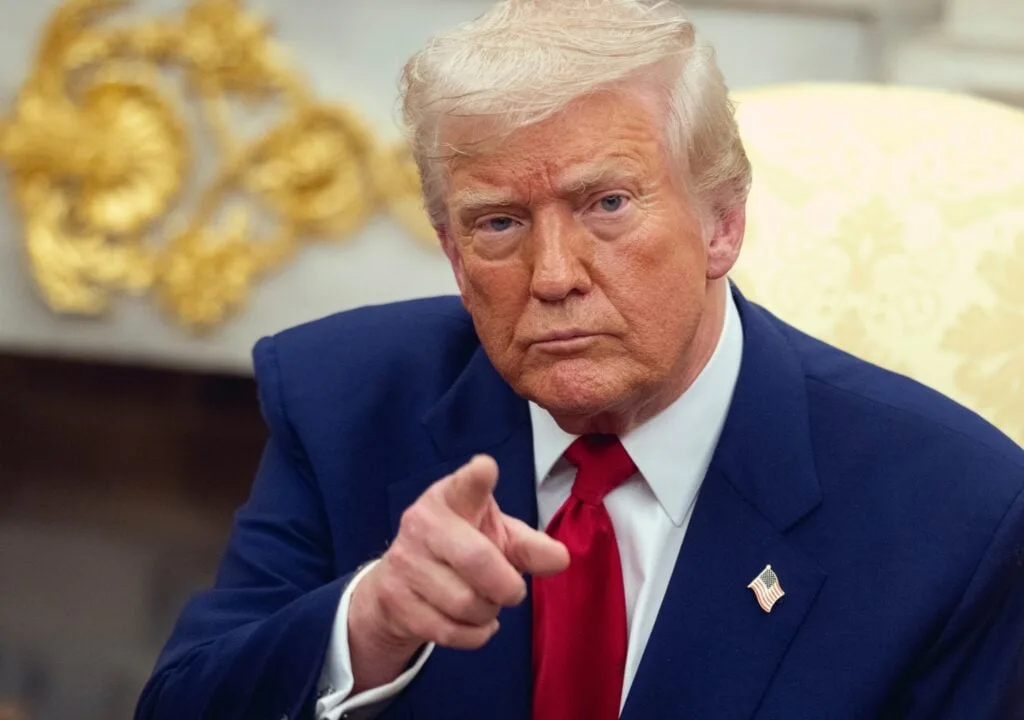

President Donald Trump claimed on Monday that a former U.S. commander-in-chief privately admitted regret over their administration’s “soft” stance on Tehran, expressing a desire to have executed the aggressive military strategy Trump is currently spearheading in the Middle East.
Speaking to the newly renamed Trump-Kennedy Center board of trustees, the president suggested that his predecessor—whom he declined to name to avoid “embarrassing” him—endorsed the current kinetic operations against the Islamic Republic.
“I’ve spoken to a certain president, who I like, actually… a former president,” Trump told the board members. “He said, ‘I wish I did it… but they didn’t do it. I’m doing it.’”
The claim comes as Operation Epic Fury enters its 18th day, a conflict that has already cost an estimated $16.5 billion and resulted in the deaths of at least 11 U.S. service members.
A “Democratic” Hint in the Oval Office
The president later doubled down on these remarks during an Oval Office signing ceremony alongside Vice President JD Vance. When pressed by reporters to identify the mystery predecessor, Trump dismissed suggestions of George W. Bush or Bill Clinton, though he teased the individual’s partisan affiliation.
“He is a member of a party… they have Trump Derangement Syndrome,” the president said, hinting at a Democratic predecessor. While Trump has historically been a fierce critic of Barack Obama’s 2015 nuclear deal and Joe Biden’s regional policies, he noted that this specific individual “happens to like me.”
None of the four living former presidents—Bush, Clinton, Obama, or Biden—have issued public statements regarding the current war, maintaining a notable wall of silence as the U.S. military strikes over 7,000 targets across Iran.
“Most Unstable Year”: Rogan Goes Viral
The geopolitical volatility has sparked a firestorm on social media, punctuated by a viral clip from podcast giant Joe Rogan.
“If only someone warned you,” Rogan told his audience in a segment that has dominated 2026’s digital discourse. Rogan characterized 2026 as “the most unstable year” in modern history, citing the simultaneous military actions in Iran and the recent capture of Venezuelan leader Nicolás Maduro.
The sentiment echoes a growing domestic anxiety as energy markets reel. Brent crude surged past $115 per barrel this week after Iran targeted Gulf energy sites in retaliation for strikes on the South Pars gas field. U.S. gas prices have jumped an average of 60 cents per gallon in the last month alone.
Bipartisan Backlash on Capitol Hill
Despite the administration’s claims of military success—including the reported destruction of 95% of Iran’s drone capabilities—lawmakers from both sides of the aisle are mounting a challenge to the war’s legality.
- The Constitutional Challenge: Rep. Thomas Massie (R-Ky.) and Rep. Ro Khanna (D-Calif.) recently led a 212-219 vote attempting to invoke the War Powers Resolution. Massie slammed the strikes as “unconstitutional” and warned that the targeted killing of Iranian leaders could “backfire by turning them into martyrs.”
- The “No Strategy” Critique: Senate Minority Leader Chuck Schumer (D-N.Y.) accused the White House of a “failure to foresee” the economic leverage Iran holds over the Strait of Hormuz.
- The Russia Connection: Senators Elizabeth Warren (D-Mass.) and Jeanne Shaheen (D-N.H.) issued a scathing joint statement accusing the administration of loosening sanctions on Russia—allegedly to lower oil prices—while Moscow provides intelligence to Iran to target U.S. troops.
By the Numbers: The Cost of Conflict
| Category | Reported Statistic (As of March 19, 2026) |
| U.S. Casualties | 11 Killed in Action, 18 Wounded |
| Financial Cost | ~$1.375 Billion per day |
| Military Targets | 7,000+ Iranian sites struck |
| Energy Impact | $3.63 National Average Gas Price (22-month high) |
As the 60-day window under the War Powers Resolution continues to tick down, the White House maintains that the mission is “substantially ahead of schedule.” However, with the Strait of Hormuz still heavily mined and regional allies like the UAE and Qatar activating air defenses, the “short excursion” Trump promised is rapidly evolving into a era-defining confrontation.