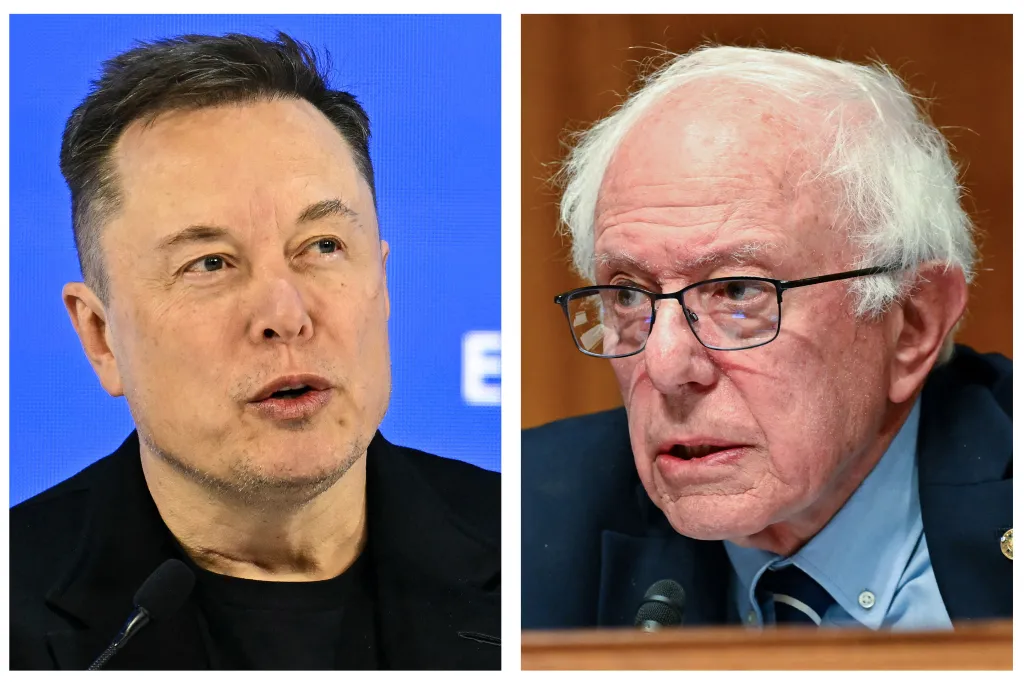

WASHINGTON — A fundamental divide over the purpose of American taxation has reached a boiling point as Elon Musk and Senator Bernie Sanders (I-Vt.) weaponize the same financial data to reach diametrically opposed conclusions. At the heart of the debate is a simple, staggering figure: the $8.2 trillion combined net worth of the nation’s 938 billionaires.
The Debt Reality Check
Elon Musk, the world’s wealthiest individual, argues that targeting the ultra-rich is a mathematical distraction from the looming fiscal crisis. With the U.S. national debt hurtling toward $39 trillion, Musk maintains that even a 100% seizure of billionaire wealth would fail to stabilize the country’s balance sheet.
“Even if you tax every billionaire in America at 100%, it barely makes a dent,” Musk stated, warning that such measures would inevitably lead to higher taxes for all citizens to cover the interest on federal borrowing. His perspective frames the issue as one of systemic overspending rather than insufficient revenue.
The Sanders Strategy: Targeted Redistribution
Senator Sanders, alongside Rep. Ro Khanna (D-Calif.), isn’t disputing Musk’s math regarding the debt. Instead, he is shifting the goalposts toward social equity through the “Make Billionaires Pay Their Fair Share Act.”
The proposed legislation would implement a 5% annual wealth tax on billionaires, projected to generate $4.4 trillion over a decade. Sanders’ vision for these funds includes:
- Immediate Stimulus: A one-time $3,000 check for households earning $150,000 or less (roughly 74% of the U.S. population).
- Education Reform: Establishing a $60,000 minimum salary for public school teachers.
- Healthcare Restoration: Reversing $1.1 trillion in projected cuts to Medicaid and the Affordable Care Act.
“This legislation demands that the billionaire class finally pay their fair share so we can create an economy that works for all of us,” Sanders said.
A Servicing Crisis
The urgency of this debate is underscored by the rising cost of American debt. The U.S. now spends nearly $1 trillion annually just to service interest—a figure that has tripled in five years and now eclipses Medicare spending. By 2032, interest payments alone are expected to exceed $1.5 trillion.
While Musk views the $8.2 trillion billionaire pool as an insufficient band-aid for a “1,000%” bankruptcy trajectory, Sanders views it as a vital reservoir for a struggling middle class. The clash highlights a pivot in American political discourse: is the priority to save the state from insolvency, or to protect the individual from an affordability crisis?
As the national debt grows by $11 trillion every five years, the math suggests that neither a 5% tax nor spending cuts alone will provide a total solution.