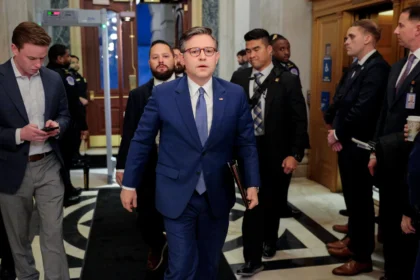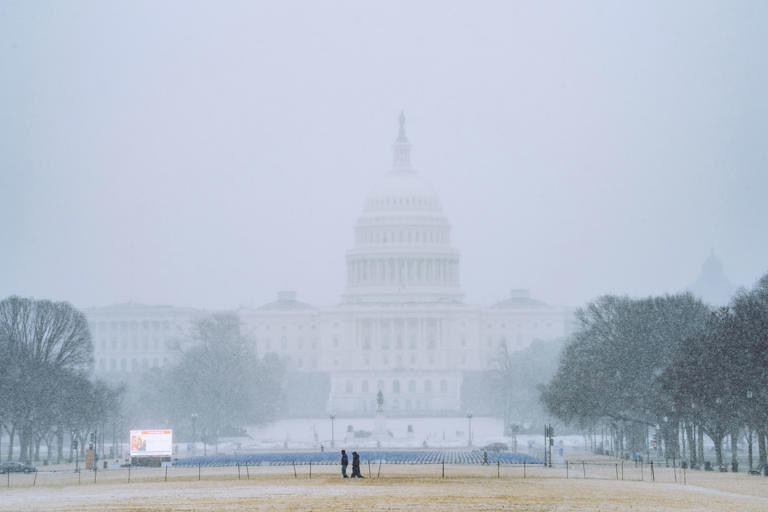

In his 1926 novel The Sun Also Rises, Ernest Hemingway described bankruptcy as occurring in two ways: “Gradually, then suddenly.” A century later, constitutional experts and former lawmakers warn that the U.S. Congress is mirroring that trajectory, sliding toward a state of permanent institutional impotence that threatens the American balance of power.
The warning signs are no longer subtle. A recent report from the Bipartisan Policy Center, titled “Congress at a Crossroads,” suggests the legislative branch has reached a “point of no return.” The study identifies a toxic mix of hyper-polarization and the “nationalization” of politics, where lawmakers prioritize media attention over the granular, often tedious work of legislating.
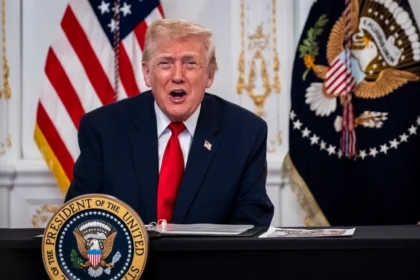
The result is an executive branch that increasingly operates without legislative check. Former Rep. Fred Upton (R-MI), who served 35 years before retiring in 2023, offered a blunt assessment of the current state of play.
“I learned ninth-grade civics: You’ve got three equal branches of government,” Upton said. “But right now, the Congress is not one of them. It abdicated everything to the White House.”
This sentiment is echoed across the aisle. Sen. Tina Smith (D-MN), who recently announced her retirement after only seven years, described the institution as nearing a “tipping point” of irrelevance.
The data supports the dire rhetoric. In the first year of the current administration, Congress passed the fewest laws of any first-year presidency since at least 1989. In the vacuum left by legislative inaction, the presidency has surged:
- Executive Orders: Over 225 issued in the first 11 months of the current term—surpassing the total of the previous four years combined.
- Budgetary Failure: Funding for federal agencies was finalized four months past the deadline, and only after a six-week government shutdown.
- Vanishing Oversight: Critical foreign policy moves, including military actions in the Middle East launched on Feb. 28, have proceeded with zero formal input or public hearings from House or Senate leadership.
The American public’s faith in the “First Branch” has withered alongside its productivity. According to Gallup tracking data, the erosion of trust is staggering:
| Metric | 2002 | 2025 |
| Trust/Confidence in Congress | 67% | 32% |
| “No Trust at All” | 6% | 24% |
| Job Approval Rating | ~20% | 16% |
Even the Judiciary has taken notice. Supreme Court Justice Neil Gorsuch recently excoriated congressional atrophy in an opinion regarding tariff policies, noting that the “deliberative nature” of the legislative process—once the bedrock of the Republic—is being bypassed for political convenience.
While some point to rare bipartisan wins, such as the release of the Jeffrey Epstein investigative files, critics argue these are “basic blocking-and-tackling” tasks that now require extraordinary effort to achieve.
As the 2026 midterm cycle approaches, the question remains whether the institution can recover its constitutional status as a co-equal branch. Without a fundamental shift in the “character and inclination” of those within the Capitol, the gradual decay of the last several decades may soon give way to the “sudden” collapse Hemingway once described.