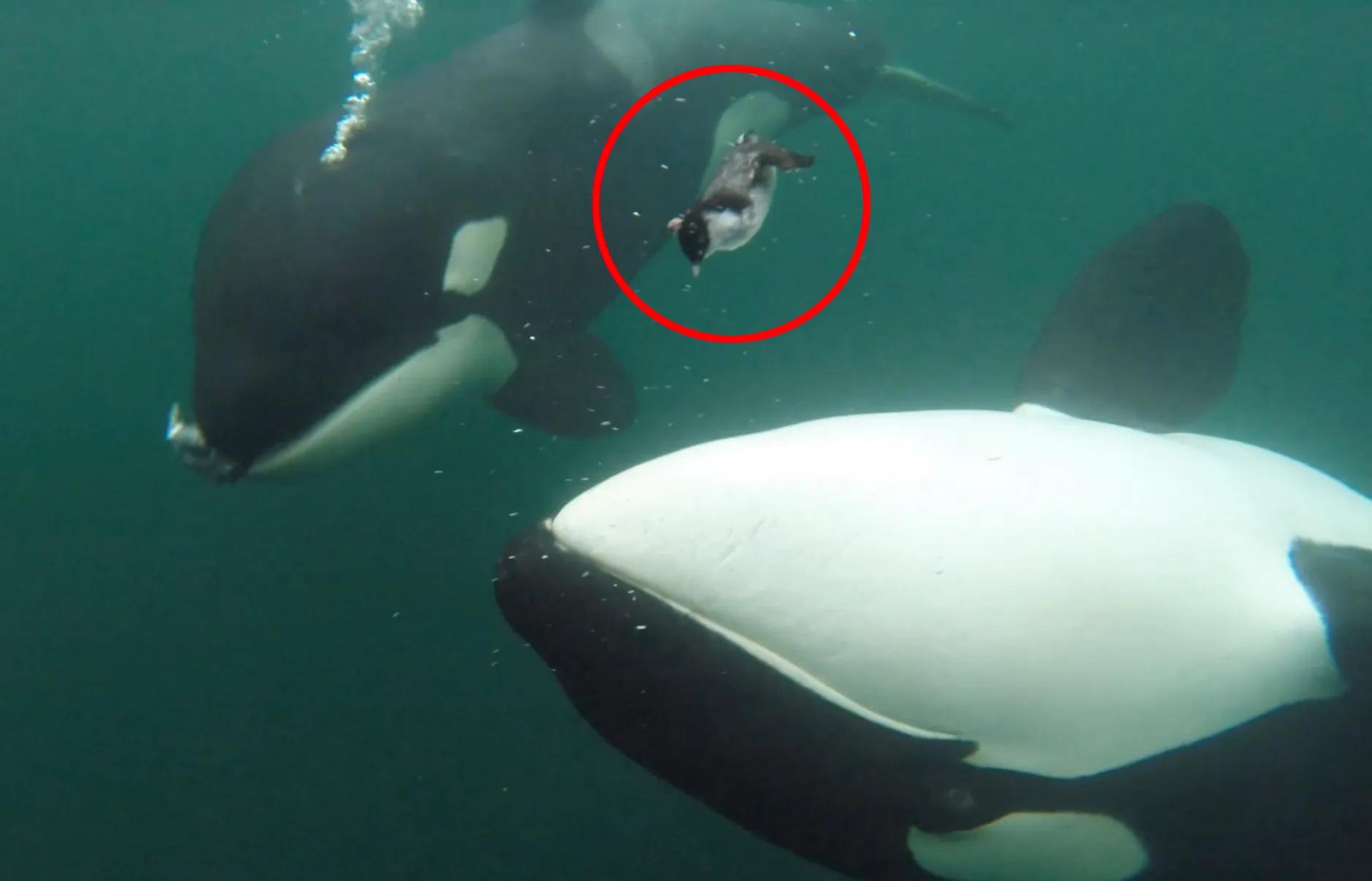

In a rare and puzzling display, killer whales have been spotted presenting “gifts” to humans, a behavior that marine biologists describe as “extremely unusual” and never-before documented in this way.
Dozens of these extraordinary encounters have been captured on camera and observed in waters off Norway and New Zealand, where orcas were seen swimming up to humans and offering items such as fish, birds, turtles, and even mammals before gently releasing them.
Uncharted Social Behavior
Scientists say the behavior closely resembles food-sharing rituals orcas typically perform among themselves. But this is the first time it’s been observed being directed toward humans.
“Orca are very social, and we frequently see them share food with each other,” said Dr. Ingrid Visser, lead researcher. “To witness this directed at humans across different parts of the world is absolutely fascinating.”
In each case, the 5-ton marine predators were seen carrying a prey item in their mouths, swimming up to people—whether in the water, on boats, or even onshore—and releasing it in front of them, often waiting to see what happened next.
What the Orcas Offered
Researchers catalogued 34 incidents of orcas giving gifts to humans:
- 11 while people were swimming
- 21 while people were on boats
- 2 while humans stood onshore
In nearly every instance, the orcas appeared to watch and wait for a response—and in at least seven cases, they offered the gift more than once when it was not accepted.
“There appears to be a prosocial element to this behavior,” said Jared Towers, one of the study’s authors. “It’s something almost never observed in wild non-human animals.”
Why Are They Doing It?
The motivations behind this gesture are still unclear, but researchers believe it may be an extension of the whales’ highly complex social and emotional intelligence.
“Orcas are apex predators. They don’t need to share food—especially not with humans,” said marine biologist Vanessa Prigollini. “But doing so might reflect an attempt to connect, explore, or simply show curiosity about us.”
The behavior is also reminiscent of cats, which are known to bring prey to humans as a form of bonding.
A Glimpse Into the Orca Mind
Noted ecologist Dr. Carl Safina emphasized how significant this kind of behavior could be in understanding orcas.
“Of the many minds in the sea, orcas likely have the most complex,” he said. “To them, we must appear as strange visitors in their world. These interactions may be their way of trying to understand us.”
For an incident to be counted in the study, an orca had to:
- Approach humans voluntarily
- Drop an item directly in front of them
- Exhibit waiting or repeat behavior
The findings, recently published in the Journal of Comparative Psychology, offer a new glimpse into how inter-species social communication might be more common than previously thought.
More Orca Oddities
This comes shortly after scientists filmed two killer whales “kissing” underwater in Norway, with their tongues visibly touching—another highly rare and affectionate interaction.
The orcas engaged in three “kissing” sessions, each lasting between 10 and 26 seconds.
Are Orcas Dangerous to Humans?
Despite being nicknamed “killer whales,” orcas are not known to attack humans in the wild.
They are apex predators that hunt seals, dolphins, and even large whales, but have no natural predators themselves. Until recent reports of orcas ramming boats, no fatal orca attacks on humans had ever been confirmed.
These gift-giving behaviors only further confirm how intelligent, curious, and social these creatures truly are.
“We’re just starting to understand the emotional and social depths of these animals,” said Dr. Visser. “They may not be just watching us—they could be trying to communicate.”