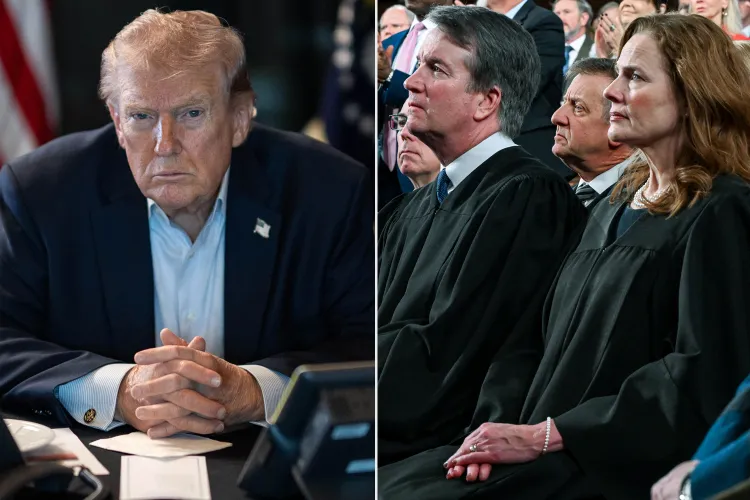

President Donald Trump made an unprecedented appearance at the Supreme Court becoming the first sitting U.S. president to attend oral arguments. The high-stakes session focused on the administration’s controversial executive order aimed at terminating birthright citizenship for the children of undocumented immigrants.
Trump sat in the public gallery—a section typically reserved for high-ranking officials and Cabinet members—alongside Attorney General Pam Bondi. His presence underscored the gravity of the legal battle over his January 20, 2025, executive order. The directive seeks to deny automatic citizenship to infants born on U.S. soil if their parents are “unlawfully present” or holding temporary visas.
The Supreme Court Historical Society confirmed that no previous sitting president has ever observed oral arguments from within the chamber.
The administration’s case, presented by Solicitor General D. John Sauer, hinges on a narrow interpretation of the 14th Amendment. Ratified in 1868, the amendment grants citizenship to all persons “born or naturalized in the United States, and subject to the jurisdiction thereof.”
Sauer argued that the original intent of the amendment was to secure the rights of formerly enslaved people, rather than to provide a “universal” birthright to the children of foreign nationals present without legal status. Critics and constitutional scholars, however, maintain that the “jurisdiction” clause has been settled law for over 150 years, applying to nearly everyone born within U.S. borders.
:max_bytes(150000):strip_icc():focal(791x1024:793x1026):format(webp)/donald-trump-supreme-court2-4126-dc8fcd164d934dbeb0020629fcb770cc.jpg)
The arguments come at a period of heightened friction between the White House and the judiciary. On February 20, the Supreme Court delivered a stinging 6-3 defeat to the administration, ruling that Trump exceeded his authority by implementing sweeping global tariffs.
Following that ruling, Trump publicly rebuked the court, specifically targeting Justices Amy Coney Barrett and Neil Gorsuch—both of whom he appointed—calling the institution “a disgrace.”
The proposed executive order is not expected to be retroactive, meaning it would only apply to births occurring after the policy’s implementation. Legal experts suggest the ruling will serve as a landmark definition of executive power and constitutional interpretation.
:max_bytes(150000):strip_icc():focal(517x423:519x425):format(webp)/donald-trump-supreme-court-4126-e6d3f1a82ea14af68e12d93b5809af68.jpg)
The Supreme Court is expected to issue its final decision by the end of June 2026. If upheld, the order would fundamentally alter a century and a half of American legal precedent. If struck down, it would represent the second major judicial rebuke of the Trump administration’s second term within six months.