
President Donald Trump signaled his intent to challenge a federal court order halting construction of a new White House ballroom, asserting that the project’s reliance on private donations exempts it from congressional oversight.
During an Oval Office press conference originally convened for the signing of an executive order on mail-in voting, the President addressed a recent judicial ruling that paused the development. The judge stipulated that the administration must obtain explicit congressional approval before proceeding with the massive addition to the executive mansion.
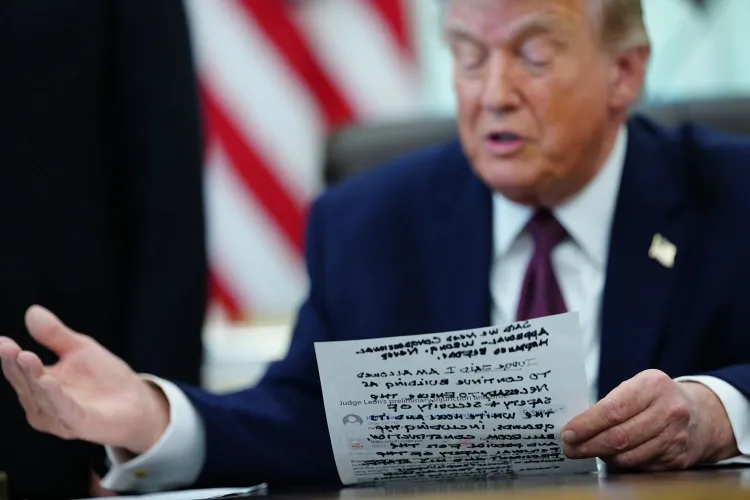
Trump, 79, appeared to rely on a “cheat sheet” featuring large, marker-drawn lettering to navigate his remarks. Despite the prepared notes, the President momentarily struggled with his delivery while detailing the facility’s specialized defenses.
“He also said—but this is positive for us—I’m allowed, meaning we are allowed, to continue building as necessary to… let’s see… what is that?” Trump said, pausing to decipher his handwriting. He eventually described the project as featuring a “drone-proof roof” and “ballistic-proof” glass.
:max_bytes(150000):strip_icc():focal(749x0:751x2):format(webp)/donald-trump-notes-3-040126-b016c2f960154bf097dfb890c09951ae.jpg)
White House spokesperson Davis Ingle later dismissed concerns regarding the President’s reliance on the notes, characterizing Trump as “the sharpest, most accessible, and energetic president in American history.”
The briefing took a sharp turn as Trump pivoted to his treatment by the media. He claimed to receive “93% to 97%” negative coverage, briefly and jokingly suggesting that Press Secretary Karoline Leavitt was doing a “terrible job” before clarifying that he intended to keep her on staff.
Trump further claimed that his administration’s survival in the face of negative press was a testament to a “landslide” victory. However, official election data contradicts this characterization; Trump was elected with 49.8% of the popular vote, falling short of a majority.
Following the press conference, the President took to Truth Social to escalate his rhetoric against the judicial block. He argued that the ballroom’s funding model—utilizing private donations rather than federal taxpayer money—removes the requirement for legislative consent.
“In the Ballroom case, the Judge said we have to get Congressional approval. He is WRONG!” Trump wrote. “Congressional approval has never been given on anything… having to do with construction at the White House.”
Legal experts suggest the administration’s position may face significant hurdles. Regardless of funding sources, structural modifications to the White House—a National Historic Landmark—typically require vetting through the Commission of Fine Arts and the National Capital Planning Commission, alongside statutory federal oversight.
The White House has not yet provided a list of the private donors funding the project, raising further questions regarding transparency and ethics in the ongoing construction.