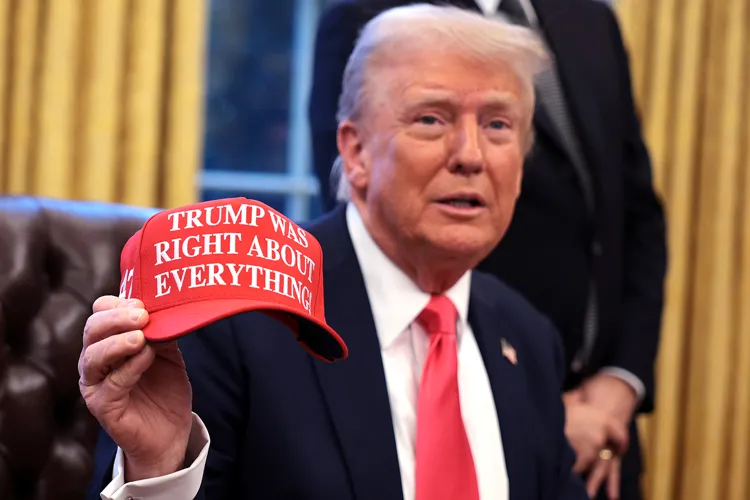

President Donald Trump issued a direct warning to the American private sector on Tuesday, urging major corporations to waive their rights to $160 billion in tariff refunds mandated by the Supreme Court.
Speaking on CNBC’s Squawk Box, the 79-year-old president suggested that corporate compliance with the court’s ruling would be viewed as a test of loyalty. “If they don’t do that, I’ll remember them,” Trump stated, adding that companies who decline the refunds have “gotten to know me very well.”
A High-Stakes Legal Defeat
The tension follows a landmark February 20 Supreme Court ruling that struck down a series of tariffs enacted under the International Emergency Economic Powers Act of 1977 (IEEPA). The Court determined the administration had exceeded its statutory authority, rendering the collected duties unlawful.
The ruling creates a massive fiscal liability for the Treasury, requiring the government to return approximately $160 billion to the companies that paid the levies. Trump criticized the judiciary for not including a “non-retroactive” clause in the decision.
“All [the justices] had to do is add one sentence… ‘You don’t have to pay back anything taken in thus far,’” Trump said during his Tuesday appearance.
Intra-Party Friction and Judicial Attacks
The president’s rhetoric has increasingly targeted the high court’s conservative wing. While he praised the dissenting opinions of Justices Brett Kavanaugh, Samuel Alito, and Clarence Thomas, he directed sharp vitriol at his own appointees, Amy Coney Barrett and Neil Gorsuch.
- Public Rebukes: Trump characterized the rulings of Barrett and Gorsuch as “an embarrassment to their families.”
- Allegations of Bias: In a March 15 post on Truth Social, the president claimed the court had been “swayed by foreign interests” and accused Republican-appointed justices of lacking the partisan cohesion he attributes to the court’s liberals.
Economic Strategy Moving Forward
Despite the legal setback, the administration appears undeterred in its protectionist agenda. Trump signaled that he is already pursuing alternative legal avenues to maintain high trade barriers.
“The Court pointed out, I have the absolute right to charge TARIFFS in another form, and have already started to do so,” Trump wrote on social media.
Legal analysts suggest the president’s pressure on corporations to decline refunds represents an unconventional attempt to mitigate the ruling’s financial impact without legislative intervention. However, the move raises significant questions regarding executive overreach and the potential for retaliatory policy-making against firms that choose to reclaim their capital.