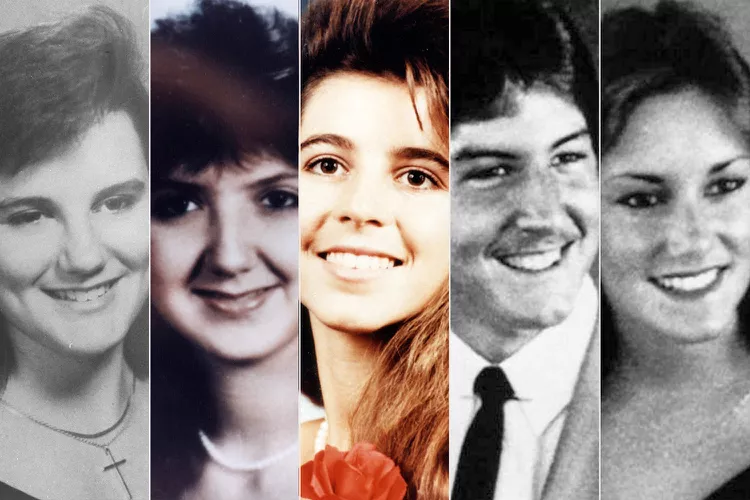

I’ll never forget that Tuesday night in late August 1990 when my roommate Stephanie called me sobbing. It was just before the fall semester started at the University of Florida in Gainesville. I was at the office of The Independent Florida Alligator, editing the “Applause” entertainment section, when the phone rang. Stephanie could barely speak, but I already had a sick feeling in my stomach. I knew what the call was about.
A serial killer had been terrorizing our college town for the past week. Five students — four women and one man — had been brutally murdered. He broke into their apartments at night, raped the women, stabbed all of them to death, and left their bodies grotesquely posed. One of the victims had even been decapitated, her head placed on a mantle near her body. Rumors spread wildly — at one point, we thought all the victims had been beheaded. That wasn’t true, but somehow the truth was worse.
:max_bytes(150000):strip_icc():focal(749x0:751x2):format(webp)/university-of-florida-101023-1-75445936e1d947b5b404fe40b033df7d.jpg)
We felt like we were living in a horror movie. And, in a way, we were — the “Gainesville Ripper,” as he would later be called, would go on to inspire documentaries, books, and eventually Scream, the hit 1996 film written by Kevin Williamson. What made it more terrifying than fiction was that the victims were students just like us, living in our neighborhood.
The four women — Sonja Larson, 18; Christina Powell, 17; Christa Hoyt, 18; and Tracy Paules, 23 — were all white brunettes. The fifth victim, 23-year-old Manny Taboada, was Paules’ roommate. He was simply in the wrong place at the wrong time.
Stephanie and I shared a small, two-bedroom duplex tucked beside a thickly wooded area — the kind of place where anything could be lurking in the shadows. The murders happened over just four days, but Gainesville remained in a state of panic for weeks. Every time I came home, even in broad daylight, I was afraid someone was waiting behind the apartment. Or next door. We didn’t know our neighbors. Trust was in short supply.
:max_bytes(150000):strip_icc():focal(651x403:653x405):format(webp)/Gainesville-memorial-wall-063025-245cf6b7a62f4d6bba3b3fd77bcfb70d.jpg)
Stephanie’s call came the day police identified the last two victims, Paules and Taboada. She didn’t call to update me on the news — I already knew. She called because one of the murdered girls had been her friend. They’d taken classes together. Her mother insisted we leave the apartment and stay with her outside the danger zone. I went with them, sleeping in a guest room, but sleep didn’t come. All I could think about were the students who went to bed just like me — and never woke up.
That Labor Day weekend, I got a brief escape. My friend Alex’s band, Henrietta’s Lovers, was playing a party at Tulane, and he invited me along for the road trip to New Orleans. We had fun, but the fear never left us. It clung to our conversations, hung in the air like fog. When we returned, the bassist offered to let me crash at his fraternity house. Safety in numbers. I declined. I didn’t want fear to control my life.
:max_bytes(150000):strip_icc():focal(999x0:1001x2):format(webp)/scream-drew-barrymore-102824-1582915166df46b39415003fca04a88e.jpg)
Back at the apartment, Stephanie was still with her mom. I was alone — in the heart of where the murders had happened.
Police had released a suspect sketch, but it was generic, indistinct — it could’ve been anyone. Still, that face lodged itself in my brain. That night, every time I closed my eyes, I saw it. When I opened them and looked out the window, it felt like he was out there, watching me from the dark. I didn’t sleep. I couldn’t.
Eventually, Stephanie came home. Gainesville began to settle back into a cautious rhythm. Two men were arrested and released before police finally caught the real killer — Danny Rolling, a drifter from Shreveport, Louisiana. He confessed to a triple homicide in his hometown and to shooting his own father before embarking on his killing spree in Florida.
By the time he stood trial in 1994, I had already graduated and moved to New York City. Rolling was sentenced to death and executed by lethal injection in 2006 — just a month after I left NYC for Buenos Aires.
And still, the fear followed me.
In February 2007, a few months after Rolling’s execution, I was the victim of a home invasion in Buenos Aires. Three men broke into my apartment. One of them held a screwdriver like a weapon. I fought back — on the cold tile floor of my bathroom — and escaped with a few bruises and a bloodstained hoodie. But something else stayed with me: a memory.
:max_bytes(150000):strip_icc():focal(824x159:826x161):format(webp)/danny-rolling-6bfbfcb24e8b4a56added8f46248380a.jpg)
Not just the trauma of the attack, but the faces — the photos — of the Gainesville victims that had run in the papers for weeks back in 1990. Unlike Stephanie, I didn’t know any of them. But as I fought for my life in that bathroom, I suddenly felt I knew what they must have felt in their final moments: the terror, the desperation, the sudden knowledge that your life might be ending.
It’s an understanding I wouldn’t wish on anyone — to know what it feels like to stare into the eyes of death when you’re young, full of dreams, and not ready to go.
That summer in Gainesville marked me forever. But what happened in Buenos Aires reawakened it — and helped me understand, finally and fully, just how precious and fragile life really is.