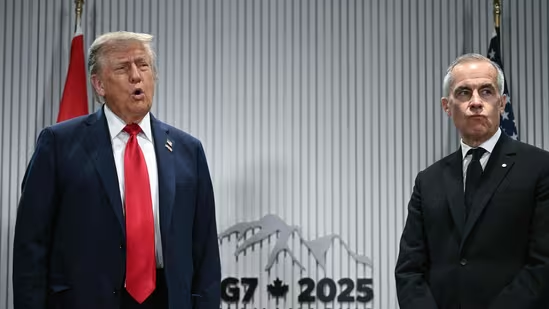

U.S. President Donald Trump announced Thursday that a 35% tariff will be imposed on all goods imported from Canada, effective August 1. The decision marks a major escalation in Trump’s push for what he calls “reciprocal” trade measures and comes amid tense negotiations with several key trading partners.
The tariff announcement was delivered in a formal letter to Canadian Prime Minister Mark Carney, one of more than 20 letters Trump has issued this week as part of a sweeping trade policy shift. The letter was also posted to Trump’s Truth Social platform.
“Instead of working with the United States, Canada retaliated with its own tariffs. Starting August 1, 2025, we will charge Canada a tariff of 35% on Canadian products sent into the United States, separate from all sectoral tariffs,” Trump wrote.
He further warned that any retaliatory action by Canada would be met with an equal increase on top of the 35% rate.
“If for any reason you decide to raise your tariffs, then whatever the number you choose to raise them by will be added onto the 35% that we charge,” he said.
Criticism of Canada’s Trade Practices
Trump took aim at Canada’s longstanding trade policies, particularly in the dairy sector, which he claimed imposes tariffs as high as 400%, restricting U.S. agricultural exports.
“The trade deficit is a major threat to our economy and, indeed, our national security,” he wrote, citing Canada’s trade stance and the cross-border flow of fentanyl as serious threats to the United States.
Part of a Broader Trade Offensive
The tariff against Canada is part of a larger move by Trump to overhaul U.S. trade policy. Earlier this week, he extended a tariff deadline for several countries from July 9 to August 1 to allow room for continued negotiations. However, he simultaneously raised tariffs on several other nations—including allies like Japan and South Korea—and imposed a 50% tariff on copper imports.
The aggressive measures signal Trump’s renewed focus on reshaping global trade under the banner of “America First,” as he seeks to reassert U.S. leverage in global markets ahead of the 2025 presidential election cycle.