
As missiles screamed overhead and Kyiv burned from a barrage of Russian drone strikes, Dr. Borys Todurov raced through the chaos in an ambulance with a mission unlike any other — he was transporting a human heart.
His patient, a critically ill child, had been battling heart disease for years. But earlier this week, her condition deteriorated sharply. Without a transplant, she had only hours left. When news came of a matching donor — another child, declared brain-dead after severe injuries — Todurov didn’t hesitate, even as Russian forces launched one of their heaviest aerial assaults on Ukraine in recent memory.
Overnight into Thursday, Russia fired more than 400 drones and 18 missiles — including eight ballistic and six cruise missiles — across Ukraine. While most were intercepted, the assault killed two and injured dozens. Yet amid the carnage, Todurov pressed on.
The heart was located at Okhmatdyt Children’s Hospital in western Kyiv. Todurov, director of the city’s Heart Institute, had to cross 10 miles — including a perilous journey over the Dnipro River, where bridges are especially vulnerable to missile debris. A video captured during the drive shows flames lighting up the roadside. Todurov, calm in the face of danger, simply states, “We’re carrying a heart.”
Just hours earlier, he had completed another surgery at his institute. Then, during the attacks, he rushed to Okhmatdyt to remove the donor organ himself — a testament to both urgency and resolve.
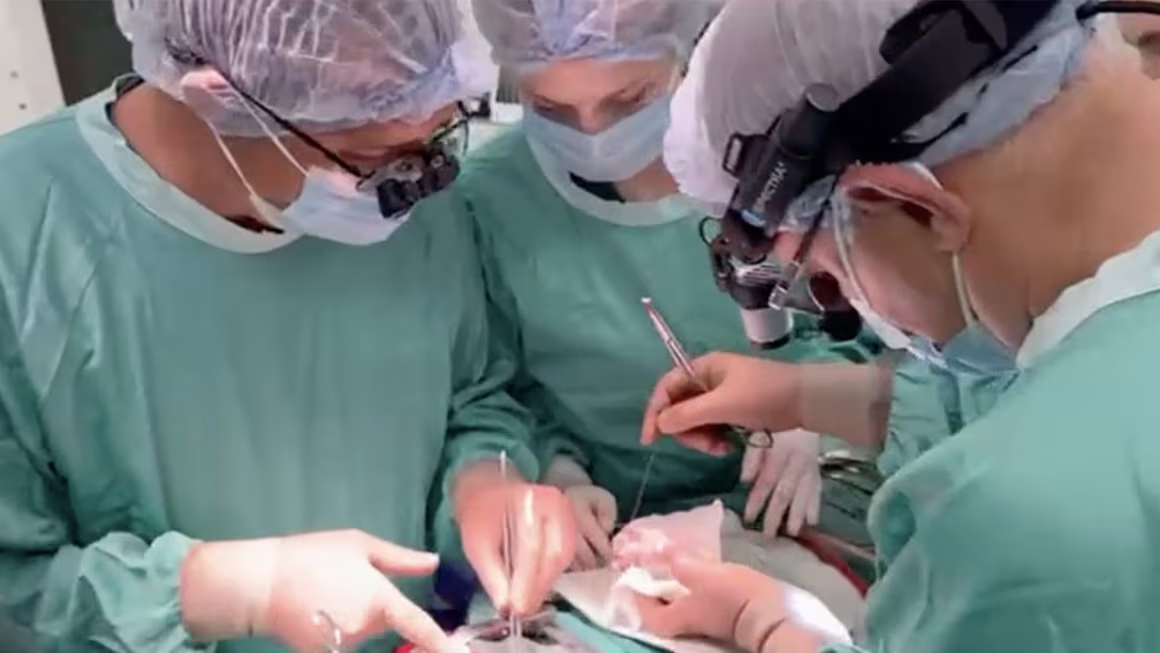
Back at the Heart Institute, as air raid sirens wailed, Todurov led a full surgical team to transplant the donor heart into the waiting child. A powerful moment was caught on video: the new heart, beating steadily in the patient’s chest.
“The heart is working. The pressure is stable. We hope she will recover and live a long and full life,” Todurov said.
The four-year-old donor’s legacy extended beyond that single life. According to the Ukrainian Transplant Coordination Centre, her kidneys went to a 14-year-old boy, and her liver to a 16-year-old girl — both also critically ill and without much time left. Those surgeries were performed at Okhmatdyt, eliminating the need for additional transport.
The donor’s mother, herself a healthcare worker, had made the heartbreaking decision to donate her daughter’s organs after a medical panel declared her brain-dead.
“May the little donor rest in peace,” the coordination center said in a statement. “Our condolences to her family and our gratitude for their difficult but deeply meaningful decision.”
In the midst of war, as destruction rained down from the skies, an act of human compassion and surgical precision gave three children a chance to live.