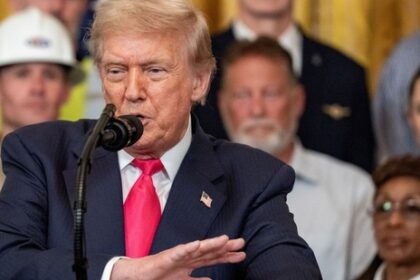

The United States will send additional Patriot air defense systems to Ukraine as part of a European Union–funded initiative aimed at strengthening Kyiv’s defenses amid a surge in Russian missile and drone attacks. The move follows renewed expressions of frustration from President Donald Trump over Russian President Vladimir Putin’s continued bombardments.
Speaking Sunday as he returned to Washington from New Jersey, Trump confirmed that Patriot batteries—“which they desperately need”—will be delivered, funded entirely by U.S. allies. “He [Putin] talks nice and then he bombs everybody in the evening. I don’t like it,” Trump said. He is expected to announce further steps this week during meetings with NATO Secretary-General Mark Rutte and congressional leaders.
European Allies Take the Lead
Germany has committed to financing at least two Patriot systems, while Norway has reportedly joined the effort. Ukraine, which already operates a limited number of U.S.-supplied Patriots from the Biden era, has repeatedly asked for more systems to protect critical infrastructure and urban centers.
What Is the Patriot System?
The MIM-104 Patriot—short for Phased Array Tracking Radar to Intercept on Target—is a mobile surface-to-air missile system developed by Raytheon Technologies. It defends against aircraft, cruise missiles, drones, and short-range ballistic missiles. A full battery includes radar, control units, power systems, launchers, and support vehicles.
Patriot missiles come in two main versions: older PAC-2 interceptors with blast fragmentation warheads, and newer PAC-3 missiles with hit-to-kill technology. Depending on configuration, the system can strike targets up to 100 miles away and at altitudes over 14 miles.
But it’s costly. Each battery runs around $1.1 billion, and individual missiles cost about $4 million, according to the Center for Strategic and International Studies (CSIS).
Experts: Patriot Symbolic, Not a “Game Changer”
Mark Cancian, a senior adviser at CSIS, told Newsweek that while the Patriot systems are significant, their primary effect may be political—meant to pressure Moscow into ceasefire talks, which Trump emphasized in his remarks.
“Trump talked about ‘billions of dollars,’ but these packages will take months to assemble,” Cancian said. “We’ll probably see announcements of smaller packages every few weeks.”
He warned that the public’s focus on Patriot systems may be misplaced. “Only about 10 percent of Russia’s attacks involve missiles that the Patriot is built to intercept,” he said. “Most are low-tech suicide drones, and Ukraine needs a broader mix of air defense solutions to counter those.”
Ukraine’s needs extend far beyond air defense, Cancian added. “They need weapons, munitions, and logistical supplies. Patriot is important, but it’s not a game changer by itself.”
Why Now?
The renewed aid package reflects both Ukraine’s urgent requests and Trump’s mounting frustration with Putin, whose military escalation continues despite Washington’s push for a negotiated settlement.
“We’re not paying anything for them,” Trump said. “But we will get them Patriots.”
The announcement also marks a reversal of a months-long freeze on U.S. arms shipments to Kyiv. After recent meetings with European leaders, Ukrainian President Volodymyr Zelensky said he had received “all necessary political signals” that U.S. aid would resume and described his dialogue with Trump as “constructive and very positive.”
Germany Steps Up
Germany’s Defense Minister Boris Pistorius is expected to meet U.S. Defense Secretary Pete Hegseth in Washington this week to finalize logistics for the Patriot transfers. Berlin continues to resist sending long-range Taurus missiles over fears they could widen the conflict.
The EU-funded deal is seen as a strong signal of Western unity, but defense experts caution that Ukraine will still require a wide array of military support—not just symbolic weapons systems—to withstand the ongoing Russian assault.