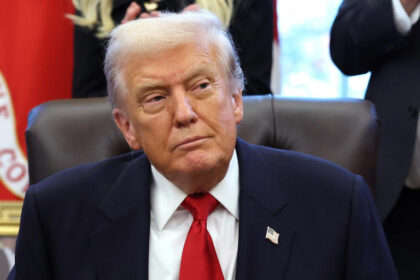
President Donald Trump on Tuesday unveiled what he called a “massive” trade deal with Japan — but a closer look at the briefing materials on his desk suggests last-minute edits and inconsistencies in the deal’s details.
In a photo shared on X by White House Deputy Chief of Staff Dan Scavino, a notecard in front of Trump during a meeting with a Japanese delegation shows hand-altered figures, including a crossed-out “$400B” investment amount replaced by “500,” and multiple tariff rates scribbled in marker. However, the numbers on the card don’t fully align with the president’s own public statements.
Trump announced the agreement on Truth Social, claiming Japan had agreed to a 15% reciprocal tariff and $550 billion in U.S. investments — a figure $50 billion higher than the corrected number on the card. The president did not clarify the apparent discrepancy.
“Japan will pay Reciprocal Tariffs to the United States of 15%,” Trump posted. “Japan will invest, at my direction, $550 Billion Dollars into the United States, which will receive 90% of the Profits. This Deal will create Hundreds of Thousands of Jobs — There has never been anything like it.”
The notecard, meanwhile, also referenced a 10% tariff and applied the 15% rate specifically to sectors like autos, semiconductors, and pharmaceuticals — details absent from Trump’s post.
It remains unclear who edited the figures or why. The White House declined to comment on the inconsistencies or provide clarification on the final deal terms.
Commerce Secretary Howard Lutnick told Bloomberg he had prepared the board shown in the photo, but emphasized that Trump was the one handling the negotiations. “I created the big board and put it there,” Lutnick said. “But the negotiator in chief is Donald Trump.”
Treasury Secretary Scott Bessent added that Japan received the 15% tariff rate on auto imports in exchange for guarantees of equity credit and investment in U.S. infrastructure — a deal structure not offered to all trading partners.
“That is a different kind of deal,” Bessent said. “They got the 15% rate because they were willing to provide this innovative financing mechanism.”
Still, markets and foreign policy experts were left puzzled by the mixed messaging. Andy Laperriere, head of U.S. policy research at Piper Sandler, said Japanese officials appear to be describing the investment component differently — viewing the $550 billion figure as a cap that includes government loan guarantees, not all direct spending.
“Especially given that the Japanese believe they are being bullied into this commitment, they will almost certainly slow walk whatever investments they don’t think are in their own economic self-interest,” Laperriere wrote in a client note.