
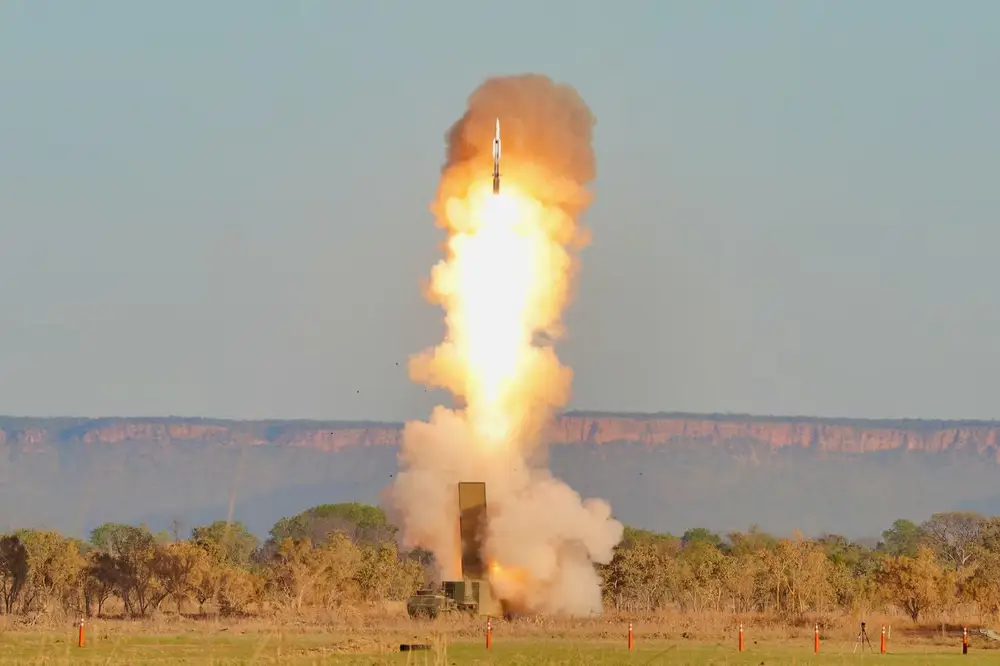

The U.S. Army successfully fired its new Mid-Range Capability (MRC), also known as the Typhon missile system, in the Western Pacific for the first time, striking and sinking a maritime target during a joint military exercise in northern Australia.
The test, conducted earlier this month during the Talisman Sabre exercise, marked the first-ever launch of the land-based MRC system west of the international date line, a symbolic milestone in the Army’s push to strengthen long-range strike capabilities in the Indo-Pacific region.
According to the Army, the 3rd Multi-Domain Task Force used the MRC launcher to fire a Standard Missile-6 (SM-6), successfully destroying a designated sea target. The MRC system is capable of firing both the SM-6 and the Tomahawk Land Attack Missile, offering flexible, precision strike options against both land and naval threats.
Col. Wade Germann, commander of the 3rd MDTF, called the successful launch “a significant step forward” in the Army’s ability to integrate and operate advanced maritime strike systems from land.
While this was the first live-fire test in the region, the MRC has been deployed to the Indo-Pacific before, including a controversial 2024 deployment to the Philippines that drew immediate backlash from China.
The system’s development followed the U.S. withdrawal from the 1987 Intermediate-Range Nuclear Forces Treaty in 2019—a move made under the Trump administration amid concerns over Russian violations. The exit from the treaty cleared the way for the U.S. to develop and deploy once-banned ground-launched missiles with ranges of 500 to 5,000 kilometers.
China has been sharply critical of the MRC’s presence near its borders. When the system was deployed to the Philippines last year, Chinese officials accused the U.S. of stoking regional instability and triggering a potential arms race. Chinese Foreign Ministry spokesperson Lin Jian described the move as “turning back the wheel of history” and claimed it posed a serious threat to regional peace.
The MRC has also been a point of tension in U.S.-Philippines relations. In August 2024, Philippine Foreign Secretary Enrique Manalo revealed that China had expressed strong concerns about the system during high-level talks, saying Beijing warned Manila not to fuel further militarization in the region. Despite the pressure, the Philippines has shown interest in the system’s combat potential.
In response to the latest test, China’s embassy in Washington reiterated its opposition, calling the MRC “strategic and offensive” and stating that “China firmly opposes the U.S.’s deployment of the land-based Mid-Range Capability missile system in the Asia-Pacific, whatever its form.”
Despite Beijing’s objections, the Army sees the MRC as a vital asset to closing what it calls a critical capability gap in the Pacific. The system is still being refined. During its initial deployment to the Philippines, U.S. soldiers made real-time modifications in the field—contributing feedback that led to several design changes, according to a Government Accountability Office report released earlier this year.
The successful test in Australia not only validated the system’s effectiveness in real-world conditions but also helped shape the Army’s evolving approach to land-based maritime strike operations.
“With mobile launchers capable of engaging targets at sea and on land, the MRC gives U.S. forces a flexible and forward-deployable tool in any future Pacific conflict,” Germann said.


