
I’ve never been obsessed with reversing aging. Getting older feels like a privilege, not a problem to fix with pricey supplements or trendy treatments like vampire facials.
But as a runner, I’ve become more curious about how my body works — and how to take better care of it. That curiosity brought me to a longevity clinic in Lisbon, nearly 3,400 miles from my home in New York City.
Recovering from a Year of Injuries
Most of 2024 was about recovery. First came a grade 2 MCL tear in my left knee — the result of dancing in shoes that weren’t up to the challenge. Once I got the green light to run again, I pushed too hard and ended up with tendonitis in my right Achilles and peroneal tendons.
I followed the recovery playbook: physical therapy, low-impact cardio, strength training. Still, my progress stalled. Without my usual workouts, I felt my whole body stiffen. My lower back — a chronic trouble spot — flared up again.
I wanted answers, not just treatment. While in Portugal, a doctor friend suggested MetaClinic in Lisbon. The center promises a holistic, integrated approach — covering everything from hormonal testing to metabolic health — and that intrigued me. My care in New York had been excellent, but each issue was treated in isolation. I was ready for a more connected perspective.
Longevity Testing for a Fraction of the US Price
As a freelance journalist with basic health insurance, I was surprised how affordable the care was in Portugal — and how much value I got from it.
I started with two common longevity tests: a DEXA scan and an indirect calorimetry assessment. The DEXA uses a low-dose X-ray to assess bone density, muscle distribution, and body fat. The calorimetry test measures your resting metabolic rate — or how many calories your body burns just by existing.
Together, they cost €190 (about $224). In the US, the same tests could run as high as $1,200 without insurance.
The DEXA results reassured me: I had minimal visceral fat, which is linked to lower inflammation and reduced disease risk. However, my total body fat was at the higher end of the normal range — 35.8%. That wasn’t surprising, since I’d stopped strength training during my injury recovery.
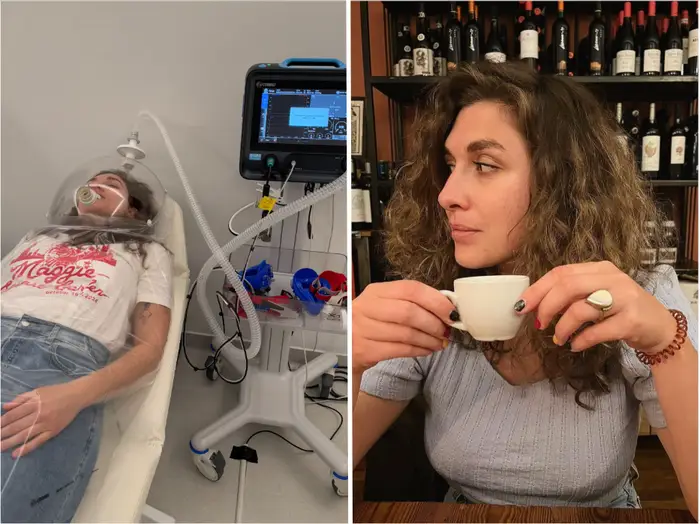
The calorimetry test was a bit more intense. Wrapped in plastic and wearing a dome-like helmet, I breathed into a machine that measured my oxygen intake and carbon dioxide output. My resting energy expenditure came in at about 1,400 kcal/day — right around average.
These tests aren’t definitive, but they offer a solid snapshot. Muscle distribution and resting metabolism can hint at future risks, from cardiovascular disease to mobility decline. It was the kind of data I’d never gotten before — and it helped me better understand where I stood after a rough year.
A Last-Minute Visit That Changed Everything
At the last minute, I added a session with MetaClinic’s osteopath. In New York, an appointment like this would’ve cost $135–$400. In Lisbon, I paid just €60 ($70).
Within minutes, she noticed an imbalance in my calves — my right calf was noticeably larger. I’d been overworking it during recovery, and she advised mirroring my physical therapy exercises on both legs, not just the injured one.
Then she investigated my lower back pain. Rather than focusing on my glutes, like most US physical therapists had, she traced the issue to tight hamstrings — a result of compensating for my injured heel. I’d never considered that connection.
Back in New York, I started strength training with a personal trainer friend, focusing on balancing both sides of my body. Four months later, my back and heel pain have significantly improved.
A Valuable Experience Abroad
In total, I spent just $224 for three assessments and another $70 for the osteopath — less than a single specialty appointment in the US. While these tests aren’t magic bullets, they gave me new insights and a clearer strategy for moving forward.
With the New York Marathon on the horizon this November, I’m now training smarter — not just harder — and finally feeling strong again.