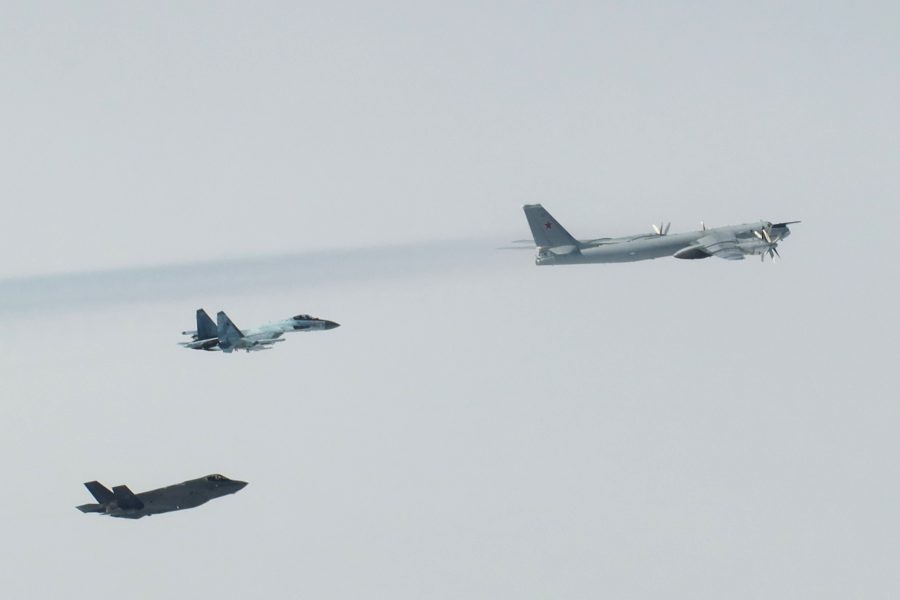

Russian military aircraft flew near Alaska on July 22, prompting a lengthy three-hour response from U.S. Air Force fighter jets assigned to North American Aerospace Defense Command (NORAD), officials told Air & Space Forces Magazine.
According to NORAD, two Russian Tu-95 “Bear” bombers and two Su-35 “Flanker” fighter jets entered the Alaskan Air Defense Identification Zone (ADIZ), an area of international airspace monitored for national security. In response, NORAD scrambled around 10 aircraft—including F-35 and F-16 fighters, an E-3 Sentry command and control plane, and three KC-135 refueling tankers—to intercept, identify, and escort the Russian planes out of the zone.
A NORAD spokesperson said the Russian aircraft remained in the ADIZ for approximately 3 hours and 15 minutes. The Russian Ministry of Defense later claimed the bombers were conducting a 15-hour mission over the Bering Sea.
Though the aircraft did not enter U.S. or Canadian sovereign airspace, NORAD emphasized that such operations are closely tracked. “This Russian activity in the Alaskan ADIZ occurs regularly and is not considered a threat,” the command stated in a release, while also noting that aircraft in the ADIZ must be readily identified for national security purposes.
The Alaskan ADIZ serves as a critical early-warning buffer around U.S. airspace, stretching outward into international territory. NORAD maintains a multi-layered defense system of satellites, ground-based and airborne radars, and fighter aircraft to monitor and respond to any incursions.
Although the July 22 incident concluded without incident, it echoed past confrontations. In September 2024, a Russian Su-35 dangerously cut across the nose of a U.S. F-16 during a similar intercept, a move NORAD Commander Gen. Gregory M. Guillot later described as “unsafe and unprofessional.”
The Russian aircraft involved this week were the same models used in that earlier episode, but NORAD reported no aggressive or unusual behavior this time. These long-range patrols, reminiscent of Cold War-era maneuvers, resumed in 2007 and have occurred periodically since.
The timing of the flight is notable. It comes just two months after Ukrainian intelligence forces launched a drone assault on Russian airfields, damaging or destroying at least six Tu-95 bombers. Those same bombers have played a key role in Russia’s war against Ukraine, launching air-launched cruise missiles in coordinated strikes with drone swarms.
The U.S. continues to fly missions in other countries’ ADIZ zones—such as around contested islands in the South China Sea—asserting the right to operate in international airspace, despite protests from rival nations like China.
Meanwhile, tensions remain high between Washington and Moscow. Former President Donald Trump recently criticized Russian President Vladimir Putin for what he called “a lack of progress” in peace talks with Ukraine. The U.S. has also finalized a NATO deal to replenish high-value military aid—including Patriot missile systems—sent to support Kyiv.