
For many people, realizing a new side of their identity can come with an agonizing tradeoff: explore it, or protect the relationship they’re already in.
In 2020, Alana Underwood had been dating Kevin Jankay for a little over three years when she began seriously thinking about her sexuality in a way she hadn’t before. For most of her life, she said she had “operated as straight,” dating only men — even though a quiet question lingered in the background about whether she might also be romantically drawn to women.
Underwood didn’t want to explore that question alone. She wanted to do it with Jankay.
When she finally told him what she’d been feeling, she said he was open to the conversation. Together, they agreed to what Underwood believed would be an “experimental, one-off, sexual experience” with another woman. Neither of them expected that it would evolve into something far more lasting.
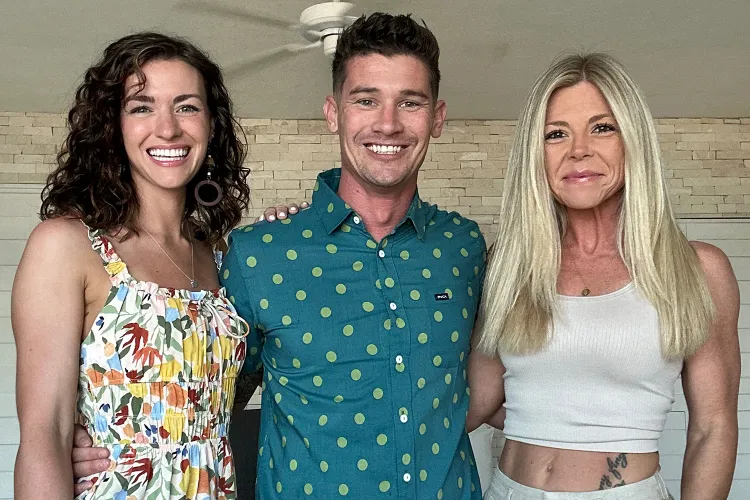
Six years later, Underwood and Jankay are still together — but their relationship now includes a third partner, Megan Smith. In some ways, they say their dynamic looks familiar: they live together, they bicker sometimes, they share a dog. In other ways, it’s nothing like the monogamous model most people assume.
The trio — known online as “Camp Throuple,” where they share their lives with nearly 300,000 TikTok followers — has been unusually open about how their relationship formed, what day-to-day life looks like, and the questions they hear repeatedly (including the one they can’t seem to escape: yes, they share a bed).
:max_bytes(150000):strip_icc():focal(748x216:750x218):format(webp)/Megan-Smith-Kevin-Jankay-Alana-Underwood-2-011326-b2f8bf2412af4b74886f58757c40670d.jpg)
How it started
Underwood and Jankay first connected with Smith through a dating app. At the time, Smith was married. The four of them chatted virtually for about a month before deciding to meet in person — a moment they recall as exciting, and nerve-wracking.
Underwood said she was bracing for multiple firsts at once: her first experience in a throuple, and her first romantic experience with a woman.
“I was freaking out internally, trying to hold it together,” she said, adding that Smith’s confidence helped calm her nerves.
At first, Jankay said, the relationship between the three was “purely sexual.” But the meetups continued, and on the two-hour drives home from Smith’s house, Underwood and Jankay started admitting what was changing: the feelings were deepening, and the connection was becoming romantic.
About four months in, Smith and her wife separated — a split Smith said was “unrelated” to Underwood and Jankay. The trio paused briefly, then reconnected months later. By January 2021, they said, they had formally become a committed throuple.
:max_bytes(150000):strip_icc():focal(776x306:778x308):format(webp)/Megan-Smith-Kevin-Jankay-Alana-Underwood-3-011326-835deda67cfc40568980ff1b4e7988d5.jpg)
Moving in and learning the hard parts fast
When the three moved in together, they said the transition came with immediate, practical challenges: a 600-square-foot apartment, one bathroom, and one bedroom — with a queen bed pushed together with an air mattress.
“One bathroom is always fun for three people,” Smith joked.
They also decided early on to rotate who slept in the middle each night.
“The middle spot — it has its pros and cons,” Underwood said. “It’s nice because you get to snuggle with both partners, but it gets really, really hot. So we rotate to keep it equal.”
Because Underwood and Jankay had already built a life together before Smith joined them, they said they were mindful of the emotional imbalance that can come when someone enters a relationship later.
“We were very aware of how she could feel, and we tried to put ourselves in her shoes,” Underwood said. “I think there could be the opportunity to feel jealous or left out, but we’ve just been very aware about that.”
Over time, they said, another lesson became crucial: treating “perfect equality” as the goal was unrealistic. Instead, they had to accept that each relationship within the trio would naturally have its own texture.
“The way you love each individual person is different,” Smith explained. “That doesn’t mean it’s more or less — it’s just a different type of relationship. Like, mine and Alana’s relationship is very different from mine and Kevin’s. But that doesn’t mean it’s more or less. It’s just a different experience and a different type of love.”
What surprised them about commitment
As their relationship became more established, they said they began noticing ways the structure could also strengthen them. Jankay compared the dynamic to a stable geometric form — saying a three-person partnership can offer more support when handled with care.
“You get double the support and double the affection,” he said. “You can bounce something off one person and get feedback from another. If you’re in a quarrel or an argument with one person, the other person can show a perspective that you might not see because you’re in the heat of the moment.”
Eventually, the trio moved to Colorado, where they now have a larger home — and, notably, three bathrooms. Jankay said that despite how unusual it may seem from the outside, it feels ordinary to him now, largely because they’re simply living life together day after day.
:max_bytes(150000):strip_icc():focal(804x407:806x409):format(webp)/Megan-Smith-Kevin-Jankay-Alana-Underwood-4-011326-2a3e2aa0148245be9b3c2a95b21c37e4.jpg)
Telling family: acceptance, shock, and distance
One of the biggest hurdles, they said, was telling their parents.
Smith’s mother, Underwood said, was supportive from the start. But Underwood and Jankay described more complicated reactions.
Underwood recalled sitting down with her parents and laying it out plainly: she was bisexual, and she had a girlfriend — who was also her boyfriend’s girlfriend.
Their shock was immediate, she said, but it didn’t last.
“They were just like, ‘OK, so have you guys gone camping together?’” Underwood said. “They just tried to figure out the best way to continue this conversation, and so it was a much better result than I could have anticipated.”
For Jankay, the outcome was harder. After he told his parents, he said his mother called him on his way home and told him she “wasn’t OK” with his relationship. They didn’t speak for two years.
“We’ve taken baby steps, and she’s started to have conversations with me, but it’s never about my life or asking how the girls are or anything like that,” he said.
Still, he added that he’s trying to leave the door open. “But we believe that everybody’s on their journey and love can overcome everything,” he said. “There’s no animosity or anger. She’s had her own journey, so I respect it, and when she wants to — and hopefully she does — I’m here.”
:max_bytes(150000):strip_icc():focal(739x233:741x235):format(webp)/Megan-Smith-Kevin-Jankay-Alana-Underwood-011326-d4f5b4a9bfb449aaab3b5aa5bd61c151.jpg)
Why they put it online
All three emphasized that polyamory was completely new to them just a few years ago — which is part of why they decided to share their lives publicly on TikTok. They named their account “CampThrouple,” and the response was immediate.
“We just posted one video, and we woke up the next morning with 300,000 views,” Smith said. “We were like, ‘Oh, s—.’”
Their content, they said, ranges from comedic videos to practical explanations and everyday moments — often answering the same questions from followers about how their relationship functions.
Underwood said some of the most meaningful messages come from people who tell them their videos helped them understand what polyamory can look like in real life — especially parents imagining how they’d respond if their own child opened up about a similar relationship.
At the same time, Smith said they aren’t trying to sell polyamory as the “right” choice for everyone. In fact, she said that if their relationship ever ended — a thought she called sad even to consider — she isn’t sure she would choose polyamory again.
“We just happen to find a match with each other and it flows and it works correctly,” she said. “I don’t think that it’s necessarily the perfect way of living or the best way to go in a relationship. I think people should do whatever makes them happy and what they’re comfortable with, but we just want to shine a light on the positive aspects of it.”