
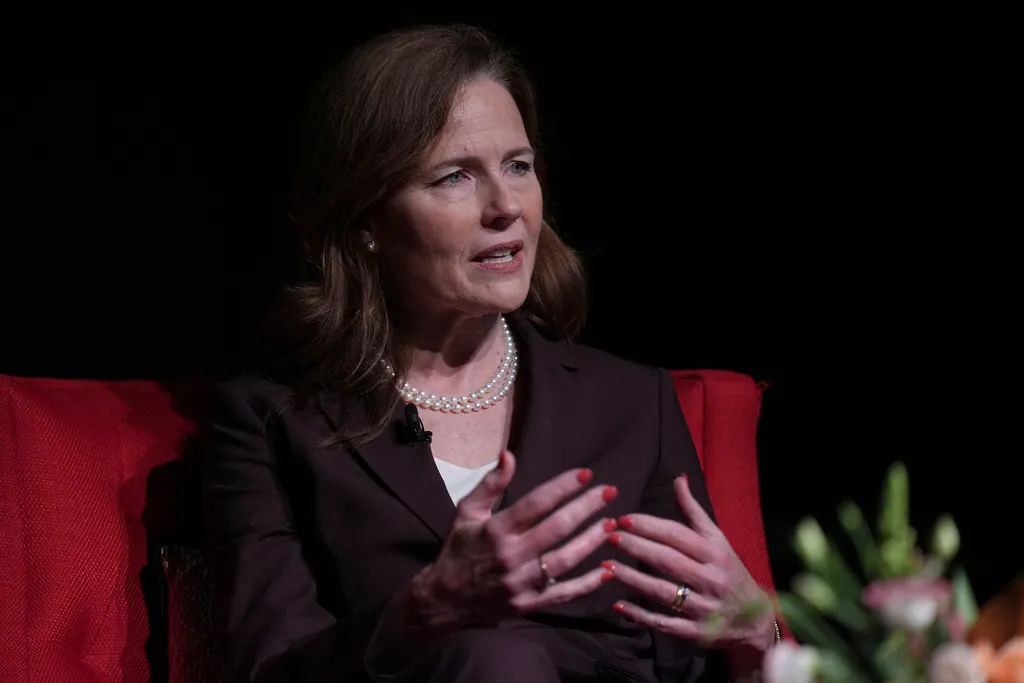

Supreme Court Justice Amy Coney Barrett pressed a lawyer for the Democratic National Committee on Tuesday about why Democrats are opposing a push to remove federal limits on how much political parties can spend in coordination with candidates—suggesting the change could help Republicans.
“Normally, regulated parties are happy to get rid of regulation and, obviously, this ties the DNC’s hands just as much as it ties the RNC’s hands,” Barrett said during oral arguments in NRSC v. FEC. “So, I guess my questions are two. One is if the parties have long been aligned on this, why change the position? And two, if there isn’t an imbalance in who this benefits, why would the DNC be here? Why would your client be here if it didn’t perceive this to be something that would benefit the RNC more than the DNC?”
Marc Elias, arguing on behalf of the DNC, the Democratic Senatorial Campaign Committee and the Democratic Congressional Campaign Committee, rejected the idea that both parties have historically been on the same side of the issue.
“Our office holders and our members in voting in Congress and in their public statements and in the platform of the Democratic Party have not been aligned with striking down this limit,” Elias said.
Why It Matters
The Supreme Court heard oral arguments Tuesday in NRSC v. FEC, a case that could upend a long-standing framework governing “coordinated spending”—money political parties spend in cooperation with candidates running for Congress or the presidency. These limits are designed to prevent wealthy donors from effectively bypassing contribution caps by routing large sums through party committees that then spend directly to support a candidate.
What To Know
Elias argued that eliminating coordinated spending limits would reshape party fundraising and spending priorities in ways that could undermine broader party-building efforts—especially those aimed at the long term.
He said the DNC could be forced to redirect resources away from activities such as building party infrastructure and voter registration, because unlimited coordinated spending would fuel an escalating financial fight focused on directly covering candidates’ campaign costs.
“They will not be able to support activity that is long-term in nature because there will be an arms race that right now doesn’t exist,” Elias said. “The coordinated party spending limits act as a buffer on how much money you can pump into directly paying the bills of a House or Senate campaign or a presidential campaign, so that you have funds to do these other party-building functions.”
Noel Francisco, representing the National Republican Senatorial Committee, urged the justices to strike the limits, arguing they clash with the Court’s more recent campaign finance decisions. The Federal Election Commission—after shifting its position following President Donald Trump’s return to office—also argued that the limits should be invalidated.
Republicans are pushing to end the restrictions, which would allow national party committees to spend more aggressively on efforts like television advertising and on-the-ground organizing tailored to individual candidates.
What People Are Saying
Supreme Court Justice Brett Kavanaugh, during oral arguments on Tuesday: “I am concerned, as you said, that the combination of campaign finance laws and this court’s decisions over the years have together reduced the power of political parties as compared to outside groups with negative effects on our constitutional democracy. So I start from that, and I’m trying to figure out how this case fits into that with respect to political parties and the strength of political parties.”
Noel Francisco, an attorney representing the National Republican Senatorial Committee, during oral arguments on Tuesday: “Lots of candidates are running unopposed or they have very little chance of winning or they’re just generally in safe seats. Parties don’t want to spend money on behalf of those candidates. So if I’m trying to submit a bribe to bribe that candidate, it’s not likely going to get through to the candidate at the end of the day. And if it does, it’s going to be pretty blazingly obvious.”
What Happens Next
The Supreme Court has not yet issued a ruling in the case.


