
Kelly Rachal always dreamed of becoming a mother. At 26, she went to a fertility specialist expecting to hear good news — instead, she learned her ovaries were covered in large masses. The diagnosis: ovarian cancer.
Now 30, Kelly is a nurse and a new mom, thanks to a surrogate. Through social media and her work with Our Way Forward, she’s using her story to help other women understand the warning signs of ovarian cancer.
“Ovarian cancer isn’t just something that happens to older women,” she says. “I’ve met someone who was 15 when she was diagnosed — even a little girl who was only 6.”
The Dream to Be a Mom
All her life, Kelly wanted a baby. After she and her husband, Eric — a helicopter mechanic in the Army — got married, they spent some time together before he deployed for a year. When he came home, they decided it was finally time to start a family.
At 26, Kelly told her doctor she wanted to get pregnant. “She said I was young and healthy — nothing to worry about,” Kelly recalls.
But after a year of trying with no success, Kelly noticed her cycles were irregular. She had been on birth control for years, so she’d never realized. In May 2021, she made an appointment at a fertility clinic in Charleston, South Carolina. She had also just been accepted to nursing school and felt hopeful about her future.
:max_bytes(150000):strip_icc():focal(512x507:514x509):format(webp)/kelly-rachal-2-092925-ebb974b550a54c219ef30aad7f33ec7e.jpg)
The fertility doctor was optimistic, telling her that everything should look great for someone her age. But during the ultrasound, everything changed.
“She said, ‘Wow, there’s a huge mass on this ovary. I can’t even see it.’ Then she checked the other one — same thing. She said they were completely encased.”
Kelly knew immediately that “mass” meant cancer. The MRI was scheduled two weeks later — an agonizing wait.
Eric tried to stay positive, but Kelly began recording private videos to process her fears.
A Shocking Diagnosis
The MRI confirmed tumors on her ovaries. The oncologist scheduled a biopsy, but because the ovaries were deep in her pelvis, it was difficult to access the tissue. After a CT-guided attempt failed, she underwent laparoscopic surgery in July 2021.
The results revealed stage 3 borderline ovarian cancer — a rare diagnosis sometimes considered pre-cancerous. “My doctor said chemo wouldn’t help, only surgery,” Kelly says. “He told me there was a small chance — about 3% — it could turn into real cancer.”
:max_bytes(150000):strip_icc():focal(722x258:724x260):format(webp)/eric-kelly-rachal-092925-785c4b3c8ce843a5a2790b88521ba6f7.jpg)
In August 2021, she had surgery to remove her right ovary, appendix, and the lining of her abdominal wall, along with as many tumors as possible. “I felt like I was losing parts of myself,” she says. “I wasn’t whole anymore.”
Because of the surgery, Kelly had to drop out of nursing school. But she focused on what mattered most — trying to become a mother.
Her oncologist eventually cleared her to do egg retrievals. “We made five embryos the first time and one more the next month,” she says. “I wanted to be ready in case I lost my other ovary.”
But when she returned to discuss pregnancy, her doctor told her it wasn’t safe. “He said he’d never feel comfortable with me getting pregnant while I still had that ovary,” Kelly recalls. Heartbroken, she decided to have it removed in May 2022.
She wasn’t prepared for what came next. “Within days, I went into menopause. I was 27 and having hot flashes,” she says.
Then came devastating news: the pathology showed stage 3 low-grade ovarian cancer — not borderline this time, but real cancer. “So much had changed in one year,” Kelly says quietly.
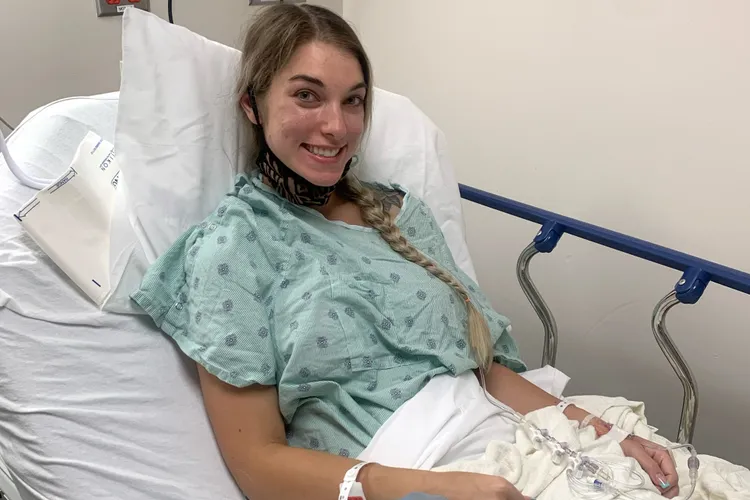
Her doctor moved quickly. The treatment plan: six rounds of chemotherapy.
:max_bytes(150000):strip_icc():focal(748x275:750x277):format(webp)/kelly-rachal-hospital-092925-7ad68ab9af384419aeed1818008926a6.jpg)
Fighting Through Chemo
Kelly began chemo at 27. Her first question was whether she’d lose her long hair. “It felt like another piece of my identity,” she says. “After losing both ovaries, I wondered if I was even a woman anymore.”
To cope, she started sharing her journey on TikTok. “There’s not enough awareness about ovarian cancer,” she says. “We’re taught about breast cancer and cervical cancer, but no one talks about this.”
She also realized she had ignored early warning signs — bloating, irregular periods, and occasional sharp pain on her right side. “So many people messaged me saying they had the same symptoms,” she says. “It made me realize how many women don’t know.”
Holding On to Hope
Kelly finished chemo in October 2022 and started nursing school again a few months later. “From the first MRI I ever had, I’ve never had a clean one,” she admits. “The tumors always come back — small, slow-growing ones on my abdominal wall.”
Despite more surgeries, she keeps pushing forward. “My doctor said I’d need five years of clean scans before getting pregnant,” Kelly says. “But I’ve never had even one.”
Still, she and Eric refused to give up. They explored adoption, praying for guidance. Then a friend offered to be their surrogate.
:max_bytes(150000):strip_icc():focal(781x247:783x249):format(webp)/eric-kelly-rachal-dog-092925-4a4b9773f2df4475ba720ff13ee3dd4f.jpg)
A Miracle Named Roman
Kelly graduated from nursing school in December 2024. In June 2025, their son, Roman Travis Rachal, was born.
“He’s a miracle,” Kelly says. “We can’t believe we’re finally parents.”
Kelly writes letters to Roman in a journal, just in case her cancer ever returns. “I’m so grateful for every moment,” she says. “I’m focused on being the best mom and wife I can be.”
Deep down, she always sensed something was wrong — even when doctors told her she was too young to worry. “I’ve learned that young doesn’t mean healthy,” she says.
When she asked her doctor how much time she had left, he told her confidently:
“You’re going to live a long, healthy life. You’re going to be okay.”
And she believes him.
What to Know About Ovarian Cancer
Ovarian cancer can be hard to detect early because the symptoms are subtle. Dr. Angeles Alvarez Secord, Director of GYN Oncology Clinical Trials at Duke Cancer Institute, explains:
“It’s often thought of as silent, but there are symptoms — they’re just easy to overlook.”
Common signs include:
- Abdominal bloating
- Feeling full quickly or loss of appetite
- Pelvic pain or discomfort
- Frequent urination or changes in bowel habits
- Changes in menstrual bleeding (for premenopausal women)
If these symptoms persist for two or three weeks, talk to your doctor.
“There’s no effective screening tool for ovarian cancer,” says Dr. Secord. “Even if your recent exam was normal, don’t ignore ongoing symptoms. Trust your instincts and go back.”