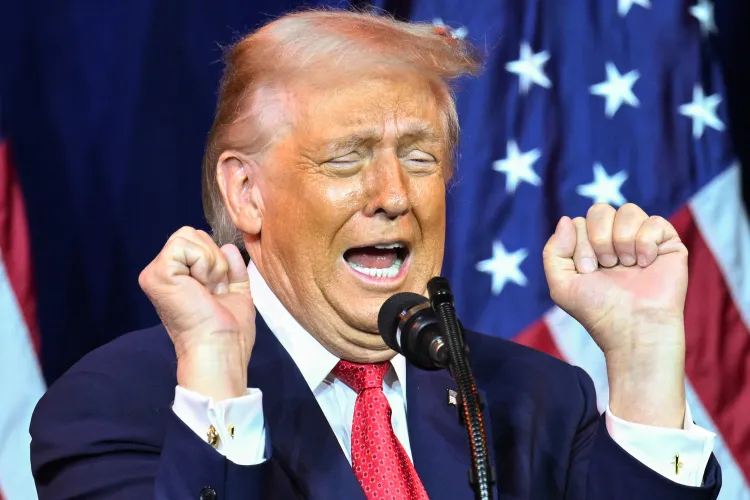

When President Donald Trump addressed House Republicans at the Kennedy Center on Tuesday, Jan. 6, he delivered a long, freewheeling speech that included an extended, irreverent imitation of a transgender weightlifter — complete with grunts and moans to underline his point.
The remarks were translated live for international viewers by Siavash Ardalan, a journalist with BBC Persian TV. Ardalan later shared a clip of the moment on X, writing, “Never had to do a live translation of a political speech where the speaker makes nonverbal noises… until today.”
Because the speech leaned heavily on sound effects and physical impressions, Ardalan found himself doing something he rarely has to do on air: reproducing the nonverbal elements as he translated Trump’s words.
Trump’s impersonation came as he criticized the inclusion of transgender athletes in women’s sports and attacked Democrats over broader transgender-related issues, including medical care for minors.
Ardalan said he frequently translates English-language speeches that may be relevant for BBC Persian’s audience, and chose to translate Trump’s Tuesday remarks amid widespread anti-government protests in Iran and the recent capture of Venezuelan President Nicolás Maduro by U.S. forces on Saturday, Jan. 3.
“We were hoping that Trump might make some references to these issues, which is of interest or audience so we just went ahead with a live translation, but those references never came,” Ardalan said. “Instead it was mostly domestic issues and of course nonverbal noises.”
:max_bytes(150000):strip_icc():focal(749x0:751x2):format(webp)/Donald-trump-1--010726-fc257b9ade5e41b7a96582ea847e63b4.jpg)
He described translating the nonverbal portions of a presidential speech as a first — and, unexpectedly, an enjoyable change of pace.
“It was a first for me, and frankly quite fun since I’m always translating political speeches and interviews that are very serious in nature,” Ardalan said. “I do feel very strongly that a live translator has a responsibility, not just to convey what a person is saying but also to reflect that person’s depth of vocabulary, sentiments and intonations.”
Ardalan added that he has been translating speeches from U.S. presidents since George W. Bush was in office.
During Tuesday’s address, Trump also acknowledged that first lady Melania Trump isn’t a fan of his impersonations or the dancing he sometimes works into speeches.
“My wife hates when I do this,” he said, adding that she has called it “so unpresidential.” Trump replied, “But I did become president,” before continuing, “She hates when I dance.”
He then told the crowd that Melania had asked him, “Could you imagine FDR dancing?” Trump responded by describing Franklin D. Roosevelt as “quite elegant,” before concluding that “he wouldn’t be doing this,” as he raised both hands in the air.
“But she says, ‘Darling, please. The weight lifting is terrible,’” Trump continued. “Now I have to say this — the dancing, they really like. She said, ‘They don’t like it, they’re just being nice to you.’ I said, ‘That’s not right. The place goes crazy. They’re screaming, ‘Dance, please!’’”