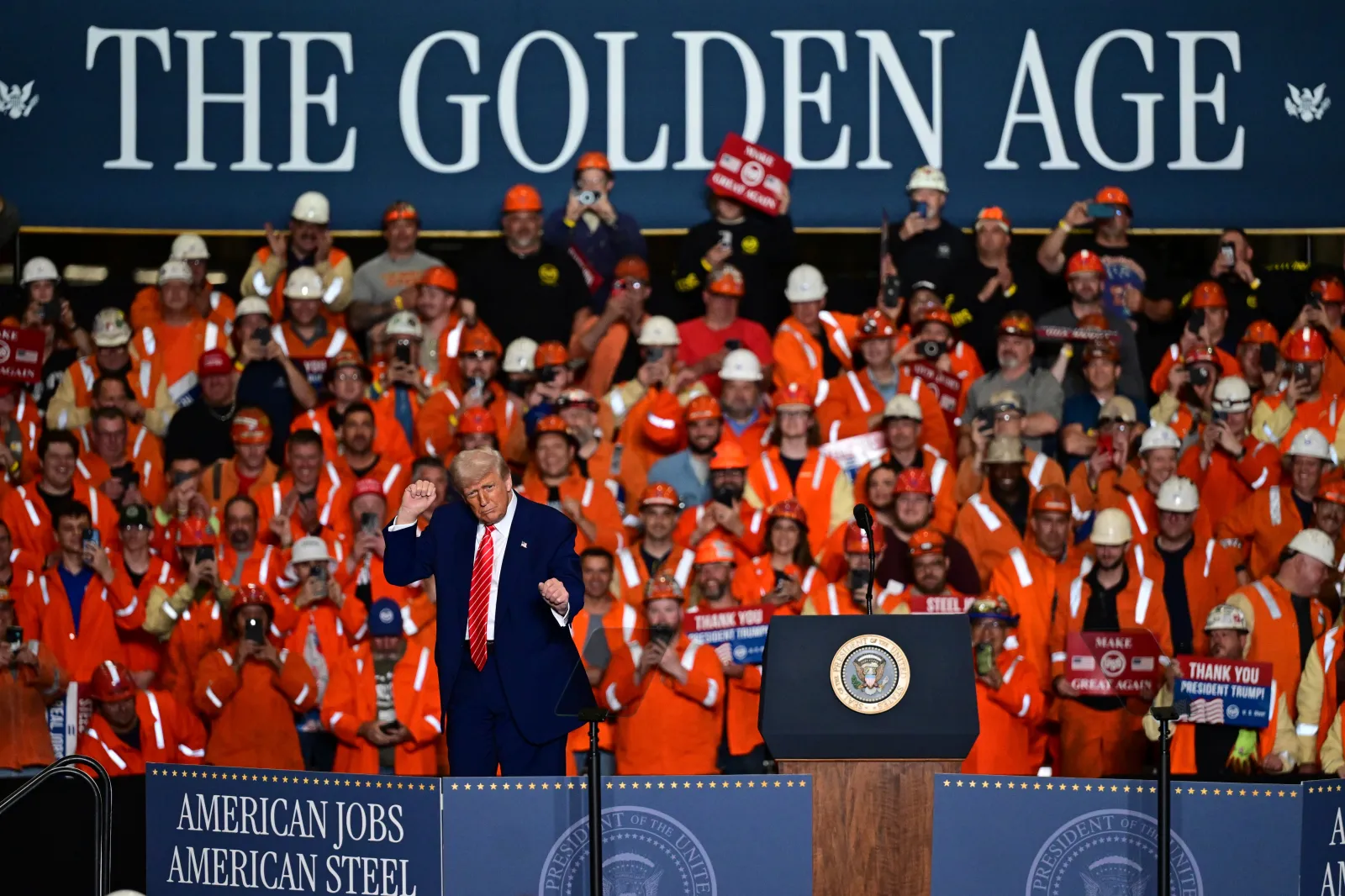

Coverage of the 2025 labor market has largely focused on white-collar workers, with artificial intelligence framed as the looming, long-term threat to the American workforce.
Given AI’s capacity to generate vast amounts of code and handle repetitive cognitive tasks at a scale humans can’t match, those worries are understandable. Recent mass layoffs at Amazon and other major companies have already cited AI as a factor.
Yet while attention is fixed on the futures of Silicon Valley engineers and Wall Street analysts, a quieter crisis is unfolding for America’s blue-collar workforce. This comes despite the current administration’s promises—and efforts—to spark a revival in sectors like construction and manufacturing.
“Reviving the blue-collar boom that Americans experienced during the first Trump term has been a day one priority for the administration,” the White House told Newsweek, pointing to gains in real wages and manufacturing output in 2025.
Recent Labor Department data, however, tells a more sobering story. September’s delayed jobs report showed an encouraging rise in overall hiring, but did nothing to halt the long-running decline in blue-collar employment.
Among the five industry “supersectors” typically viewed as blue collar—manufacturing, mining and logging, transportation and warehousing, utilities, and construction—only construction added jobs in September. Its gain of 19,000 positions was more than offset by the loss of 25,300 jobs in transportation and another 6,000 in manufacturing.
Looking at the past year, payroll declines have picked up speed since January, continuing a long-term pattern and pushing blue-collar job growth into negative territory for the first time since the pandemic.
Heidi Shierholz, who served as chief economist for the Department of Labor under President Barack Obama, told Newsweek there is clear deterioration in job conditions for blue-collar workers.
“Between April and September, goods-producing industries (manufacturing, construction, logging, mining), lost 72,000 jobs, with most of those losses (58,000) in manufacturing,” she said. The services side of the blue-collar workforce, she added, is “limping along” mainly because of hiring in health care.
David Dorn, a labor market expert at the University of Zurich, highlighted the weak or negative job growth across several blue-collar sectors, especially construction.
“This sector is highly sensitive to broader economic deceleration,” he told Newsweek, adding that “increasingly restrictive immigration policies under the current U.S. administration are likely constraining labor supply.”
On manufacturing, Dorn said it is “difficult to isolate” the direct impact of President Donald Trump’s tariffs on employment but expressed doubt that they have “generated any sustained gains” in jobs.
Dean Baker, co-founder of the Center for Economic and Policy Research, argued that tariffs have contributed to widespread uncertainty and “overall weakness in demand,” which in turn has made employers more cautious about hiring across blue-collar industries.
“Companies are reluctant to invest in a context where they have no idea what tariffs will be in place six months from now, much less three to five years from now,” he told Newsweek. “Also, tariffs pull money out of consumers’ pockets, reducing demand.”
Stepping back from the month-to-month figures, the current slowdown looks less like a sudden collapse and more like an acceleration of trends that were already underway before 2025. Beyond the effects of Trump-era policies—on trade, immigration, and more—forces like offshoring and automation have been steadily reshaping blue-collar work and seem likely to continue doing so.
Economist Orley Ashenfelter pointed to a revealing paradox: even as employment in manufacturing has fallen, output has risen this year. For him, that’s evidence that productivity is improving despite fewer workers on factory floors.
“This change is probably inevitable. It is just too easy to mechanize in manufacturing,” he said, noting that “those good old-school jobs are not coming back.”
Baker said manufacturing’s shrinking share of overall employment has “been the case for more than 50 years,” as demand for labor has shifted toward health care, education, and other roles in the service-driven economy.
“Trump is doing nothing to address these issues,” Baker said, while also acknowledging, “It is not clear what he could do.”