
California has dropped its lawsuit against the Trump administration following the federal government’s decision to pull roughly $4 billion in funding from the state’s high-speed rail project.
Court records show that on Dec. 23, the office of California Attorney General Rob Bonta filed a notice voluntarily dismissing the lawsuit without prejudice on behalf of the California High-Speed Rail Authority (CHSRA). The lawsuit had sought to restore the federal funding.
In a statement, an authority spokesperson said the decision reflects California’s conclusion that the federal government can no longer be counted on as a partner in the project.
“This action reflects the State’s assessment that the federal government is not a reliable, constructive, or trustworthy partner in advancing high-speed rail in California,” the spokesperson said.
The spokesperson added that the Federal Railroad Administration warned that all work performed by the authority would remain “at risk” and might not be reimbursed. According to the statement, that position—combined with what the state described as a lack of good-faith engagement—made it clear federal commitments were unlikely to be honored.
“As a result, the State has opted to move forward without the Trump administration,” the spokesperson said. “We regret that they will not share in California’s success.”
Transportation Secretary Sean Duffy announced in July that the administration would terminate federal support for the long-delayed project, labeling it a costly failure.
“This is California’s fault,” Duffy said at the time. “Governor Newsom and the complicit Democrats have enabled this waste for years. Federal dollars are not a blank check — they come with a promise to deliver results. After over a decade of failures, CHSRA’s mismanagement and incompetence has proven it cannot build its train to nowhere on time or on budget.”
President Donald Trump echoed those criticisms, repeatedly referring to the project as a “high speed train to nowhere.”
In a formal letter to the CHSRA, the Federal Railroad Administration said it was rescinding approximately $4 billion in federal commitments after determining the project could not be completed as promised. The agency cited ongoing delays, rising costs, and significant change orders, noting that substantial federal funds had already been spent despite missed milestones.
Despite the loss of federal support, the CHSRA has begun pursuing private-sector investment. On Dec. 19, the authority launched a process aimed at attracting private investors and developers by summer 2026, part of a broader effort to deliver the project “faster, smarter and more economically.”
“Interest from the private sector in investing in California’s high-speed rail project is strong and continues to grow,” said CHSRA CEO Ian Choudri.
“Today’s procurement formalizes efforts to partner with private investors and developers, with the shared goal of delivering California’s transformational program faster, smarter, and more economically,” Choudri said. “By leveraging private sector innovation and best practices against strong, stable state funding, we can maximize the value of California’s investment and accelerate delivery of high-speed infrastructure throughout the state.”
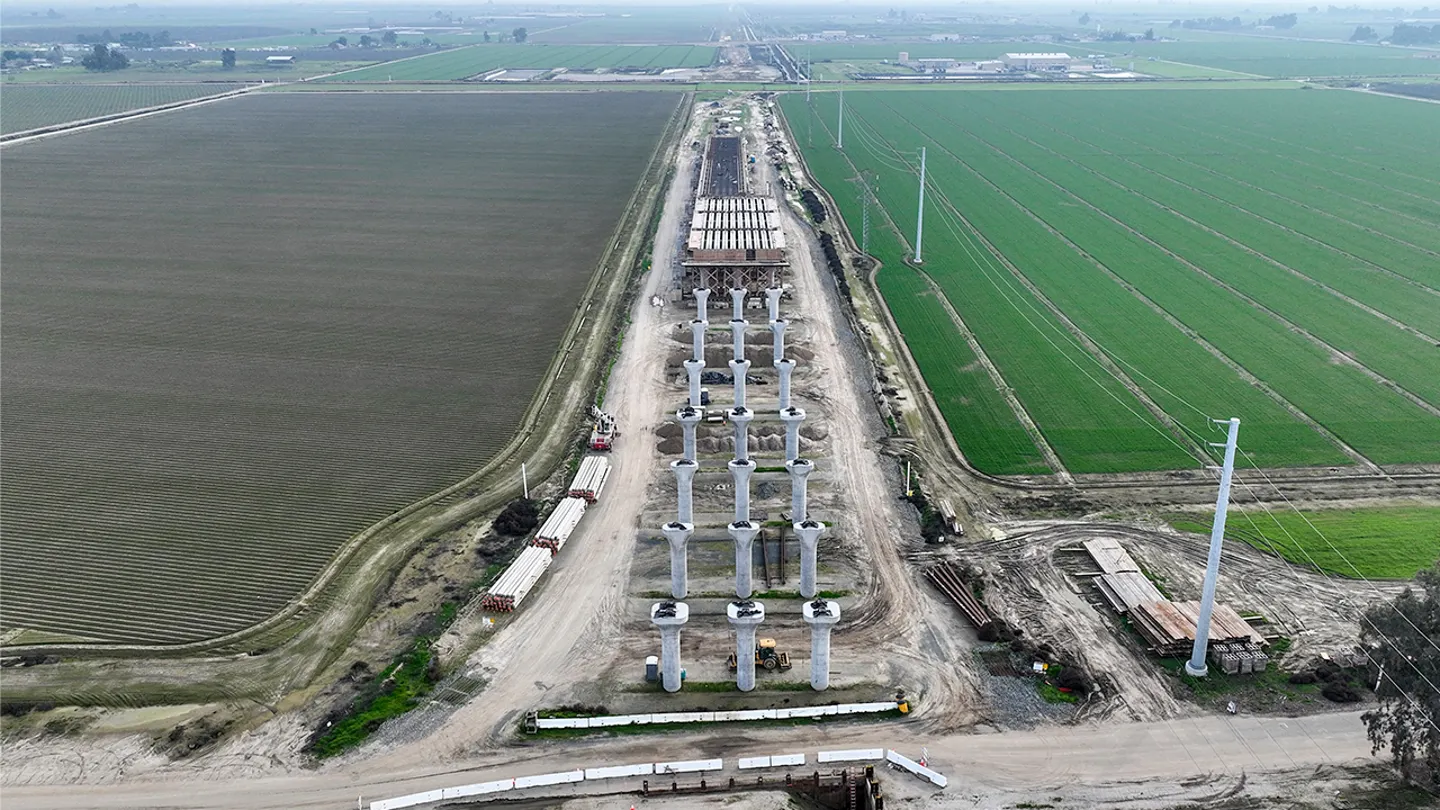
In a recent press release, the authority said 171 miles of the project are currently under design or construction between Merced and Bakersfield, with nearly 80 miles of guideway completed and dozens of major structures finished.
An authority spokesperson said the loss of federal funding will not halt construction, emphasizing that the majority of financing comes from state sources, including voter-approved Proposition 1A and the Cap-and-Invest program. Federal funds, the spokesperson said, represent about 18% of total program spending, and California intends to proceed without them.