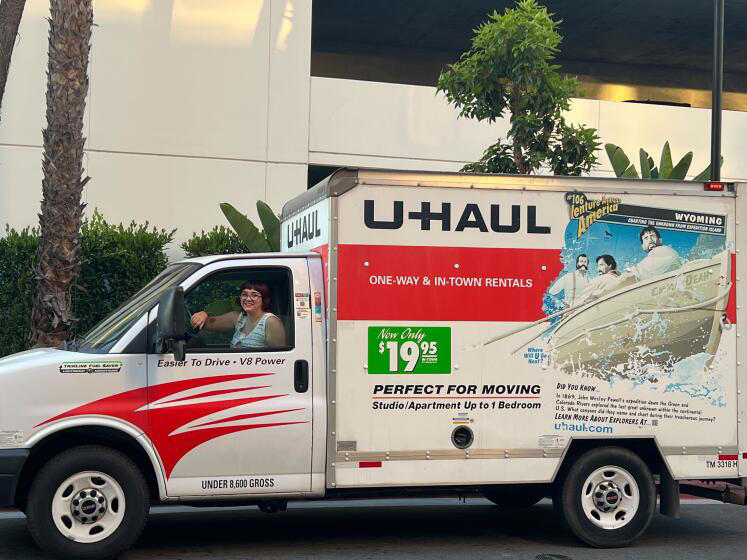

It’s not just high-profile millionaires and billionaires leaving California. A growing share of the people packing up appear to be ordinary residents — the kind who load up a rental truck and head to another state.
U-Haul, which tracks more than 2.5 million one-way trips in the U.S. each year, said California had the widest gap between customers departing the state and those arriving — the largest net outflow in the country. Even though the state continues to draw plenty of newcomers, it has now recorded the biggest net out-migration on U-Haul’s index for six consecutive years.
Most of those departures aren’t cross-country moves. The top destinations for Californians using U-Haul trucks, trailers, and moving boxes last year were Arizona, Nevada, Oregon, Washington, and Texas.
In U-Haul’s breakdown, California’s one-way traffic was nearly evenly split — but still tilted outward: 49.4% in-migration versus 50.6% out-migration. Other states near the bottom of the index included Massachusetts, New York, New Jersey, and Illinois.
U-Haul did not offer a specific explanation for why California continues to rank last. Instead, the company emphasized that most moves are driven by everyday life events.
“We continue to find that life circumstances — marriage, children, a death in the family, college, jobs and other events — dictate the need for most moves,” U-Haul International President John Taylor said in a press statement.
There was one potential bright spot: U-Haul said California lost fewer residents to out-of-state migration in 2025 than in 2024.
Even so, the broader trend remains hotly debated, especially since migration patterns became more visible after the 2020 pandemic. Demographers who track California’s population shifts often point to cost of living and housing affordability as the biggest drivers.
“Over the last dozen years or so, on a net basis, the flow out of the state because of housing [affordability] far exceeds other reasons people cite [including] jobs or family,” said Hans Johnson, a senior fellow at the Public Policy Institute of California. He described the pattern as a more than two-decade-long trend, adding that California’s sheer size makes the raw numbers especially large.
Because U-Haul operates through roughly 24,000 rental locations nationwide, its one-way rentals can offer a near-real-time snapshot of domestic movement — while official population data often arrives with delays.
California’s population, according to the California Department of Finance, rose slightly — up 0.05% in the year ending July 2025, reaching 39.5 million. After two straight years of decline following the pandemic, the state logged its third year of population growth in 2025. International migration has picked up again, but the number of residents moving out of California increased to 216,000, roughly in line with 2018 and 2019.
Another factor may be politics — though researchers caution it’s usually secondary to economic and personal reasons. Eric McGhee, also a senior fellow at the Public Policy Institute of California, said evidence suggests political identity may be shaping who leaves and who arrives: people moving out are more likely to be Republican, while those moving in are more likely to be Democratic.
“Partisanship probably is not the most significant of these considerations, but it may be just the last straw that broke the camel’s back,” McGhee said — layered on top of more traditional pressures like cost of living, jobs, and family ties.
On costs, the gaps are stark. Living in California is 12.6% above the national average, according to the U.S. Bureau of Economic Analysis, and housing is reported to be 57.8% more expensive than the national norm.
Nationally, U-Haul’s state-by-state results also hinted at a political pattern: 7 of the top 10 growth states had Republican governors, while 9 of the biggest net-outflow states had Democratic governors. U-Haul’s top three growth states were Texas, Florida, and North Carolina, and the fastest-growing metro areas included Dallas, Houston, and Austin.
Within California, there were a few exceptions. U-Haul said San Diego and San Francisco were the only California cities to land in the top 25 metro areas with a net inflow of one-way customers.