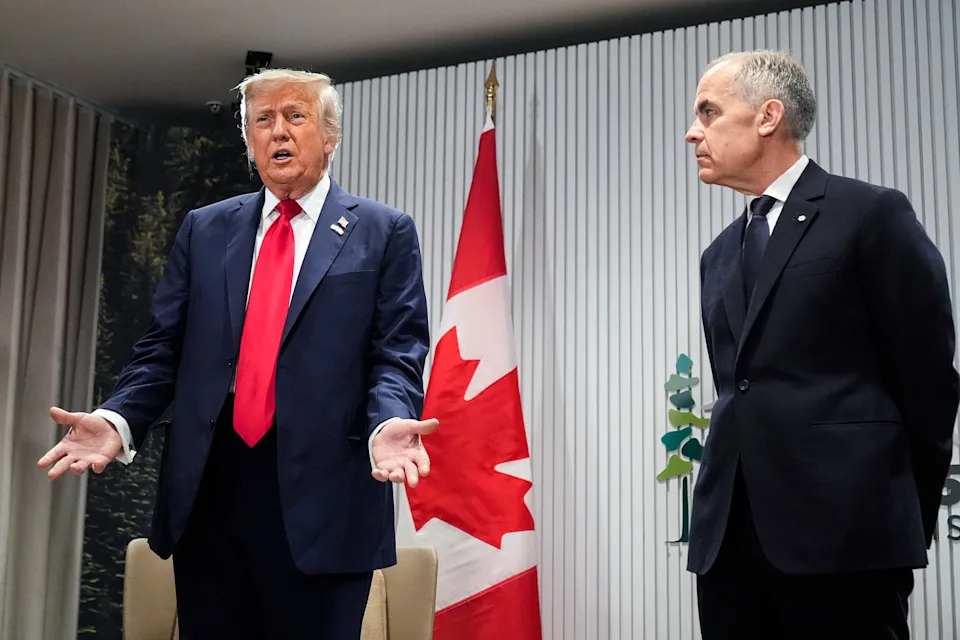

President Donald Trump announced Friday that he is ending trade negotiations with Canada, citing a new Canadian tax targeting U.S. tech companies.
In a post on Truth Social, Trump called Canada “a very difficult country to trade with” and described the tax as “a direct and blatant attack on our Country.” The levy, which takes effect Monday, applies to large tech firms — including American companies — that earn over $15 million annually from Canadian users.
“Based on this egregious Tax, we are hereby terminating ALL discussions on Trade with Canada, effective immediately,” Trump wrote. “We will let Canada know the Tariff that they will be paying to do business with the United States of America within the next seven day period.”
The Canadian digital services tax, retroactive to 2022, is expected to cost U.S. tech giants up to $3 billion, according to industry lobbyists.
Canada’s finance minister had said last week that the tax would proceed as planned, despite ongoing talks with the U.S. The Canadian government did not immediately comment on Trump’s announcement, but by late Friday, it retaliated by placing quotas on certain U.S. steel imports and imposing a 50% tariff on imports that exceed those limits.
“This is a direct response to unjust U.S. tariffs,” Canada’s finance minister said, adding that further countermeasures could be implemented if necessary.
The trade standoff marks a sharp shift after several months of relative calm in U.S.-Canada trade relations — a period that helped lift markets to new highs. Though markets briefly dipped after Trump’s announcement, the S&P 500 and Nasdaq closed at record levels Friday afternoon.
Earlier in the day, Treasury Secretary Scott Bessent had expressed optimism about negotiations, saying Trump was open to pushing back a July 9 deadline for trade deals to Labor Day and indicated that some country-specific duties were still negotiable. Trump himself echoed that sentiment just hours before abruptly canceling talks with Canada.
Canada remains America’s second-largest trading partner. Under the U.S.-Mexico-Canada Agreement (USMCA), Canadian imports face a 25% tariff if they do not meet deal requirements. Energy products are taxed at 10%, while steel and aluminum imports — where Canada is the U.S.’s biggest supplier — are subject to a 50% duty. Foreign-made vehicles and auto parts from Canada also face a 25% tariff.
The decision to suspend trade talks raises the risk of escalating tit-for-tat economic measures between the two countries — and further uncertainty for industries reliant on cross-border commerce.