After President Donald Trump set the tone for this year’s Davos summit with a burst of market-jolting, ally-rattling declarations, China is moving quickly to sell itself as the steadier option in a suddenly volatile global order—an argument that some delegates and analysts say is starting to resonate.
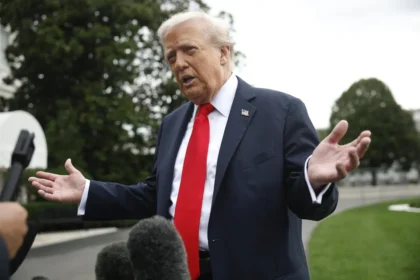
The marquee moment at the World Economic Forum so far has been Trump’s pledge—cheered by U.S. investors but met with caution across Europe—that he “won’t use force” to annex Greenland or unleash escalating tariffs on countries that oppose the long-running ambition.
But Trump’s Wednesday address landed after two high-profile speeches that framed the United States as an increasingly unreliable partner—and urged a world prepared to organize without it.
On Tuesday, French President Emmanuel Macron warned the U.S. was trying to “weaken and subordinate Europe,” later arguing this was “not a time for new imperialism or new colonialism.” Canadian Prime Minister Mark Carney, delivering one of the summit’s most quoted lines, said the “rules-based international order,” if it ever existed, was now dead—and that betting on a benevolent U.S. superpower was a bargain that “no longer works.”
With skepticism of U.S. leadership seemingly growing, Beijing is leaning into the opening—casting itself as a more responsible, dependable force while attempting to soften long-standing concerns about its economic strategy.
“China is committed to fostering common prosperity with its trading partners through its own development, and making the pie bigger for the global economy and trade,” Vice-Premier He Lifeng told the audience on Tuesday. “We never seek trade surplus; on top of being the world’s factory, we hope to be the world’s market too.”
That pitch comes with a credibility problem: China recorded a record trade surplus last year, sharpening anxiety among many of its trading partners.
He also emphasized China’s commitment to multilateralism amid what he described as unilateral intimidation—warning that the world “must not return to the law of the jungle, where the strong will eat the weak.”
“China could be a big winner here,” said Nicholas Lardy, senior fellow at the Peterson Institute for International Economics. “It is already positioning itself as a source of stability globally.”
“Even in the absence of Xi Jinping in Davos, China looks to come out of these meetings as a winner,” Wendy Cutler, Vice President of the Asia Society Policy Institute and former U.S. trade negotiator, told Newsweek.
But Cutler argued Beijing’s traction at Davos isn’t only about the appeal of multilateral language—it’s also about the United States “pivoting away from the core values and rules that has governed the world over the past 80 years.”
In the run-up to the summit, China had already moved on several fronts that signaled warmer ties with countries traditionally close to Washington.
In his speech, Carney highlighted the “strategic partnership” signed during his recent visit to China, presenting it as an example of what cooperation could look like in the “new, new world order” he believes is taking shape. And on Tuesday, the United Kingdom approved construction of a new Chinese “super embassy” in London after years of delays and security concerns.
“We are seeing the beginning of notable resets in bilateral relationships,” Cutler told Newsweek, “including agreements on bolstering trade and investment, strengthening energy cooperation, advancing business ties, and more.”
“We pursue friendly relations with all countries on the basis of mutual respect and equality, and are committed to being a constructive and stabilizing force for good,” Beijing’s U.S. embassy spokesperson Liu Pengyu told Newsweek—adding that China has “neither the intention nor the interest to compete with any country for influence.”
China’s state-owned media has already celebrated what it sees as a successful contrast with the U.S. at Davos. But analysts caution that frustration with Washington doesn’t automatically translate into trust for Beijing.
“While China may be trying to position itself as a responsible global stakeholder, much of the world is simply hedging between what they see as two self-interested powers,” said Harvard professor and international trade expert Mark Wu. “No longer able to count on the United States but still skeptical about China’s long-term motives, many of the middle powers are grappling to find a way forward among themselves without offending either big power.”
And while Macron and Carney aimed much of their criticism at “Trumpism,” Scott Kennedy, senior adviser at the Center for Strategic and International Studies (CSIS), told Newsweek their remarks also complicate China’s messaging.
He said their vision challenges “China’s brand of multilateralism, which comes with a heavy dose of power politics, an effort to create a fortress economy, and comfort with coercion.”
“So even if Beijing enjoys watching the West’s civil war of words, the reformed order that Canadian Prime Minister Carney and others are discussing would require China to substantially adjust its economic and foreign policies to fit in,” Kennedy added.
Trump’s decision to walk back some Greenland threats may have slowed the deterioration of ties with allies, but his Wednesday speech still contained pointed shots at Europe. And even with Trump touting a “framework of a future deal” on Greenland, some European policymakers say the risk of confrontation hasn’t disappeared.
“We’re not out of the woods,” Sweden’s Deputy Prime Minister Ebba Busch told CNN. Sascha Faxe, a member of the Danish parliament, called the agreement Trump says he reached with the alliance “not real” in an interview with Sky News.
No matter how the Greenland dispute evolves, experts believe Beijing will keep pushing the same message: that it is “the reliable partner in a chaotic world,” as Cutler put it.
But she also argued slogans won’t be enough. “It will need to back up any such claims by importing more, exporting less, backing off of coercive measures, and competing fairly,” she said. “Those steps will be way more difficult to implement than espousing high-level feel-good slogans.”