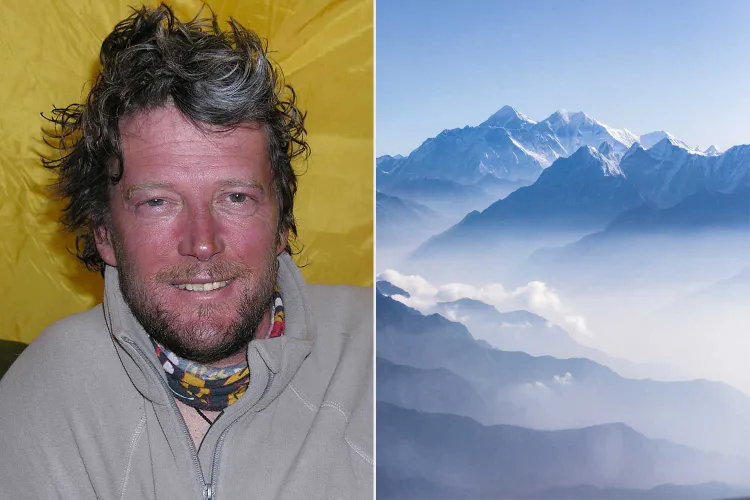

Recent social media discussions have revived interest in the extreme dangers of climbing Mt. Everest, especially the infamous “death zone,” where oxygen levels plummet and many climbers disappear without a trace.
In 2006, Australian mountaineer Lincoln Hall very nearly became one of them. After hours of failed revival attempts during his descent, his team believed he had died. They removed his essential gear and left him on a narrow ridge more than 28,000 feet above sea level.
On the morning of May 26, when Hall was 50 years old, his family received word that he had passed away.
But he hadn’t.
Hall was still alive when another climbing party—led by 45-year-old Dan Mazur and accompanied by Sherpa guides and two climbers—came across him high on the mountain. Hall sat alone, exposed to brutal cold, without gloves, without a hat, and with his insulated suit unzipped.
:max_bytes(150000):strip_icc():focal(999x0:1001x2):format(webp)/Lincoln-Hall-Mt-Everest-102325-1-13db92aa19614798a8c8578df9f9b981.jpg)
Mazur later described the shock of the moment: “We came upon him suddenly. He was sitting on the brow of a ridge with an 8,000-foot drop beside him. No hat, no gloves, no goggles, no oxygen—nothing. He was just sitting there gaping.”
According to Mazur, Hall’s original team had assumed he was dead after repeated checks and left his equipment behind. Hall even greeted the rescuers with unexpected clarity, allegedly telling them, “You must be surprised to see me here,” to which Mazur replied, “Yeah, buddy, I’m really surprised to see you.”
Despite the enormous risk to their summit attempt, Mazur and his team immediately shifted to rescue mode. “How could you just walk past someone like that?” he said. “If you walk past someone who’s alive and talking, you’re going to hell, dude.”
They tried repeatedly to help Hall dress himself, but he kept removing his gloves and hat as though confused. In the severe cold—minus 20 to minus 30 degrees—his fingers resembled “waxy yellow candles,” frozen halfway down.
With Hall’s harness clipped to a Sherpa’s snow anchor to keep him from falling, it became clear he was hallucinating from oxygen deprivation. He believed he was on a boat, commenting, “Strange boat ride we’re on,” and asking the team if they were on the boat too.
The rescuers offered him Snickers bars, water, and oxygen from a spare tank. Gradually, Hall became more coherent and mobile. A logo on his jacket helped identify his expedition base camp, which Mazur’s team contacted to report that Hall was, against all odds, still alive.
The rescue cost Mazur’s team their summit attempt. They had lost four critical hours, used valuable oxygen, and risked getting caught in afternoon storms. Reflecting on the experience, Mazur said he felt humbled: “You feel about an inch tall up there. Just tiny. Like a little pea.”
Hall survived, was evacuated, and eventually made a full recovery. Doctors later treated him for frostbite and brain swelling caused by extreme altitude.
His survival remains one of Mt. Everest’s most extraordinary rescue stories—a rare moment of hope in a place known for unforgiving conditions.