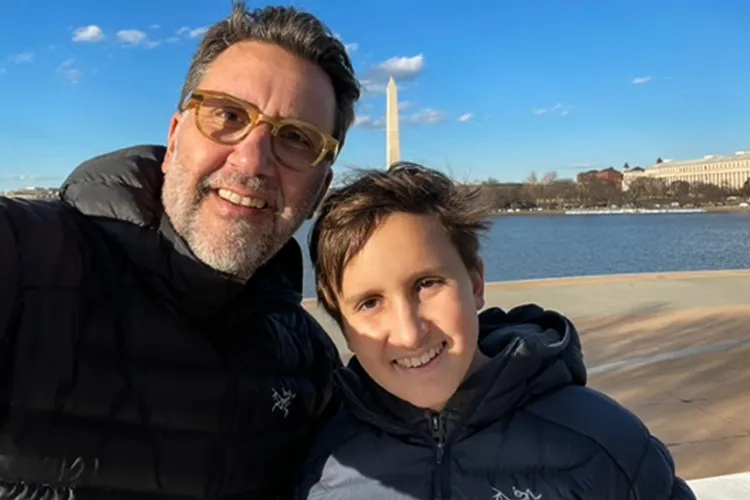

Fernando Goldsztein, an entrepreneur in Brazil, remembers when life felt ordinary for him, his wife Barbara, and their two sons, Frederico and Henrique. That sense of normalcy shattered in 2015, when 9-year-old Frederico began suffering from headaches and sudden vomiting episodes.
At first, doctors didn’t find anything alarming. Then Frederico developed double vision — a symptom that led to a devastating diagnosis: a malignant brain tumor called medulloblastoma.
“It’s very hard to put in words,” Fernando says. “We were terrified with the diagnosis. It’s kind of like the watch stopped and our lives froze, and then everything started from there.”
Roughly 500 children are diagnosed with medulloblastoma each year, according to estimates published in the Journal of Clinical Neuroscience, and the disease makes up about 20% of all childhood brain tumors.
For Fernando, the diagnosis became a turning point — not only in how he fought for his son, but in how he chose to spend his life. In 2021, he launched the Medulloblastoma Initiative to raise money and awareness and accelerate the search for a cure.
:max_bytes(150000):strip_icc():focal(599x0:601x2):format(webp)/fernando-federico-goldsztein-family-2-121125-3d5a3b9eaa3b48e6a410d2dd0fe5bee3.jpg)
“This is my purpose,” he says. “This is my motivation. That’s how I spend my time nowadays.”
After the initial diagnosis, Frederico underwent surgery and then traveled to Boston for months of radiation treatments.
“My parents told me that I had a little ball in my head and it would have to have it removed,” says Frederico, now 19. “After that, there were 30 sessions of radiation and nine rounds of chemo. There were side effects. Nausea, vomit — and I could not feel the taste of the food. It was really tough.”
Fernando admits the treatment was terrifying to witness — but he says Frederico never lost his nerve.
“He faced everything with lots of courage,” Fernando says.
The family eventually returned to Brazil, where Frederico continued medical follow-ups every three months. But in 2019, the family got the news they feared most: the tumor had returned. More radiation and chemotherapy followed.
:max_bytes(150000):strip_icc():focal(599x0:601x2):format(webp)/fernando-federico-goldsztein-family-6-121125-2f3c139815b64f49b0300d9f41c127fa.jpg)
According to the American Cancer Society, medulloblastoma recurs in about 30% of children, and the 5-year survival rate after recurrence is described as “close to zero,” noting that “with recurrence, there aren’t any other effective treatment options.”
“A relapsed medulloblastoma is equal to a death sentence,” Fernando says. “The doctors in the U.S. told us that there might be something to do like a clinical trial, but the best option would be to go back to Brazil and for Frederico to be with the people that he likes.”
Fernando couldn’t accept that as the final word.
As he began speaking with more people in the field, he connected with Dr. Roger Packer, a pediatric neurologist with the Children’s National Research Institute. Through those conversations, Fernando came to understand what he describes as a painful reality: the core treatments for medulloblastoma have remained largely unchanged for years, with limited innovation.
:max_bytes(150000):strip_icc():focal(599x0:601x2):format(webp)/fernando-federico-goldsztein-family-3-121125-82d6c9debd2d4b5798eeb8073753e4d8.jpg)
After Fernando made a donation to support Packer’s work, a group of top scientists focused on the disease began forming. Seeing the momentum build, Fernando created MBI to “create something bigger and faster” — and, as he puts it, “to find the cure as fast as possible.”
Since then, the organization has raised $13 million to date and now supports 16 laboratories collaborating toward the same goal.
Fernando also says the group has two clinical trials recently approved by the FDA: one designed to help the patient’s own cells “to identify and destroy the cancer cells,” and another testing an mRNA vaccine intended to “generate a targeted immune response to destroy tumors.”
Frederico isn’t eligible for the new trials, Fernando explains, because his health has stabilized to the point that no tumors appear on MRI scans. Still, he says the family remains vigilant.
“He does not need this trial so far, but we know that his tumor will come back because it always does,” Fernando says.
For now, Frederico’s health remains steady. Having graduated from high school last year, he’s preparing to begin his freshman year of college.
Since launching MBI, Fernando has stayed in close touch with families around the world facing the same diagnosis. He speaks with them through Zoom and WhatApp — and says many see the organization as their best chance.
“They see us maybe as their only hope,” he says. “It’s very hard, but that gives me strength to work even harder.”
“I want to save Frederico, but now, it’s much bigger than him,” he adds. “We are talking about thousands of kids, and this is the purpose of my life.”