
The Democratic National Committee has rolled out a new initiative aimed at improving its standing with younger Americans—an effort party leaders hope will strengthen their position heading into the 2026 midterm elections.
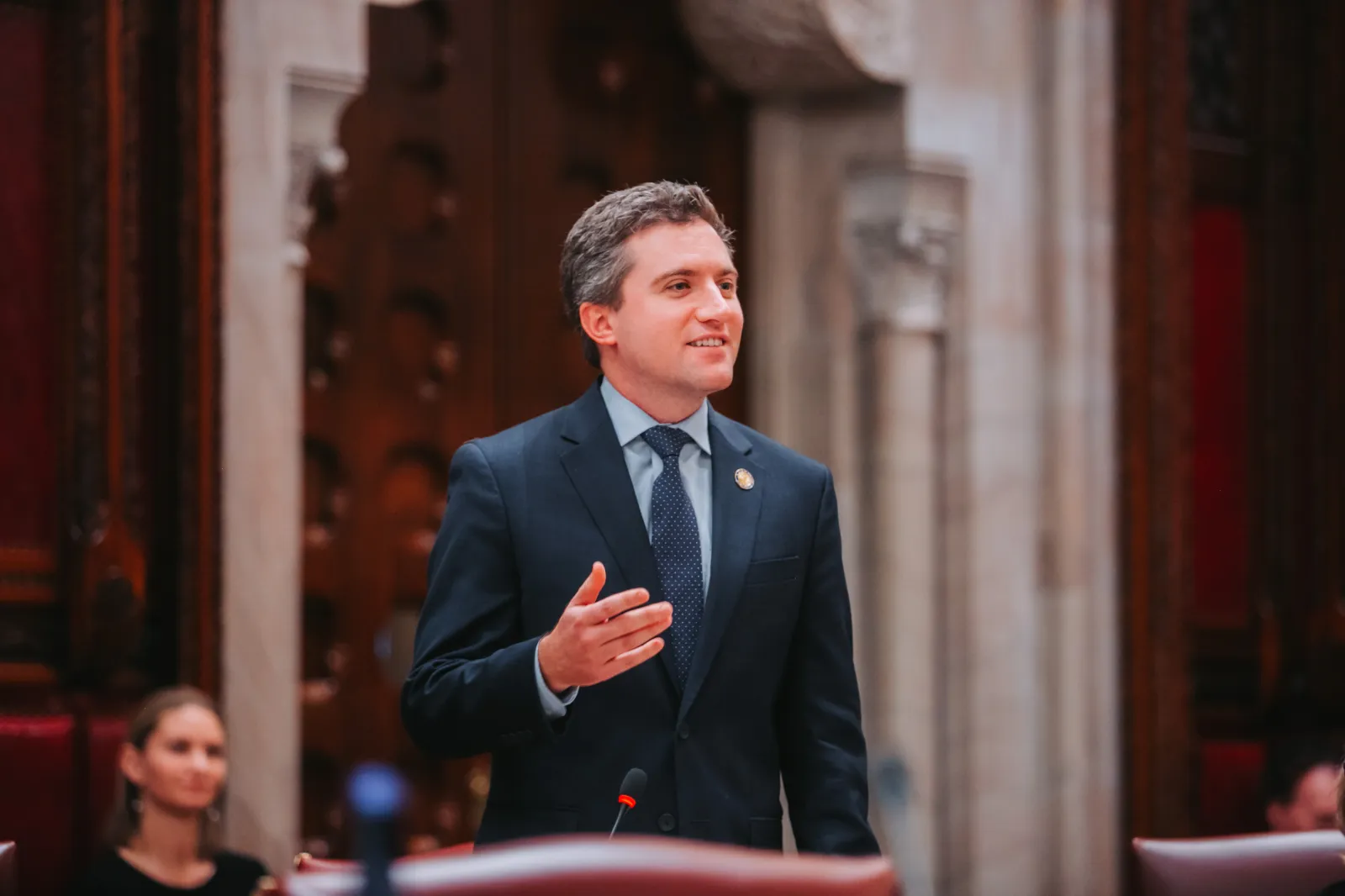
In an exclusive interview with Newsweek, New York State Senator James Skoufis announced the formation of the DNC’s National Youth Coordinated Table (NYCT), which he will chair. The coalition brings together the Young Democrats of America, the College Democrats of America, the High School Democrats of America, and a range of left-leaning organizing groups.
Skoufis said the NYCT was created at the request of DNC Chair Ken Martin, in response to Republican gains among young voters in the 2024 election. During that cycle, President Donald Trump won 47 percent of voters ages 18 to 29—an 11-point increase from his 2020 showing—according to the Tufts University Center for Information & Research on Civic Learning and Engagement (CIRCLE). Skoufis argued that shift reflected Trump’s ability to sell younger voters on a clearer promise of a better future, even if it meant challenging the status quo.
The goal of the NYCT, he said, is to better align party priorities with what young voters want—and to modernize the way Democrats communicate with them. The effort marks the first time the DNC has formally brought these youth organizations and allied groups under a single committee structure. Participants plan to draft a strategy that the DNC intends to support with additional resources over time.
“This is an effort to break down silos,” Skoufis told Newsweek. “All of these various youth organizing groups aligned with the Democratic Party have often sort of done their own thing, but this is the first time that we’re looking to bring everyone under one umbrella to maximize efficiencies, make sure we’re not wasting resources, we’re not being redundant, and that we’re all rowing in the same direction with best practices.”
Old Playbook Out, New Approach In
Skoufis, 38, first won elected office at 25, becoming the youngest member of the New York State Assembly after flipping a previously Republican-held seat. While he joked that he’s now an “old Democrat” (the Young Democrat cutoff age is 36), he said Trump’s 2024 gains pushed him to focus more directly on youth engagement.
During his earlier, long-shot run for DNC chair, Skoufis built relationships with younger DNC members and got a closer look at their frustrations with the party. He later ended his campaign and endorsed Martin, whom he said shared a similar urgency around rebuilding youth support. Martin, Skoufis noted, founded two state chapters of the Young Democrats of America in Kansas and Minnesota and, as chair, has emphasized strengthening state party infrastructure.
The creation of the NYCT appears to be a direct attempt to put that organizing focus into practice.
Not everyone is impressed. Brilyn Hollyhand, 18, the former chair of the Republican National Committee’s Youth Advisory Council, dismissed the effort as a surface-level fix for deeper problems—arguing the party’s broader message and leadership remain unconvincing.
“The Democrats are desperate,” he told Newsweek. “After we broke their monopoly on our generation, they’ve lit tens of millions of dollars on fire to study my peers and I like we’re aliens. I’ll save them all the time and money and answer their golden question for free: They lost us because they labeled our masculinity toxic, called us Hitler Jr., and their closing pitch the week of the election was to label us all garbage. They had four years to make life easier for my generation and somehow managed to make it even worse. There’re not enough influencers or talking point memos in the world that can win them back Gen Z.”
Recent polling suggests Democrats still have ground to make up, even as margins remain tight. According to the Institute of Politics at Harvard Kennedy School Fall 2025 Youth Poll, Trump holds a 29 percent approval rating among voters ages 18 to 29, compared with 27 percent for congressional Democrats. Trump’s rating fell two points from the previous survey, while Democrats rose four points. Congressional Republicans, meanwhile, sat at 26 percent—down three points from the spring.
A Fellowship Program and a Growing Organizing Network
Democrats may need that momentum to continue, because observers on both sides largely agree that conservative youth organizing remains more robust—especially through Turning Point USA. Republicans and Democrats alike have acknowledged that there is no direct Democratic equivalent to the group, which Trump administration officials credited with helping mobilize young voters. Since the assassination of its founder, Charlie Kirk, the organization has reportedly drawn a surge of donations totaling hundreds of millions of dollars.
Skoufis said the NYCT isn’t a direct response to Turning Point, but he believes it can help create similar opportunities for young people to plug into politics in practical, community-building ways. A key piece of the plan is a fellowship program intended to prepare “hundreds if not more” young Americans for campaign work and activism. The fellowship is expected to launch in the coming months and would include paid training run by the DNC and member organizations at the Youth Table.
In addition to the Democratic youth wings, participating groups include Swing Left, NextGen America, Voters of Tomorrow, the NAACP Youth & College Division, Student Turnout Project, Rise Free, Blue Future, and Grassroots Democrats HQ.
The groups began coordinating over the weekend at the DNC’s winter meeting in Los Angeles. At the same gathering, the DNC also launched a job bank designed to connect young people with campaign roles nationwide. Skoufis said the NYCT plans to meet monthly, virtually and likely in person during the spring DNC meeting.
“I think the really great thing about this is that when you bring folks together in this way, you very quickly start exposing gaps that exist in the ecosystem,” DNC National Political Director Shelby Wiltz, 33, told Newsweek. “While each of these organizations has to go out and execute on their own missions, their own priorities and strategies, what we are attempting to do is figure out where we can collectively have the most impact and implement that plan.”
One gap already on the DNC’s radar, Wiltz said, is outreach to college-age Americans who aren’t enrolled in school—an audience that often sits outside the strongest organizing pipelines. As Democratic support has grown among college-educated voters in recent cycles, non-college-educated voters have shifted away. College Democrats of America President Sunjay Muralitharan, 21, said many Gen Z Americans—both in college and not—are struggling to find “third spaces,” or community hubs beyond home, work, and school.
He argued that if the NYCT can help create those spaces, it could also help bring back young voters who have grown distrustful of institutions and disillusioned with party politics—an attitude that often drives persuadable voters away from the ballot altogether.
That challenge may be central to the NYCT’s mission. Trump’s appeal to younger voters has often leaned on disruption and anti-establishment messaging, while Democratic campaigns under Joe Biden and Kamala Harris positioned the party as a defender of institutions. In a media environment that rewards authenticity—and amid ongoing economic uncertainty—the NYCT will likely be judged on whether it offers engagement that feels meaningful for young people, not just beneficial for Democratic candidates.