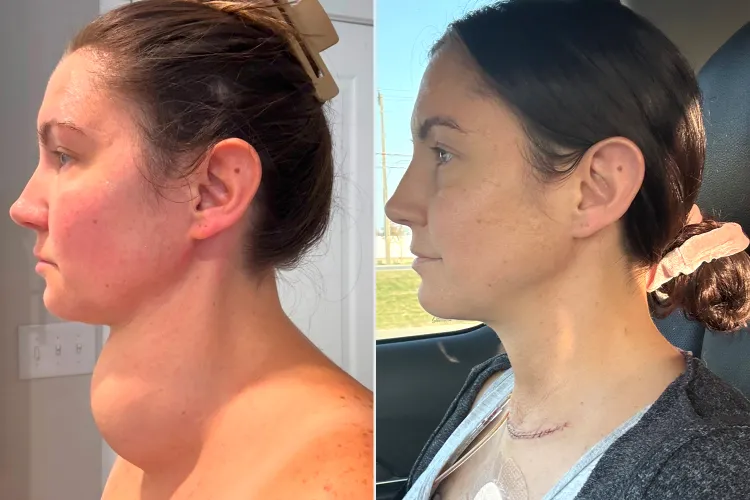

In May 2017, Heather Wallace noticed swelling in her neck that looked like a goiter — a visible enlargement of the thyroid gland. The change seemed to accelerate quickly, and when she developed a persistent cough, she sought medical help.
By April 2018, she was sitting in an endocrinologist’s office undergoing routine thyroid bloodwork. The doctor ordered standard tests for thyroxine (T4) and thyroid-stimulating hormone (TSH) to check whether her thyroid was functioning normally.
The results came back within the expected range. But Wallace, a mother of three, felt something still wasn’t right. She asked for deeper testing — and says she was brushed off.
“I knew there was something deeper going on, but [the doctor] never listened to me or my concerns,” Wallace, 40, says.
:max_bytes(150000):strip_icc():focal(749x0:751x2):format(webp)/thyroid-goiter-1-020426-aa48a495f75a4195a485789ffcaab125.jpg)
As the goiter continued to grow, she gradually began to connect the dots between the swelling in her neck and the way her body felt day to day. Things that used to be easy — long walks, keeping up with her kids, even simple movement — started leaving her unusually short of breath. At the time, she blamed being out of shape, not realizing how long the strain had been building.
“Some days I would truthfully just forget that I had a giant goiter in my neck because my body didn’t feel inflamed or bothered,” Wallace says. “But there were other days when I would be in a flare, and my throat would feel so thick and large.”
The physical symptoms were only part of the burden. Living with a visibly enlarged neck meant constant attention in public — stares she couldn’t avoid, even when she tried to ignore them. Eventually, the comments moved online, where strangers mocked her appearance, calling her “frog throat girl” and comparing her to a bullfrog.
:max_bytes(150000):strip_icc():focal(749x0:751x2):format(webp)/thyroid-goiter-2-020426-49b59b073fe541efb8187d7a00b389b0.jpg)
“My mental health was definitely affected,” she says, explaining that the emotional weight sometimes triggered depression. “I had such negative views about my looks, I felt so ugly.”
Over time, the combination of persistent symptoms, unanswered questions, and the visible changes to her body eroded her self-esteem. “After years of trying to figure out the reason for my goiter with no avail… I felt so defeated,” she says.
Eventually, after consulting yet another physician, she was told surgery could no longer be avoided. In December 2025, Wallace went into the operating room expecting a hemithyroidectomy (thyroid lobectomy), believing only her right thyroid lobe would be removed. She says she was devastated to learn afterward that surgeons had to remove her entire thyroid gland.
:max_bytes(150000):strip_icc():focal(749x0:751x2):format(webp)/thyroid-goiter-3-020426-4764576f4ab8454d8982cb8ebb10b327.jpg)
“It was such a disappointment,” she says. “When I woke up and found out I had lost my entire thyroid, I was so very sad.”
That sadness quickly shifted to anger when the post-surgical biopsy revealed signs of undiagnosed Hashimoto’s disease — an autoimmune disorder in which “immune-system cells lead to the death of the thyroid’s hormone-producing cells,” per the Mayo Clinic.
“I had spent years seeing doctors and never once did any of them test for Hashimoto’s until now,” Wallace says. “I just wish I would have known this from the start so I could have taken care of myself in ways I didn’t know I should have because I didn’t know I had autoimmune issues until it was too late.”
Two months after surgery, she says life without a thyroid has begun to settle into a new normal. Medication adjustments helped reduce the effects of an initially high hormone dose, and she says her body is responding well.
:max_bytes(150000):strip_icc():focal(749x0:751x2):format(webp)/thyroid-goiter-4-020426-0b230a617d6741f4928287bbc783ef99.jpg)
Emotionally, though, the transition has been harder. Wallace says she’s still processing what it means to lose a vital organ — and to depend on daily medication moving forward.
And yet, in an unexpected way, she says the change has also brought relief. Without the goiter, she feels more like herself than she has in nearly a decade.
“Once I got [the goiter] removed, I was finally able to wear necklaces again after eight years, I finally had a stronger jawline again, and I can hug my family without my neck getting squished between us,” she says. “I think finally looking like the woman I was when I married my husband 10 years ago has really helped rebuild my confidence.”
Now, Wallace hopes her experience encourages others to trust their instincts when something feels wrong — even if early tests look “normal.”
:max_bytes(150000):strip_icc():focal(749x0:751x2):format(webp)/thyroid-goiter-5-020426-7e0a4c3b1a044082a75347cd3d7ad27b.jpg)
“Advocate for yourself,” she urges, encouraging patients to keep asking questions, seek support, and push for thorough evaluation.
And for anyone living with a visible medical condition, she emphasizes that other people’s judgment doesn’t define your value.
“You have a purpose in this life and you can change so many people’s lives because of the issues you have to face on a daily basis,” Wallace says. “Let your heart shine brighter than the dark world around you.”