
WASHINGTON — The White House medical team moved to address growing speculation surrounding President Donald Trump’s health on Monday, after the 79-year-old commander-in-chief appeared at a Medal of Honor ceremony with a prominent skin rash and recurring hand discoloration.
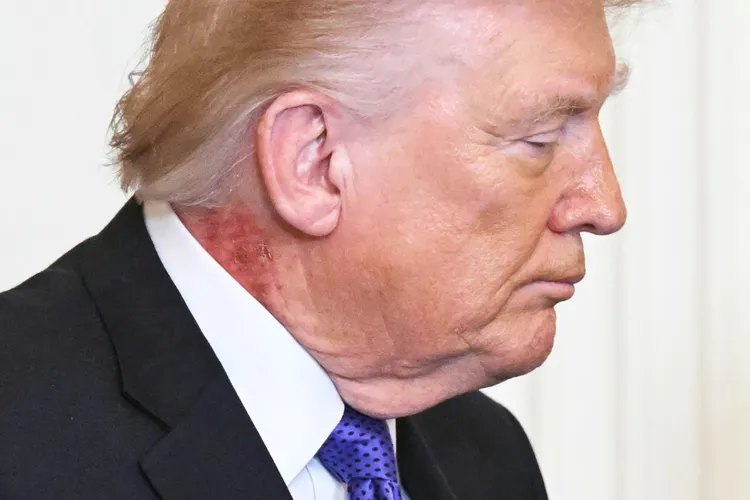
During the East Room event on March 2, 2026, high-resolution photography captured a large, red, scaly rash extending from behind the President’s right ear to his hairline. The appearance of the new ailment, coupled with visible bruising on his right hand—partially obscured by cosmetic makeup—has reignited questions regarding the physical toll of the presidency on the oldest person to ever hold the office.
Medical Team Cites ‘Preventative Treatment’ for Neck Rash
In a statement released to clarify the President’s appearance, White House physician Dr. Sean Barbabella identified the neck irritation as a side effect of a prescribed medical regimen rather than an underlying illness.
“President Trump is using a very common cream on the right side of his neck, which is a preventative skin treatment,” Barbabella stated. While the physician did not disclose the specific diagnosis requiring the cream, he noted that the treatment is scheduled for one week and that the resulting “redness is expected to last for a few weeks.”
The lack of detail regarding the “preventative” nature of the cream has left independent medical analysts wondering if the treatment is for actinic keratosis—precancerous skin patches common in older adults—or a reaction to a dermatological procedure.
:max_bytes(150000):strip_icc():focal(756x639:758x641):format(webp)/President-Donald-Trump-speaks-during-a-Medal-of-Honor-ceremony-030226-2-d4f2242da605485dbb84252efe2759c0.jpg)
The Mystery of the Persistent Bruises
While the neck rash is a recent development, the “near-constant” bruising on the backs of the President’s hands has been a recurring feature of his public appearances for over a year.
At Monday’s ceremony, the bruise on Trump’s right hand was visible despite an apparent layer of cover-up. This follows a year-long timeline of shifting explanations from the administration:
- February 2025: Press Secretary Karoline Leavitt attributed the marks to “constantly working and shaking hands.”
- July 2025: Dr. Barbabella linked the bruising to chronic venous insufficiency and a daily aspirin regimen.
- January 2026: A new bruise appeared on Trump’s left hand during the World Economic Forum in Davos. Since the President is right-handed, the “handshaking” explanation was replaced by a report that he had struck his hand on a “signing table.”
Aspirin Intake Exceeds Medical Recommendations
The President has been uncharacteristically candid about his self-prescribed medical habits. In a January profile with The Wall Street Journal, Trump admitted to taking 325mg of aspirin daily—four times the 81mg “baby aspirin” dose typically recommended for cardiovascular maintenance in seniors.
“They say aspirin is good for thinning out the blood, and I don’t want thick blood pouring through my heart,” Trump told the Journal. “I want nice, thin blood… Does that make sense?”
Medical experts note that such high doses of aspirin significantly increase skin fragility and the likelihood of “senile purpura,” or easy bruising, as the blood’s clotting ability is suppressed.
Looking Ahead: Transparency and the Path to 2028
As President Trump nears his 80th birthday, every physical blemish is viewed through a highly political lens. While the White House maintains these issues are minor and cosmetic, the frequency of medical “clarifications” suggests an administration sensitive to perceptions of frailty.
The White House has not yet indicated if a more comprehensive summary of the President’s recent dermatological biopsies or blood work will be made public in the coming weeks.