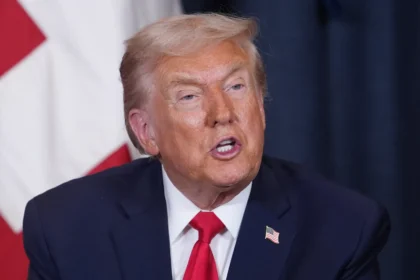
President Donald Trump opened his latest major interview about his health with a blunt warning to New York magazine’s Ben Terris.
“I hate to waste a lot of time on this, but if you’re going to write a bad story about my health, I’m going to sue the ass off of New York magazine,” he said. “There will be a time when you can write that story, maybe in two years, three years, five years — five years, no one is going to care, I guess. Go ahead and sit down.”
Speculation about Trump’s health has intensified over the past year, with online commenters pointing to issues such as swollen ankles — described by some as a symptom of chronic venous insufficiency — as well as an advanced imaging test he appeared unfamiliar with and frequent bruising on the backs of his hands. Despite the chatter, his physicians have continued to say he is in strong condition.
On the question of cognitive decline, Trump acknowledged a family history: his father, real estate developer Frederick “Fred” Trump, lived to 93 but developed Alzheimer’s disease in his final years.
“He had one problem,” Trump, 79, said of his father in the interview. “At a certain age, about 86, 87, he started getting, what do they call it?”
Terris wrote that Trump pointed to his head and looked to press secretary Karoline Leavitt for help.
:max_bytes(150000):strip_icc():focal(1059x692:1061x694):format(webp)/trump-11-2000-193716bc66ad490586f050ae898a8080.jpg)
“Alzheimer’s,” Leavitt said.
“Like an Alzheimer’s thing,” Trump replied. “Well, I don’t have it… I don’t think about it at all. You know why? Because whatever it is, my attitude is whatever.”
He then pointed to longevity in his mother’s family as evidence he expects to do well.
“Genetically, I’m in great shape,” he said. “My mother and her family lived very long, well into their 90s. No heart disease in my family. No this, no that.”
Trump also used an anecdote about a friend’s family history to underline his view that genetics are decisive.
“I have this friend whose mother died at 49 of a heart attack. His father died at 51 of a heart attack. He’s now 60. I said, ‘You’re f—ed,’ ” Trump said. “He watches everything he eats. But you can’t beat genetics.”
During the interview, Trump contrasted his openness about health questions with that of political rivals, while also turning attention to two White House medical staff who were brought into the room: Cpt. Sean Barbabella, his lead physician, and Col. James Jones, a physician’s assistant with a Ph.D. in health science.
Leavitt noted that Jones served in the White House during the Obama administration, prompting Terris to ask who was healthier: Trump or Barack Obama. Terris wrote that Jones answered without hesitation.
“President Trump,” Jones said, according to Terris. Trump, Terris added, nodded and directed him to include it: “Write that.”
Elsewhere, Terris returned to one of Trump’s long-discussed health habits: his aspirin routine. Trump said he takes 325 milligrams — higher than the commonly cited 81-milligram daily dose often referenced for heart health — and he signaled he has no interest in changing.
“I want thin blood,” Trump said, adding that he has gained about 11 pounds since his physical exam in April. “Real thin blood.”
Though doctors have raised concerns about higher-dose aspirin in the past, Trump dismissed the idea of adjusting course.
“I’ve been doing it for 30 years, and I don’t want to change,” he said. “You know what? You’re in the Oval Office now, right? I don’t want to change a thing.”
He also brushed aside broader concerns about aging.
“I feel the same as I did 40 years ago,” he said.
As for talk that he nods off during meetings, Trump denied falling asleep and said his demeanor in a recent Cabinet session reflected boredom, not fatigue.
“It’s boring as hell,” he said. “I’m going around a room, and I’ve got 28 guys — the last one was three and a half hours. I have to sit back and listen, and I move my hand so that people will know I’m listening. I’m hearing every word, and I can’t wait to get out.”
Trump and others in his administration repeated the frequent claim that he does not need much sleep.
“I think five hours is plenty,” he said. “I find that when I’m really enjoying myself, I sleep less.”
Leavitt echoed that framing, arguing that Trump’s workload has only increased.
“He’s working harder now than he did in his entire life,” she said. “Even in real estate when he was on top of the world in New York.”
She also claimed the Marine sentries stationed outside the Oval Office have had to increase staffing because of how often Trump is inside.
“The Marine sentries who stand outside the Oval Office, they had to request more staff and bring up more Marines because the president is in the Oval Office so much,” she said. “They’ve never had to do that before.”
Responding to the New York magazine article, White House communications director Steven Cheung said: “As the headline states ‘The Superhuman President,’ President Trump is in perfect physical and cognitive health, as evidenced by his nonstop work on behalf of the American people. In just one year, he has achieved what most presidents achieve in their entire term.”