
President Donald Trump’s approval rating has declined across every major policy area, according to a new national survey.
Why It Matters
The findings suggest a broad—if modest—cooling in public sentiment as the 2026 midterms come into view. Voters continue to cite inflation and immigration as top concerns, while also voicing unease about immigration enforcement tactics in Minneapolis and other U.S. cities.
What To Know
Trump’s overall job approval fell to 45 percent in January, down from 47 percent in December, with declines recorded across key issues including the economy, immigration, and foreign affairs, according to the latest Harvard CAPS/Harris poll.
The online survey was conducted January 28–29, 2026, among 2,000 registered voters nationwide. It reports a margin of error of ±2 percentage points and is a long-running collaboration between the Harvard Center for American Political Studies, The Harris Poll, and HarrisX.
Across a year of monthly Harvard/Harris tracking—from January 2025 through January 2026—the president’s issue ratings have eased gradually. That steady slide has now produced Trump’s weakest multi-issue profile in months.
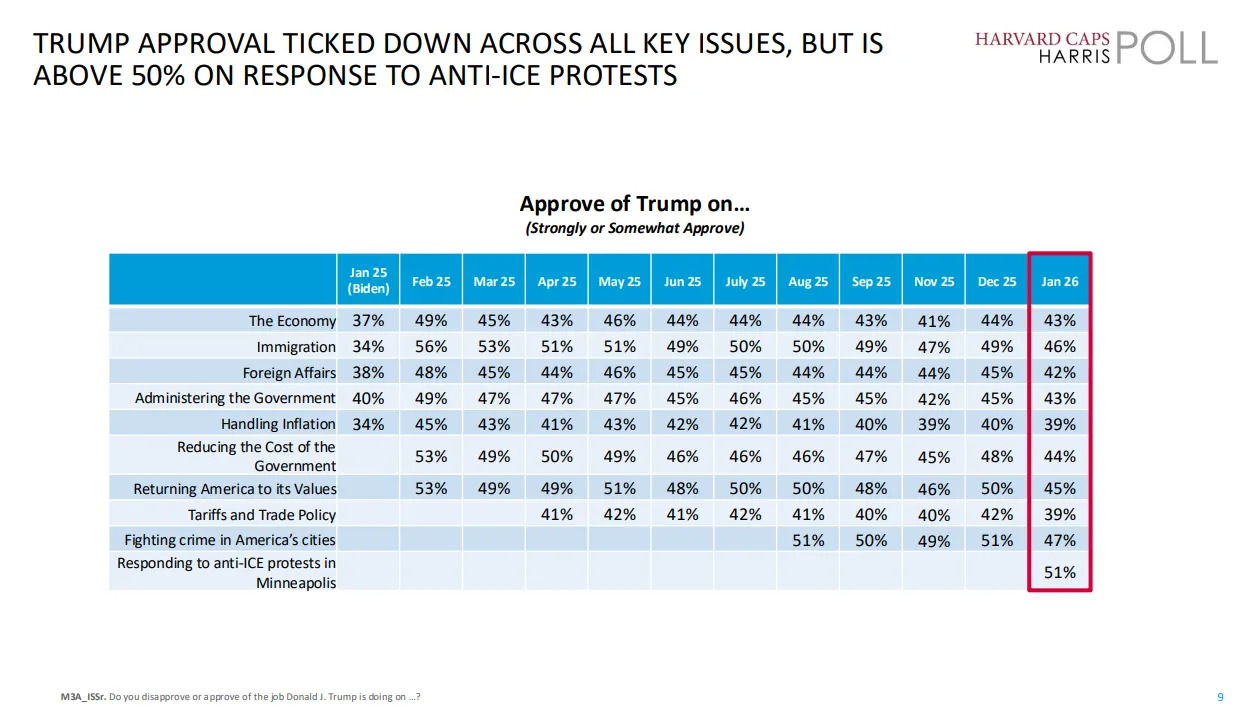
The sharpest drop came on immigration, which fell from 49 percent approval in December to 46 percent in January, continuing a months-long downtrend from the mid-50s earlier in 2025.
Other categories also slipped:
- Economy: down to 43 percent, from a high of 49 percent in February 2025
- Foreign affairs: down from 45 percent in December to 42 percent in January
- Administering the government: down to 43 percent from 45 percent
- Inflation: down to 39 percent from 40 percent, matching Trump’s lowest score in a year
- Tariffs and trade policy: down to 39 percent as well
The only standout item was a newly tested question on Trump’s handling of the anti–U.S. Immigration and Customs Enforcement (ICE) protests in Minneapolis, where 51 percent said they approved—one of his strongest showings in the poll, alongside fighting crime in America’s cities (47 percent).
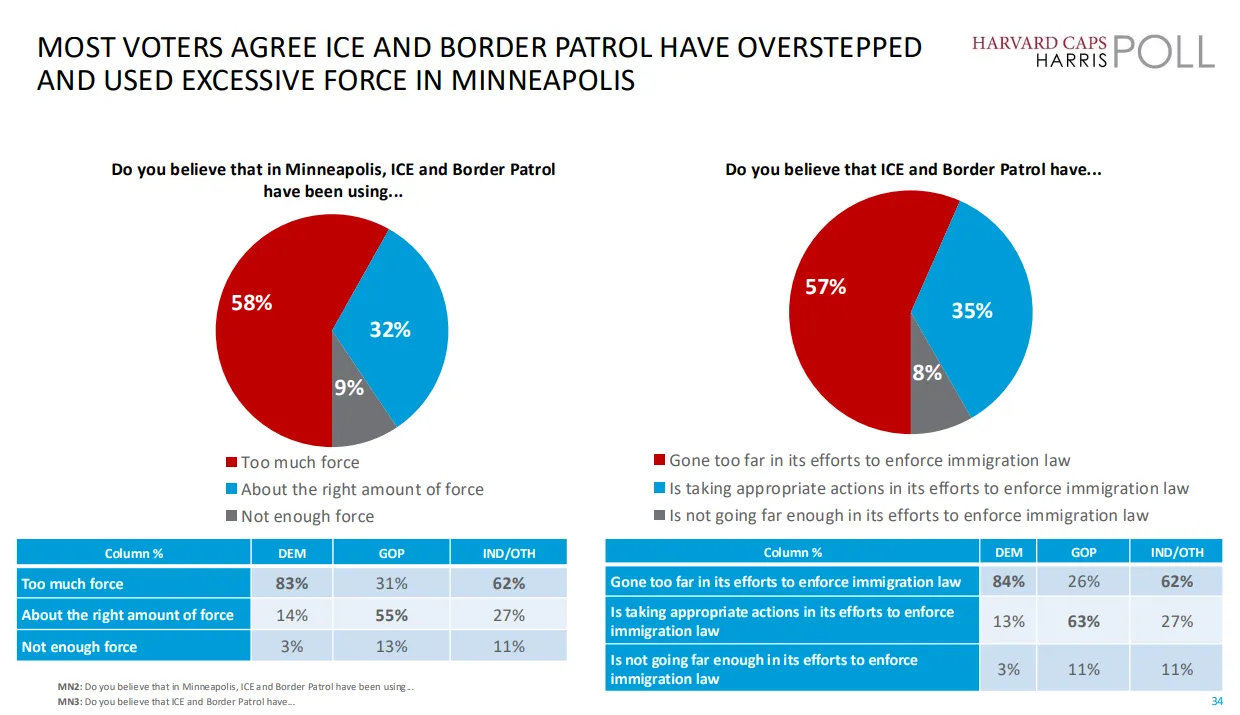
But even that relative bright spot comes with mixed signals. In the broader immigration enforcement portion of the survey, respondents expressed significant concerns:
- 57 percent say ICE and Customs and Border Protection have “gone too far” enforcing immigration law
- 55 percent disapprove of how enforcement is being carried out in American cities
- 86 percent want federal agents required to wear body cameras
- 80 percent say agents must identify themselves during operations
Voters overwhelmingly support targeting criminal offenders, but a plurality believe enforcement efforts are sweeping up non-criminal undocumented immigrants—an interpretation that divides Democrats and Republicans and conflicts with the administration’s public messaging.
Overall, the time series suggests a presidency that peaked early in 2025—benefiting from a political handover, a rallying economy, and strong Republican enthusiasm—then moved into a slower, incremental decline over the rest of the year. Support has not collapsed; it has eroded across multiple issues at once, a pattern that can signal broad disengagement rather than backlash tied to a single event.
The two-point dip in overall approval is modest, but it also widens a mismatch between Trump’s strongest areas (crime and immigration raids) and the issues voters say matter most—especially inflation and the economy, where his ratings are weakest.
One of the poll’s more notable tensions is economic attribution. Despite saying inflation is rising and believing the economy is shrinking, 63 percent of voters now credit the economy’s current condition to Trump rather than Biden—an 11-point jump.
At the same time:
- Half of voters say Trump’s policies have been consistent with his campaign promises
- A majority say he has accomplished “a lot” in his first year
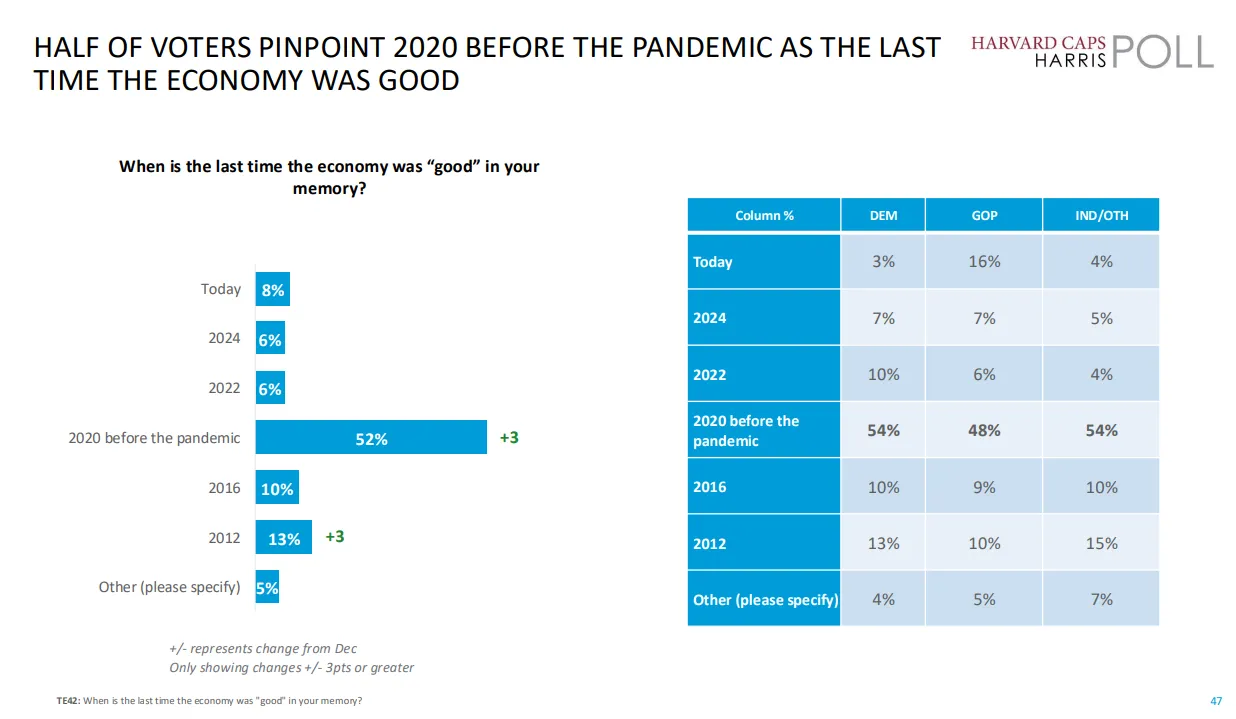
- 52 percent say the economy was last “good” in 2020
- 56 percent believe the economy is currently shrinking
That contradiction appears to be weighing on his ratings for inflation and economic management, which have gradually drifted into the high 30s—levels often associated with midterm headwinds.
What People Are Saying
Mark Penn, co-director of the Harvard CAPS/Harris poll and Stagwell chairman and CEO, said:
“President Trump’s ratings are slowing declining with Americans seeing the economy sagging and inflation raging, even though economic statistics show the opposite.
“On immigration, the public supports removing criminal aliens but believe that ICE has gone too far and is randomly picking up migrants, a policy they do not support. Given these two trends, Republicans are now facing a tough midterm election.”
Trump wrote on Truth Social last week: “My polling is highest ever. Thank you!”
In another post, he added: “Fake and Fraudulent Polling should be, virtually, a criminal offense… I am going to do everything possible to keep this Polling SCAM from moving forward!”
White House spokesperson Kush Desai previously told Newsweek via email:
“President Trump campaigned on fixing Joe Biden’s economic disaster and border crisis. By every metric, he is delivering—inflation has cooled, GDP growth is accelerating, and the border is sealed.
“Instead of covering how far America has come in just one year, the media has fixated on one contrived scandal after another. President Trump is most in his element when he’s with the everyday Americans who propelled him to office, and the President will continue delivering results and cutting out the Fake News middleman to tout what he has and continues to do for the American people.”
Republican pollster Daron Shaw said:
“The president faces two difficult obstacles—the virtually unanimous and intractable opposition of Democrats and the stubbornness of high prices.”
What Happens Next
Pollsters are expected to release additional monthly snapshots through the 2026 midterm cycle, offering a clearer read on whether concerns about immigration enforcement and inflation intensify—or fade—as the election approaches.