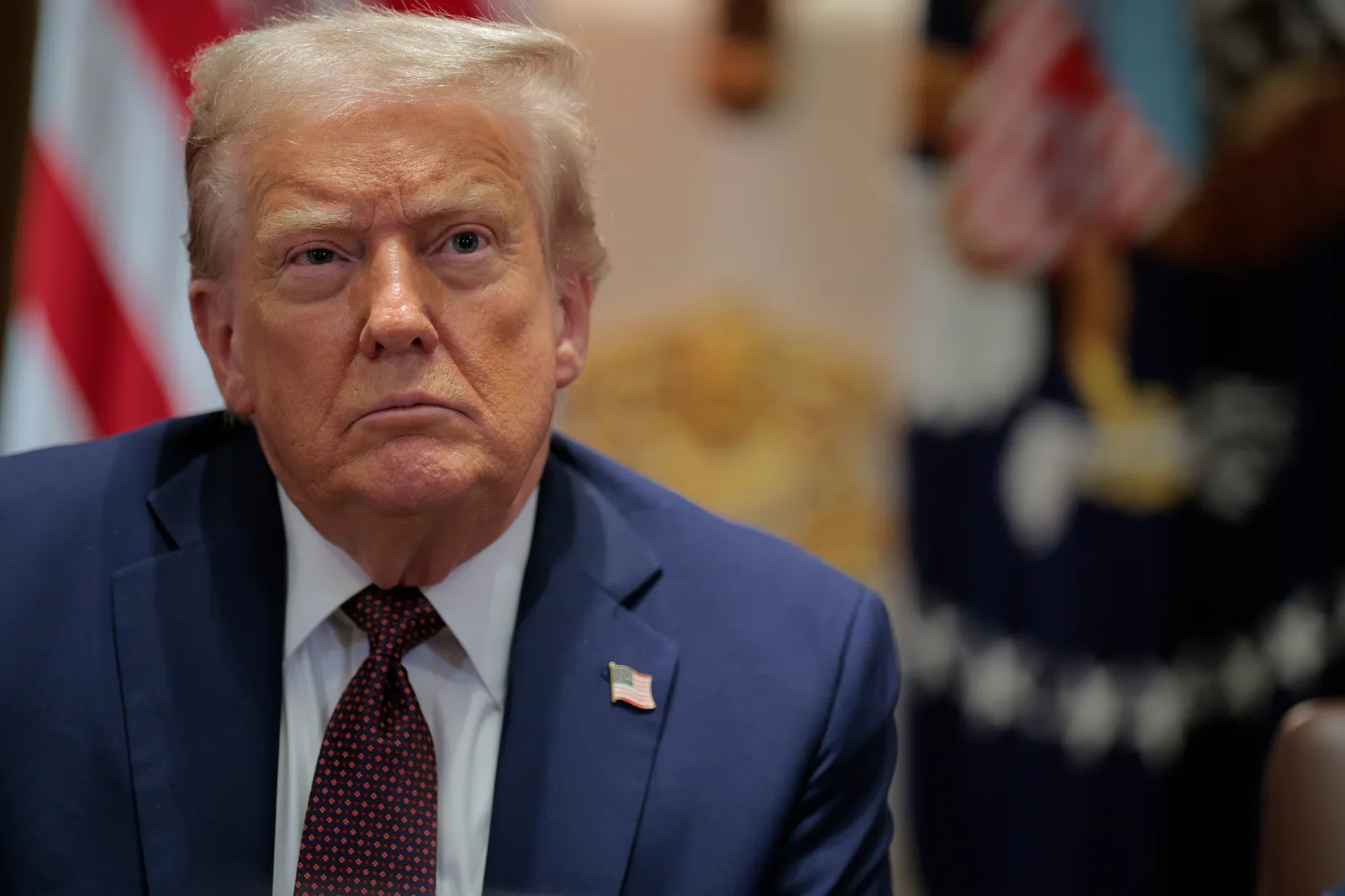

President Donald Trump has privately discussed the possibility of seeking a third term with a former lawyer who is preparing a book examining whether such a bid could be constitutional, according to reports.
Trump’s recent conversations—both behind closed doors and in public—have revived a long-running argument over presidential term limits and the scope of the 22nd Amendment.
Why It Matters
The prospect of a third term carries major constitutional and political consequences. It tests the boundaries of executive power and the durability of the two-term tradition formalized by the 22nd Amendment in 1951. Even as Trump has often framed his remarks as hypothetical or joking, the topic has fueled speculation among supporters and critics and prompted renewed scrutiny of how strictly the Constitution forecloses creative legal interpretations.
What to Know
The Wall Street Journal reported that Trump met with his former legal adviser, Alan Dershowitz, who presented a draft of his upcoming book, Could President Trump Constitutionally Serve a Third Term? The book explores whether the Constitution’s language is as definitive as it appears when applied to unusual or indirect paths back to the presidency.
The 22nd Amendment states: “No person shall be elected to the office of the president more than twice.”
Dershowitz argued that while the two-term limit is clear in ordinary circumstances, questions can arise in edge-case scenarios involving succession or contingent elections. He told The Wall Street Journal that the matter is “not clear” in certain hypotheticals, saying it is uncertain “if a president can become a third-term president” and whether it would be permissible under the Constitution.
According to Dershowitz, Trump found the subject interesting but did not signal a concrete plan to challenge the two-term restriction. Dershowitz added that he does not believe Trump will ultimately run for a third term.
In the draft, Dershowitz lays out theoretical scenarios that could, in his view, create a route back to office. One example he discussed involves a third-term run followed by an Electoral College outcome in which members abstain from voting in a way that prevents any candidate from securing the necessary majority—sending the decision to Congress under the Constitution’s contingent election process. Dershowitz described that as Congress selecting, rather than voters electing, the president.
He emphasized that such a chain of events would be extraordinary. The National Constitution Center notes that electors have abstained only twice in U.S. history, and those instances did not trigger Congress choosing the president.
What Trump Has Said About a Third Term
Trump has addressed third-term speculation several times, alternating between dismissal and openness to the idea in the abstract.
- In October, speaking to reporters aboard Air Force One, he said: “If you read it, it’s pretty clear. I’m not allowed to run. It’s too bad.”
- In a March interview with NBC News, he said: “There are methods which you could do it,” but added: “it is far too early to think about it.”
- In an August CNBC interview, he said “no, probably not” when asked if he would run again, while also adding, “I’d like to.”
What People Are Saying
Dershowitz told The Wall Street Journal that Trump viewed the issue as an intellectual question.
White House chief of staff Susie Wiles told Vanity Fair this week that Trump “knows he can’t run again.”
Senate Majority Leader John Thune said a third term would be possible only “with a change in the Constitution,” adding that Trump may be “having some fun with it” and “messing with” reporters who keep asking.
House Speaker Mike Johnson said he and Trump have discussed the Constitution’s constraints.
Legal scholar James Sample, a Hofstra University professor, rejected alleged workarounds as “absurd.” In an emailed statement to The Wall Street Journal, he pointed to the most plausible area of concern as a coordinated succession strategy in which allies win office with an intent to resign, potentially allowing Trump to return through the line of succession—an approach he said presents “quasi-credible concern,” even if it remains far-fetched.
What Happens Next
Trump’s comments continue to keep the issue alive, but there is no public evidence of an active or credible effort to bypass the 22nd Amendment.
Changing the two-term limit would require a constitutional amendment: passage by two-thirds majorities in both the House and Senate, followed by ratification from three-quarters of the states—an exceptionally difficult process that remains unlikely in today’s political environment.