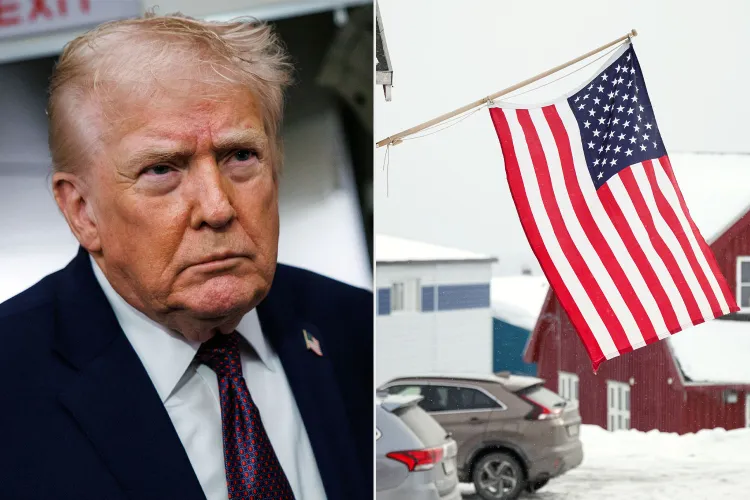

President Donald Trump said in a new interview with The New York Times that securing full “ownership” of Greenland is, in his words, “psychologically important.”
In a two-hour sit-down with several Times reporters on Jan. 7, Trump was asked why he wouldn’t simply increase the U.S. military presence on Greenland — something permitted under a Cold War–era agreement — if his primary goal is to deter foreign threats. Trump said that wouldn’t be enough, adding that he wouldn’t feel comfortable unless the United States owns the island.
“Why is ownership important here?” Times national security correspondent David E. Sanger asked.
“Because that’s what I feel is psychologically needed for success,” Trump, 79, replied. “I think that ownership gives you a thing that you can’t do, whether you’re talking about a lease or a treaty. Ownership gives you things and elements that you can’t get from just signing a document, that you can have a base.”
White House correspondent Katie Rogers, whom Trump recently insulted in a separate dispute over coverage of his age, followed up: “Psychologically important to you or to the United States?”
“Psychologically important for me,” Trump answered. “Now, maybe another president would feel differently, but so far I’ve been right about everything.”
Trump also told the Times he wouldn’t rule out using nuclear force if he “needed it” to take over the Arctic island, while acknowledging it “might upset NATO,” since Greenland is a self-governing territory within Denmark — a NATO member.
That comment drew attention to NATO’s mutual defense provision. Article five of the North Atlantic Treaty states that “any armed attack on a NATO member shall be considered an attack against them all,” prompting Connecticut Sen. Chris Murphy to say on NBC News’ Meet the Press that if the U.S. took over Greenland, “it would be the end of NATO.”
:max_bytes(150000):strip_icc():focal(749x0:751x2):format(webp)/Donald-Trump-Jr-plane-Greenland-011226-bc56993d96f0430cabdc05ee2b92fa22.jpg)
Trump has repeatedly raised the idea of taking Greenland since returning to the White House, often pointing to its strategic position and natural resources, including oil and untapped minerals.
“We are going to do something on Greenland, whether they like it or not, because if we don’t do it, Russia or China will take over Greenland, and we’re not going to have Russia or China as a neighbor,” Trump told reporters on Jan. 9.
A spokesperson for China’s foreign ministry responded in a press briefing by criticizing Trump’s remarks, accusing the United States of using “other countries as an excuse to pursue its own private interests.”
Danish Prime Minister Mette Frederiksen also responded publicly over the weekend, writing on Facebook that the “idea of freedom” should not be compromised and warning that disputes between the United States and Europe only help their rivals.
“The United States and Europe are rooted in the idea of freedom. We should never compromise on this,” she wrote. “Disagreements and conflicts between the United States and Europe only benefit our adversaries. They weaken us and strengthen them.”
She added that Denmark remains a committed ally and is prepared to defend its values in the Arctic, emphasizing “international law” and “peoples’ right to self-determination,” as well as “sovereignty, self-determination and territorial integrity.”
Frederiksen’s remarks appeared to address Trump’s comments to the Times, where he said he didn’t “need international law” because he’s “not looking to hurt people.”
In the same interview, Trump — who has also made claims about exerting control over Venezuela after the reported capture of its president on Jan. 3, and has since threatened additional nations — told the paper in an article published on Jan. 8 that he believes only “one thing” could stop him from global dominance.
“My own morality. My own mind,” he said. “It’s the only thing that can stop me.”