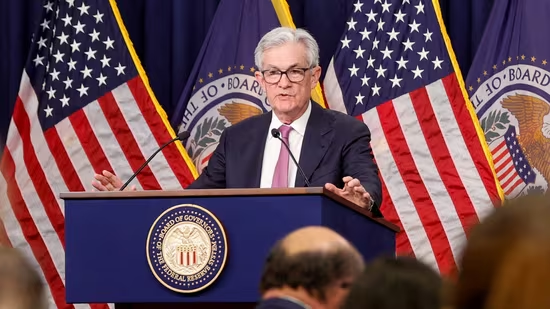

President Donald Trump has intensified his criticism of Federal Reserve Chairman Jerome Powell, hinting at possible dismissal over what he claims could be “fraud” tied to a $2.5 billion renovation at the Fed’s Washington headquarters. However, legal experts caution that Trump would need substantial evidence to justify such a move.
Renovation Controversy Becomes Political Flashpoint
The controversy centers on a costly overhaul of the Fed’s historic building, a project that has faced rising expenses in the post-pandemic economy. While Trump has long attacked Powell over interest rate policies—calling him a “numbskull” and a “moron”—he now suggests the renovation budget could be grounds for dismissal.
“It’s possible there’s fraud involved with the $2.5, $2.7 billion renovation,” Trump said Wednesday, without offering specific proof.
The White House has yet to present any evidence of mismanagement, and Powell has requested the Fed’s independent inspector general conduct a fresh review of the project. In a letter to the administration, Powell emphasized that the renovations do not include lavish features like VIP dining rooms or private elevators, and both buildings involved require significant structural repairs.
Can Trump Fire Powell?
Firing a sitting Fed chair would be an unprecedented move, and one that may not be legally viable without clear justification. According to Lev Menand, associate professor at Columbia Law School, the law allows removal only for “cause,” such as malfeasance, neglect of duty, or inefficiency.
“Right now, there’s no publicly available evidence of mismanagement,” Menand told AFP. “There’s just no legal basis to remove Powell ‘for cause.’”
Even if Trump proceeded, Powell would be entitled to formal notice of the allegations and the opportunity to contest them—potentially allowing him to remain in office during that process.
Backdrop of Interest Rate Disputes
Trump’s frustration with Powell has grown over the Fed’s decision to hold interest rates steady, despite the president’s repeated calls for aggressive cuts. Trump argues that lower rates would ease the country’s debt burden and accelerate growth, especially with inflation now appearing relatively tame.
Currently, the federal funds rate stands between 4.25% and 4.50%, levels the Trump administration has labeled as excessive.
Market Reaction and Broader Implications
Analysts warn that an attempt to forcibly remove Powell could trigger significant market volatility.
“Equities would likely sell off immediately in a risk-off move,” said Padhraic Garvey, Americas research head at ING. “It would be a stunning move—one without precedent.”
However, Garvey added that markets might eventually rebound if investors believe Powell’s exit could lead to deep rate cuts, boosting economic activity.
Still, Trump may find it difficult to sway monetary policy unilaterally. The Federal Open Market Committee (FOMC) has 12 voting members, and policy decisions are made based on economic data—not presidential pressure.
“The Fed’s credibility remains intact—for now,” Garvey said, “and will likely hold as long as Powell remains in place.”
As of now, both Powell and the Federal Reserve continue to operate independently, while Trump’s remarks have further intensified a growing rift between the White House and the central bank.