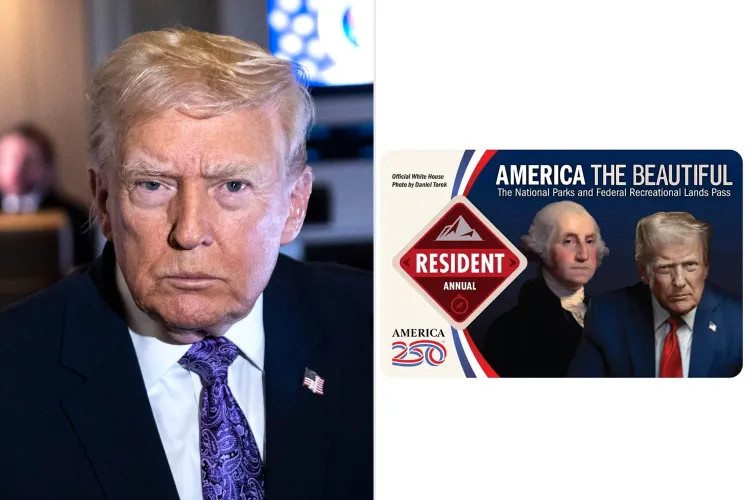

Despite years of clashes over public land policy, President Donald Trump will now be featured on new annual passes for U.S. national parks.
The Department of the Interior recently announced a series of changes to national park access, including updated artwork, the launch of digital passes and a new fee structure the agency says is designed to “put American families first.”
In recognition of the United States’ upcoming 250th anniversary in 2026, the “America the Beautiful” resident pass will feature portraits of both Trump and George Washington.
Trump will also appear on the annual pass for military members, shown saluting with his back turned — a pose that continues his pattern of ignoring the spirit of 36 U.S. Code § 301, which says only individuals in uniform, service members or veterans are supposed to salute the flag.
:max_bytes(150000):strip_icc():focal(749x0:751x2):format(webp)/National-Park-Pass-120225-32fb8999acf243adb7d1b4a754c13ba2.jpg)
Beginning Jan. 1, 2026, the new “America-first” pricing system for national parks will take effect. Annual passes will cost $80 for U.S. residents and $250 for nonresidents. Nonresidents who do not hold an annual pass will also pay a $100 per-person fee to enter 11 of the most visited national parks, in addition to the usual entrance fee.
Those parks are:
- Acadia National Park in Maine
- Bryce Canyon National Park in Utah
- Everglades National Park in Florida
- Glacier National Park in Montana
- Grand Canyon National Park in Arizona
- Grand Teton National Park in Wyoming
- Rocky Mountain National Park in Colorado
- Sequoia and Kings Canyon National Parks in California
- Yellowstone National Park in Idaho, Montana and Wyoming
- Yosemite National Park in California
“President Trump’s leadership always puts American families first,” Interior Secretary Doug Burgum said in a press release announcing the updates. “These policies ensure that U.S. taxpayers, who already support the National Park System, continue to enjoy affordable access, while international visitors contribute their fair share to maintaining and improving our parks for future generations.”
The Interior Department also unveiled eight fee-free holidays for the coming year, when entrance fees will be waived but access will be limited to U.S. residents only:
- President’s Day (Feb. 16, 2026)
- Memorial Day (May 25, 2026)
- Flag Day/Donald Trump’s birthday (June 14, 2026)
- Independence Day weekend (July 3–5, 2026)
- 110th Birthday of the National Park Service (Aug. 25, 2026)
- Constitution Day (Sept. 17, 2026)
- Theodore Roosevelt’s birthday (Oct. 27, 2026)
- Veteran’s Day (Nov. 11, 2026)
The new pricing and access rules arrive after a tumultuous period for national parks and other public lands.
Shortly after Trump began his second term in January, his newly created Department of Government Efficiency (DOGE), led by Elon Musk, dismissed around 1,000 National Park Service employees as part of a broader effort to cut government spending.
In April, Trump signed an executive order aimed at boosting U.S. timber production, opening more than half of formerly protected national forests to potential logging. Agriculture Secretary Brooke Rollins subsequently lifted environmental protections and designated 113 million acres of National Forest System land as an emergency situation, making them eligible for logging and other “emergency actions” on the grounds of public safety.
Senate Republicans were later urged to strip language from Trump’s so-called “Big Beautiful Bill” that would have put millions of acres of public land up for sale. Even so, the administration has continued to advance plans to log, drill and mine on National Forest System lands.
A September analysis by the Center for American Progress estimated that nearly 88 million acres of land have been targeted for reduced or removed environmental protections to allow those industries to expand.
Earlier this year, Tucker Johnson of the National Parks Conservation Association argued that the administration’s combined moves “represent the greatest threat that our national parks have seen.”
“Each action harms our national parks,” he wrote, “but together they undermine the very conservation foundation the Park Service was founded on and the legacy conservation champions like Teddy Roosevelt left for our country.”