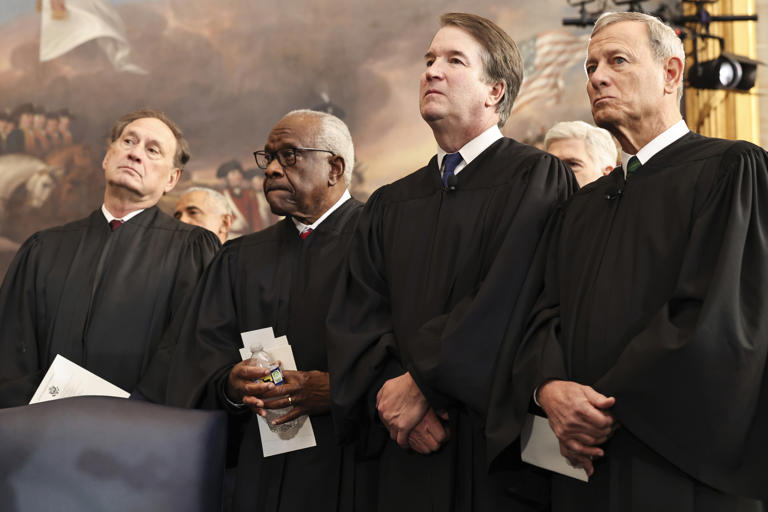

As lower court judges weigh disputes involving the Trump administration, some Supreme Court justices believe their rulings aren’t being followed as intended — and perhaps even being ignored.
“Lower court judges may sometimes disagree with this Court’s decisions, but they are never free to defy them,” Justice Neil Gorsuch warned in a strongly worded statement joined by Justice Brett Kavanaugh.
His remarks came in connection with an Aug. 21 ruling that temporarily allowed the administration to halt health research grants tied to diversity, equity and inclusion programs, often referred to as DEI.
Gorsuch criticized a federal judge who blocked the DEI grant cancellations while the case proceeds, saying that judge should have known the order conflicted with prior Supreme Court direction. In April, the justices determined that such challenges must be handled by the Court of Federal Claims, which specializes in government contract disputes.
Gorsuch argued that the teacher training grants at issue in that earlier case were “materially identical” to the National Institutes of Health research grants now in question.
But Chief Justice John Roberts, along with the court’s three liberal justices, disagreed. They concluded the cases were different, and that the district court order was valid.
Barrett’s Split Approach
Justice Amy Coney Barrett suggested a middle ground, noting that part of the dispute could remain with the district judge while other parts should go to the Court of Federal Claims. Her position underscored the lack of consensus even among the justices themselves.
Legal scholars also weighed in. Steve Vladeck, a Georgetown University law professor, argued that the court’s use of brief, vague emergency rulings leaves lower court judges in a difficult position. He wrote that the justices seem to expect judges to “read their minds” when trying to apply such limited guidance.
Jackson Pushes Back
Justice Ketanji Brown Jackson voiced frustration, writing separately that the court’s earlier “half paragraph of reasoning” in the teacher grant case was insufficient to justify what she called an “abrupt cancellation of hundreds of millions of dollars allocated to support life-saving biomedical research.”
Jackson also warned that the court appeared to be favoring the government while undermining lower courts. Comparing the approach to “Calvinball,” the rule-free game from Calvin and Hobbes, she wrote: “We seem to have two [rules]: that one, and this Administration always wins.”
Differing Perspectives
Harvard Law professor Richard M. Re suggested both Gorsuch and Jackson were too quick to accuse others of acting in bad faith. The close and divided ruling, he noted, revealed that “the key legal issue was difficult and maybe indeterminate.”