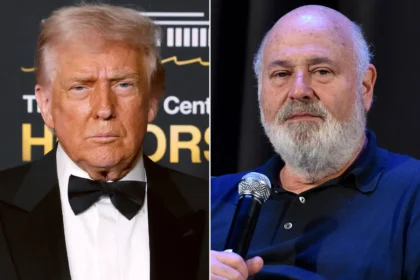
As his administration faces growing pressure to release Justice Department files tied to the Jeffrey Epstein case, President Donald Trump is turning attention to another issue — cashless bail.
This week, in a Truth Social post, Trump claimed that removing cash bail as a requirement for release from jail has caused crime to rise in U.S. cities. But research so far does not show a clear connection.
What Trump said
TRUMP: “Crime in American Cities started to significantly rise when they went to CASHLESS BAIL. The WORST criminals are flooding our streets and endangering even our great law enforcement officers. It is a complete disaster, and must be ended, IMMEDIATELY!”
The facts
Experts say there is no solid proof that cashless bail increases crime.
“I don’t know of any valid studies supporting the President’s claim and would love to know what the Administration offers in support,” said Kellen Funk, a Columbia Law School professor who studies bail systems. “In my judgment, the claim is false and inflammatory.”
Jeff Clayton, executive director of the American Bail Coalition, which represents the bail industry, also agreed there’s little evidence.
“Studies are inconclusive in terms of whether bail reforms have had an impact on overall crime numbers,” he said, adding that it is also difficult to define what truly counts as “cashless” bail.
Different laws, different approaches
In 2023, Illinois became the first state to fully end cash bail after the state Supreme Court upheld a law from 2021 called the SAFE-T Act. Judges now decide if someone should be released before trial, based on the charges, risk to others, or whether they might flee.
A 2024 report from Loyola University of Chicago’s Center for Criminal Justice reviewed Illinois’ law a year after it began. It found that overall crime did not rise — and in some counties, violent and property crime actually dropped.
Other places, like New Jersey, New Mexico, and Washington, D.C., have also reduced or eliminated cash bail, with exceptions for serious crimes.
Supporters of reform argue that cash bail punishes poor people, since wealthy defendants can pay to get out while poorer ones must remain in jail. Critics argue bail ensures people show up to court and prevents dangerous criminals from being released.
What the studies show
Research so far has been mixed.
- A 2024 report by the Brennan Center for Justice found “no statistically significant relationship” between bail reform and crime rates.
- A 2023 paper in the American Economic Journal found no proof that cash bail stops crime or ensures court appearances, studying a 2018 Philadelphia policy.
- In Harris County, Texas, most people charged with misdemeanors are released without bail. A 2024 monitoring report showed misdemeanor arrests have dropped more than 15% since 2015, and rearrest rates stayed stable.
The White House cited a 2022 Yolo County, California report on temporary cashless bail during COVID-19. It found that over 70% of people released were later arrested again.
Another study, published in 2025 by the IZA Institute of Labor Economics, said California’s temporary policy during COVID increased rearrests within 30 days. But when cash bail returned, rearrest numbers stayed the same. The study noted that pandemic disruptions could have been a factor.
Why crime changes
Experts say crime rates are influenced by many factors, not just bail rules.
Other policies, changes in police staffing, sentencing laws, or even social conditions can all play a role.
“There’s a lot of variation in crime that even criminologists don’t fully understand,” said Paul Heaton, a University of Pennsylvania law professor.