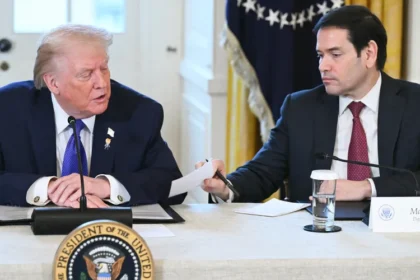
President Donald Trump criticized wind power during a recent Cabinet meeting, saying it was too expensive and claiming that “smart” countries don’t use it.
But many of his statements were misleading or false. His remarks came just after he signed an executive order on Monday to phase out subsidies for “green” energy.
Here’s a breakdown of the facts:
CLAIM: “Wind is a very expensive form of energy.”
THE FACTS: Onshore wind is actually one of the cheapest ways to generate electricity. New wind farms are expected to make electricity for about $30 per megawatt hour, while new natural gas plants cost around $65, and advanced nuclear reactors can cost over $80, according to the Energy Information Administration.
Onshore wind farms usually cost less to build and operate than natural gas plants, even without tax credits. However, unlike gas, wind cannot generate electricity 24/7. Offshore wind is more expensive, at about $88 per megawatt hour.
Electricity prices have risen across the country in the last decade, but states that added large amounts of wind power, like Iowa, Kansas, Oklahoma, and New Mexico, saw slower price increases compared to other states, said Brendan Pierpont of Energy Innovation. In Iowa, for example, wind energy grew from 15% of power in 2010 to nearly 60% in 2023, while electricity prices rose slower than in 42 other states.
“Wind should be part of a mix of energy sources and helps keep costs down,” Pierpont said.
Trump, meanwhile, has pushed for more fossil fuel production.
CLAIM: Wind turbines are “almost exclusively” made in China.
THE FACTS: China does make more than half of the world’s wind turbines, and it’s installing them rapidly. China has 1.3 terawatts of wind and solar projects in development, according to the Global Energy Monitor. That’s more than all the electricity Japan used in 2023.
China leads the world in offshore wind power, though it continues to use coal and gas too.
“The idea that China isn’t doing anything about carbon emissions isn’t true,” said Tom Harper of the consulting firm Baringa. “China is building a mix of clean energy to reduce its reliance on fossil fuels.”
CLAIM: “Smart countries don’t use wind.”
THE FACTS: At least 136 countries and territories generate electricity from wind power, says the EIA. In 2024, the top five markets were China, the U.S., Brazil, India, and Germany. New growth is happening in places like Uzbekistan, Egypt, and Saudi Arabia, according to the Global Wind Energy Council.
Michael Gerrard of Columbia University said many European countries — like Germany, the U.K., Spain, and Sweden — are investing heavily in wind energy.
“By cutting back on wind, the U.S. is letting China take the lead in this important technology and costing American jobs,” Gerrard said.
CLAIM: Offshore wind farms are killing whales.
THE FACTS: The National Oceanic and Atmospheric Administration says there is no evidence that offshore wind projects are linked to whale deaths. NOAA investigates every large whale death and bases conclusions on science and data.
Offshore wind is expanding in the U.S. The first large-scale farm opened in 2024 near Montauk Point, New York, and another major project is underway off Massachusetts. A small five-turbine project has been running since 2016 off Rhode Island.
CLAIM: “The birds are dying all over the place.”
THE FACTS: Wind turbines can pose risks to birds, but the National Audubon Society says climate change is a much bigger threat. Two-thirds of North American bird species are at risk from rising temperatures.
Audubon supports both offshore and onshore wind energy if projects are planned carefully to protect wildlife. “Science shows that offshore wind can be developed responsibly while protecting birds and their habitats,” said Sam Wojcicki of Audubon.
CLAIM: Wind turbine blades can’t be buried or recycled.
THE FACTS: Wind turbine blades are tough to recycle, but it is possible. The Department of Energy found that 90% of turbine materials can already be recycled using existing systems. New recycling methods are being developed for the rest.
Some companies are taking action. For example, Danish wind developer Ørsted pledged in 2021 to never send turbine blades to landfills, instead reusing or recycling them.